The right to think differently than most of society has historically been seen as a threat or wrongdoing, which continues to be a trend even today. The “outsiders” or “underdogs” constantly challenge mass opinions, whether statewide, nationwide or worldwide.
The Clarence Brown Theatre’s production, “Inherit the Wind,” tells the story of the infamous Scopes Monkey Trial, in which a schoolteacher challenged Tennessee’s Butler Act, a law that stated evolution could not be taught in schools. The trial was completely staged, though the public was not aware of this until later.
The production, originally written by Jerome Lawrence and Robert E. Lee, is based on the trial that took place in Dayton, Tennessee, in July 1925, but almost all of what is written is fictional.
The play takes place in Hillsborough, a small town where everybody knows everybody. The teacher, played by Clay Cooper, is represented by Henry Drummond, played by Jed Diamond.
Drummond is depicted as an “evil” character and is rumored to have represented and won a case for a murderer.
Terry Weber plays the town hero, Matthew Harrison Brady. Brady is given a more-than-warm welcome to the town, with a place to sleep, food to eat and people who praise him. Alongside Tom Davenport, played by Denzel Dejournette, Brady acts as a prosecutor.
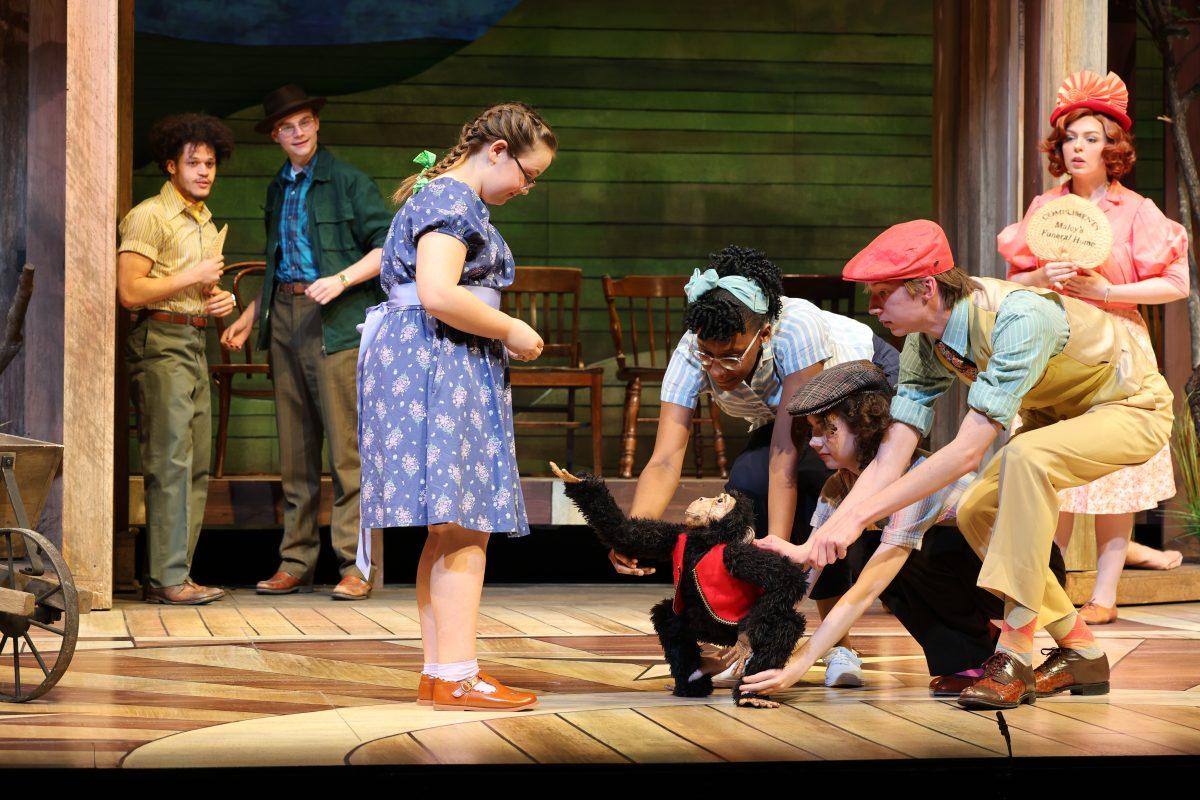
At the beginning of the play, Brady is welcomed with a parade, and actors hold signs that say, “Don’t monkey with our schools,” “Are you man or monkey?” and “My ancestors ain’t apes.” However, the most vivid and important sign on the stage is one that hangs front and center for the entirety of the play, displaying “Read Your Bible” in bold letters. Drummond recognizes this sign as biased for the trial, but the town refuses to take it down.
Initially, the town is unarguably on the prosecutors’ side — not including Cates’ fiancée, Rachel Brown, who is played by Deepika Jayan. However, as the trial progresses, the town starts to question its own beliefs, leaning toward Drummond and Cates’ side.
The production uses the original script, but Katie Lupica, director of the production and assistant artistic director at the Clarence Brown Theatre, explained how she used her own creative ideas to make the play unique.
“One thing we kind of did to make it our own is to take that invitation of a democratic story at a democratic scale,” Lupica said. “We have the ability to have a large community on stage, and we really celebrated that.”
Lupica explained that the audience’s takeaway from the play is up to them. The goal is for each member to take away something different, challenging their way of thinking.
“The play is about the freedom to think, so we want you to play with us,” Lupica said. “We want you to fall in love with these people, to fall in love with this town, to root for someone you might not root for, and to be in that liminal space where you might feel and learn something surprising, which is actually kind of hard in such a polarized world.”
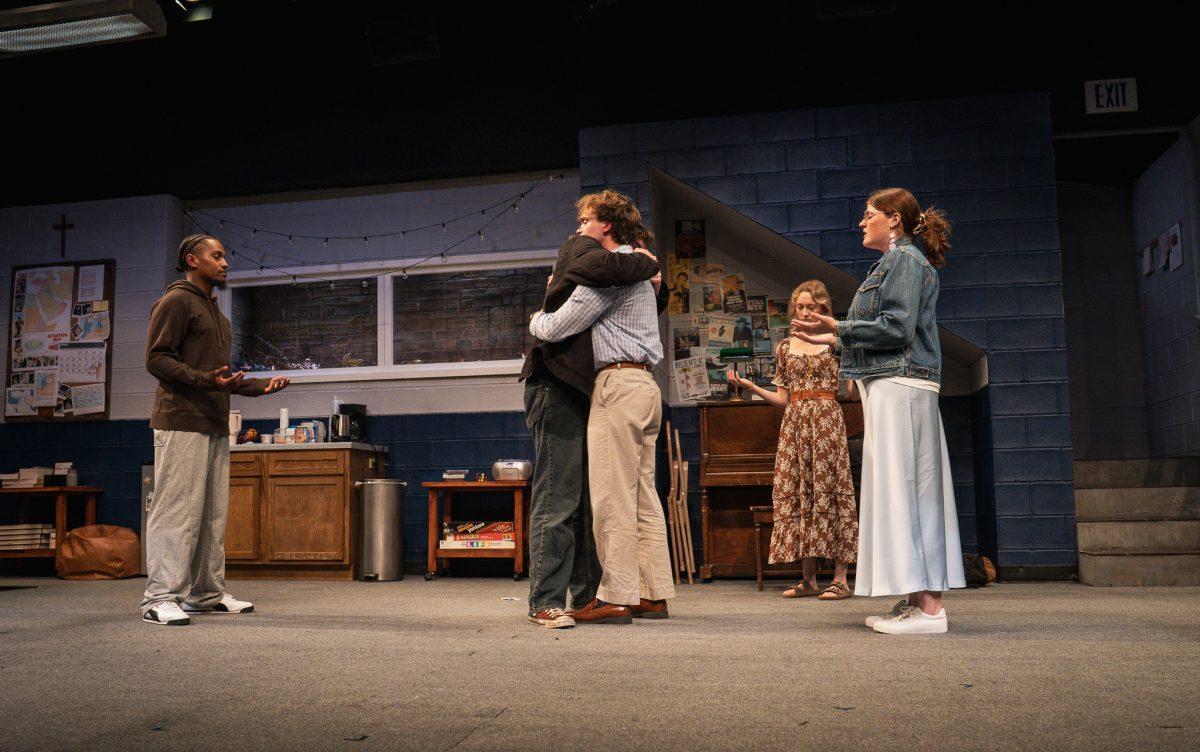
With two years in the making, the production team was able to think critically about every aspect of the show — from costumes to mannerisms to set design to sound. Everything was perfectly placed for the audience to use their imagination to depict their own meaning of the play, including myself.
During the beginning of the show, I was almost certain that I would be handed a Bible on my way out, along with a southern lady telling me to have a “blessed night.” As the play progressed, I realized that while the actions and thoughts of the people who live in the town of Hillsborough are deeply based on their religion, the production challenges that and asks the characters to think differently than what they have always been taught and are surrounded by.
The original play was made to have more than 60 actors. Yet, Clarence Brown Theatre’s production had 38 actors on stage during the show. Each actor brings a different view to the trial, ages ranging from teenagers to elders. The audience is able to see a diversified way of thinking and interpret how each perspective contributes to the trial.
“Different people encountering these questions at different points in their lives made it very easy to create a genuine community,” Lupica said.
Everything within the audience’s view — from the costume design to the set design to the sound — contributed to the production’s message. One of the first things I noticed when the show began was the bright, pastel colors that flooded the stage. It was almost impossible not to get lost in the costume design of each character. Lupica explained that the costume designer, Kaelyn Marie, wanted the actors to look like they were dressing for heaven.
“These are people who are living for the future, who love the town that they live in, who love the way that they live, who find beauty and comfort in this story,” Lupica said. “We were hopeful that the bright and engaging colors and the singing and the dancing would help us fall in love with the town.”
The story told in “Inherit the Wind” is not only a piece of historical fiction but also a challenge to the audience to think differently and question what society and the government tell us to do or think. After watching the show, I was reminded that there is no right or wrong way to think and that there is always room to keep an open mind.
“Uncertainty is hard,” Lupica said. “It would be so nice if we could just erase all of the question marks and ambiguity about the human condition with one way of thinking about things, but as Drummond points out, that’s what we are plagued with — that’s what we do.”