This week is the American Library Association’s (ALA) Banned Books Week, which celebrates the freedom to read and highlights historic censorship attempts.
To celebrate this week, on the second floor of the John C. Hodges Library, a shelf of challenged and banned books is displayed in the hallway next to Starbucks. Library visitors can learn about and check out books that have been challenged or banned.
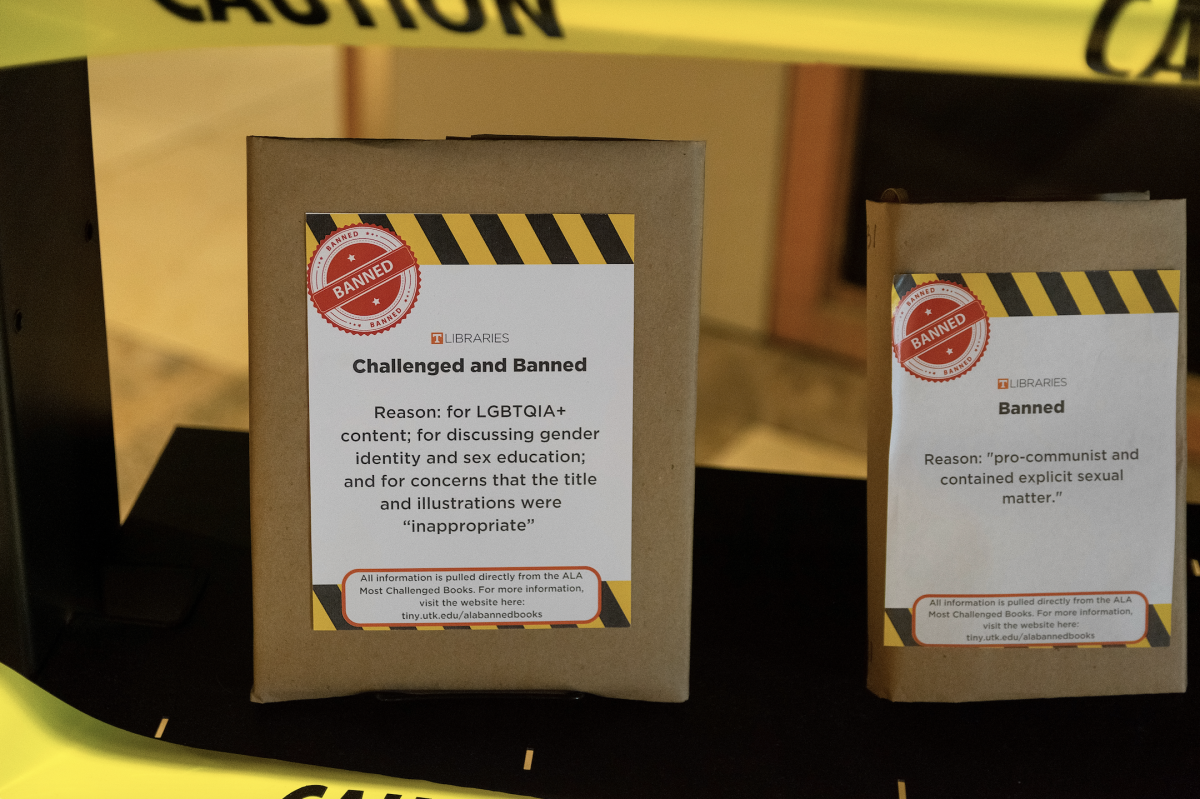
The display features three infographic posters alongside a shelf of books with their covers wrapped up in brown paper bags. The infographics include quotes about censorship, the top ten most-challenged books of 2021 and other censorship statistics.
Some of the quotes on one informational poster come from popular authors like Stephen King and Stephen Chbosky. Both authors condemn the censorship of books and urge people to read anything that others have tried to ban since it is “exactly what you need to know,” according to King.
The censorship statistics infographic states that most challenges raised against books take place in school libraries and come from parents. Library patrons along with political and religious groups also frequently initiate challenges against books in public libraries as well.
The display draws attention to some of the most popular reasons books get challenged or banned, which includes containing LGBTQ themes, sexually explicit content, profanity, political indoctrination and violence. Parents raise concern against books containing this content because they’re worried that it could negatively affect their children, or they simply believe that their children shouldn’t be exposed to it at all.
The infographics all cite the ALA as the source of their statistics. You can learn more about the ALA and banned books on their website.
In addition to the infographic posters, the display also provides an opportunity for students and faculty to engage with banned books. Since the covers of each book have been wrapped in brown paper bags, readers go into whichever book they select blindly, the only clue of its content coming from the labels on each cover.
These labels provide the reasons why each book was banned or challenged. Some examples of the different reasons include going against “family values/morals,” “discussing gender identity and sex education” and being “demoralizing.” One label revealed that its book had been burned in four different countries from 1918 to 1923.
While the frequency of burning controversial books has dropped, there is clearly still an issue with censorship in literature. By creating this display, UT has actively made an effort to combat this issue.
Not only does the display raise awareness about the issue of censorship, but it also provides an opportunity for Hodges library visitors to take action against censorship themselves. By checking out and reading books that have been banned, readers are pushing against attempts to censor knowledge and free expression.
Tom Fortner, a student at UT, noticed the display during his visit to the library and looked through several of the banned books that were featured. He shared what drew his attention to the display and why banned books interest him.
“I don’t like to be told what to do, so I was interested in what content the books had that people didn’t want me to read,” Fortner said.
Alex Boris, a librarian in the Hodges Learning Commons Department and creator of the display, wanted to shed light on banning books since it remains a prevalent problem today, especially in the school environment. Boris elaborates on why it is important for people to read banned books.
“As librarians, we believe that everyone is allowed access to information in any form. For me, books open up dialogues between people to better understand the world around them. ALA puts it best on their Banned Books Week page: ‘Books reach across boundaries and build connections between readers. Censorship, on the other hand, creates barriers,’” Boris said.