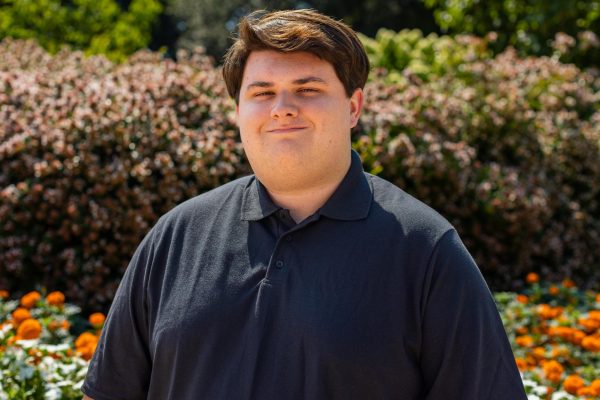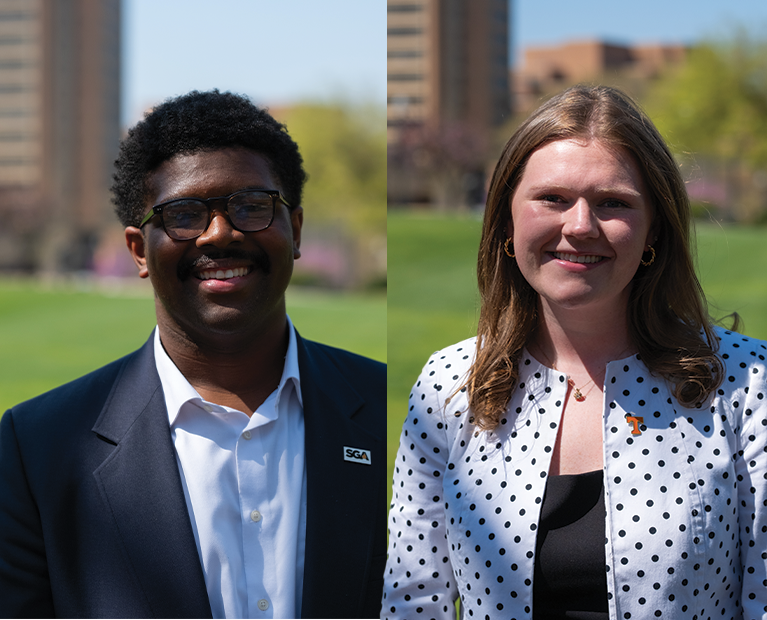
Adarius Parrish and Anna Beth Thompson are both candidates for student body vice president. Parrish is a junior studying political science and has previously served on SGA’s first-year council and in the undergraduate senate. Thompson is a junior studying business management with a concentration in supply chain management and has previously served on first-year council, on the executive cabinet of the general body and currently as executive secretary in the Darwin administration. The following are a question-and-answer format interview between Beacon staff writer Tessa Nacke and candidates Parrish and Thompson.
This interview has been edited lightly for clarity.
Q: What do you believe you will do better than your opponents and what evidence from your past experience supports that?
Parrish: I think they’re all running great campaigns. I think, however, that there’s this maintaining of the status quo that we’ve had for quite a few administrations now, and I think that people don’t really know what SGA does, we have this motto that everyone’s a member, and we have general body, but nobody knows what we do. Nobody wants to come to a meeting or be engaged with something that they have no idea about.
I think I saw something that said that only 20% of people don’t even know that we have an SGA here. And I think that’s a problem, and I don’t think that there’s been any intentionality in addressing that, and I don’t think there will be from other candidates, again, running great campaigns, but I think that trying to get some visibility out there. I think that just having a good communications director, engaging people where they’re at instead of having to come to us, is an important thing.
I think we’ve seen it time and time again. For a week, we’re always out there, and then we disappear. So I think trying to keep that throughout the week, throughout the year, and just like, we’re here for you, you don’t have to come to us, and we’ll engage you that way.
Thompson: I believe that I bring a deeper and a more comprehensive understanding of how SGA operates and how to make it more effective from my first day in office. Although my opponent and I both began in the first-year leadership council, I’ve continued to stay deeply involved within SGA, and I think that that shows my sense of consistency within the organization, serving the student body.
Over the past two administrations, I really had a front row seat of what SGA or what the students interests and concerns have been, and SGA has made significant internal changes, like revitalizing the SGA constitution to reflect the true foundation of SGA, which, at the end of the day, is to advocate for all students in really a meaningful and an engaging way. I’ve seen firsthand the commitment and the advocacy that the role of the vice president must have to be successful.
I believe my experience and my relationship with administration that I’ve built since my freshman year and my deep understanding of the students here at UT shows my qualifications to achieve success in this role.
Q: How will you work with university administration when student interests conflict with administrative priorities
Parrish: I have a little bit of experience doing that now, as IFC president, so I’m just going to keep the same, the same kind of structure going into it. One thing I’ve kind of lived by during my administration and with IFC is that just because we’ve always done it one way, doesn’t mean we’ve always done it the right way.
And so, engaging in dialog with anybody and everybody that I can and need to to figure out one some of the institutional knowledge pieces about like, how did the way we’re doing it come about? What kind of factors led to that? What are the parts that we can control? Is this something that we can figure out how to do right now, or is this something we need to slow roll out?
And sometimes it means that maybe some of the things that I want to do I won’t be able to do, but I can make steps to set it up for the next person to be able to continue that work. And I think that that’s important. I think there’s room for continuity.
Obviously, I was just saying that I want to change some things and make some things more visible. But obviously there are some things that have worked and trying to make those better, and things that aren’t working, trying to figure out how we engage in dialog and make sure that everybody has a has a voice in the seat at the table to make sure we get it done
Thompson: Relationships are a very important component of all this work, and I’ve really witnessed that over the past two years in my role as the executive secretary, the student interest being met with real, achievable initiatives.
An example of this that comes to mind is the recent Canvas mental health module that was added, which this administration has taken the opportunity to continue the relationship with student success and to bring mental health to students in a way that’s easily accessible.
And my main focus as the vice president will be to expand the transparency of the internal work of SGA and to communicate effectively when priorities of student needs in the university policies conflict.
Another important thing to note here is while SGA exists to advocate for the student body, There are limits to what can be accomplished due to university and state policies, but in my role as a vice president, I’ll make sure to speak for all students at every table I meet with the university administration to advocate best for the interest of students.
Q: What are a few high-priority issues for students you’ve identified, and what will you do to address them in the first 60 days?
Parrish: One is really just the visibility — no one knows what we do. Even if I was doing really cool stuff, if nobody even knows what our organization is, nobody’s really going to engage with it. So the first piece is, let’s keep this momentum up. Let’s keep going for the first two months. And during that time, we can really reach 40,000 people and get them engaged.
When we actually start doing the cool stuff, the new stuff, the ingenuitive stuff, people are actually ready and willing to accept it. But I think another big part is trying to increase some of the funds and some of the resources we get to work with. There are some studies that show that we probably have one of the lowest budgets from any SEC school. I think Florida is up there at like 22 million that their SGA gets to directly influence.
So I think about having those conversations. How do we engage with state lawmakers? How do we engage with the university administration? How do we get in some of those rooms to affect some of that money?
That way, SGA really is advocating for all students, and that means going out and reaching out to organizations, Greek organizations, interest organizations, major organizations, things like that. Whatever you need to work with, whatever money you have, whatever resources you have, let’s pull them together and let’s do something really big for everybody.
Thompson: In my first 60 days as vice president, I really plan to utilize my executive cabinet appointments to focus on the effectiveness of SGA in the projection of effectiveness for this administration in the future, and a position that the vice president appoints as the communication director. And with this role, I plan to really meet students where they are. One of my campaign pillars is together, we connect.
And in that pillar, it shows how I will strengthen SGA communication by really enhancing our social media presence and partnering with campus media outlets and launching consistent monthly informational reels on Instagram to highlight initiatives, really explain how to get involved with SGA and clearly communicate our work, but I think by prioritizing accessibility and transparency and outreach within those first 60 days from the start of an administration, we can build a stronger connection with the student body and really sustain engagement over the years.
Q: What do you believe sets you apart from the other candidates?
Parrish: I think the fact that I’ve had experience on both sides. I’ve been in SGA. I’ve been very well steeped in SGA. I’ve helped create a position in SGA that most people don’t know about. But I’ve also had the time to take a step away and realize that once you’re not in it, you don’t really know what’s going on exactly.
So trying to figure out, how can I use that knowledge that I’ve had from both inside and outside to give a more well rounded perspective to everybody as to what we’re trying to do and what we can do together?
And so I think that’s what sets me apart, and also already being in some of those rooms and having some relationships with the people that I’ll be working with — Dean (Byron) Hughes, Dr. (Frank) Cuevas, Todd (Cox). I still interact with him regularly, and some people that you don’t necessarily hear about.
Dr. (Susannah) Marshman, John Keith from OSFL, having those relationships already. I don’t have to spend the first month of my tenure trying to figure out how to meet people and how to get people to trust me. That’s already built high credibility.
Thompson: I think what really sets me apart from other candidates is my why. Like I said earlier, the relationships I’ve built over the past two administrations, being selected by the president the past two years to serve in this role, and I want to be clear that the depth of my reasoning for running (and) the genuine passion that I have for this role has led me to where I am today.
This is not a decision that I’ve made, you know lightly, but it’s something that I’ve thoughtfully considered over a long period of time, through many conversations with current and former members of SGA.
I’ve really gained valuable perspective on what this position demands, and how I can best contribute. Serving as the vice president, it takes time, and it takes consistency, and it takes a person who is dedicated and available to serve the responsibilities of this role.
And over the past three years in SGA, I really have invested significant time and energy into a variety of roles, and I’m really prepared. I’m fully prepared to continue at that level of commitment and that, you know, sustained involvement that I talked about earlier has given me both the experience and the perspective to step in this role ready to serve from day one.
Q: What organizations, administrators or leaders will you need to work with to accomplish your goals?
Parrish: Dean Hughes, (Cox is) the SGA advisor. He’s very influential and gives updates on a lot of stuff we’re doing. Who I really need to work with is everyone. This is a university. We’re all a part of this. We just want everybody to be civically engaged, and that means trying to get everybody to have something to say and know where to voice their concerns.
So I want to engage with organizations like the engineering club. I want to engage with organizations like IFC, and Panhellenic and Multicultural Greek Council, Women of Haslam, one of the biggest clubs here.
Trying to get people whose decisions will affect the room and work with them and see what they see, what they see, what they think. And I think one thing that I’ve learned recently is that not everybody’s going to be happy with every decision or every outcome from every situation, but people are a lot more willing to engage with it when they feel like they’ve been heard. I think that there’s a lack of that, and that’s something we can definitely fix very easily.
Thompson: Over the past two administrations, I’ve built a lot of relationships with admin, student organizations across campus. I’m a part of all campus events, so I have a great working relationship with the Center for Student Engagement.
I have connections with The Volunteer Channel. I definitely think that we need to meet students where they are, and utilize pre-existing social media outlets. So whether that will be partnering with The Volunteer Channel, partnering with The Daily Beacon, to really hone in on connection and really meeting students where they are, I would also like to touch that SGA has advisors, and obviously I’ve known them since my freshman year, and have a great working relationship with our advisors. And so that’s something that will be preestablished when I step into this role, and we’ll be able to hone in on while serving my term.