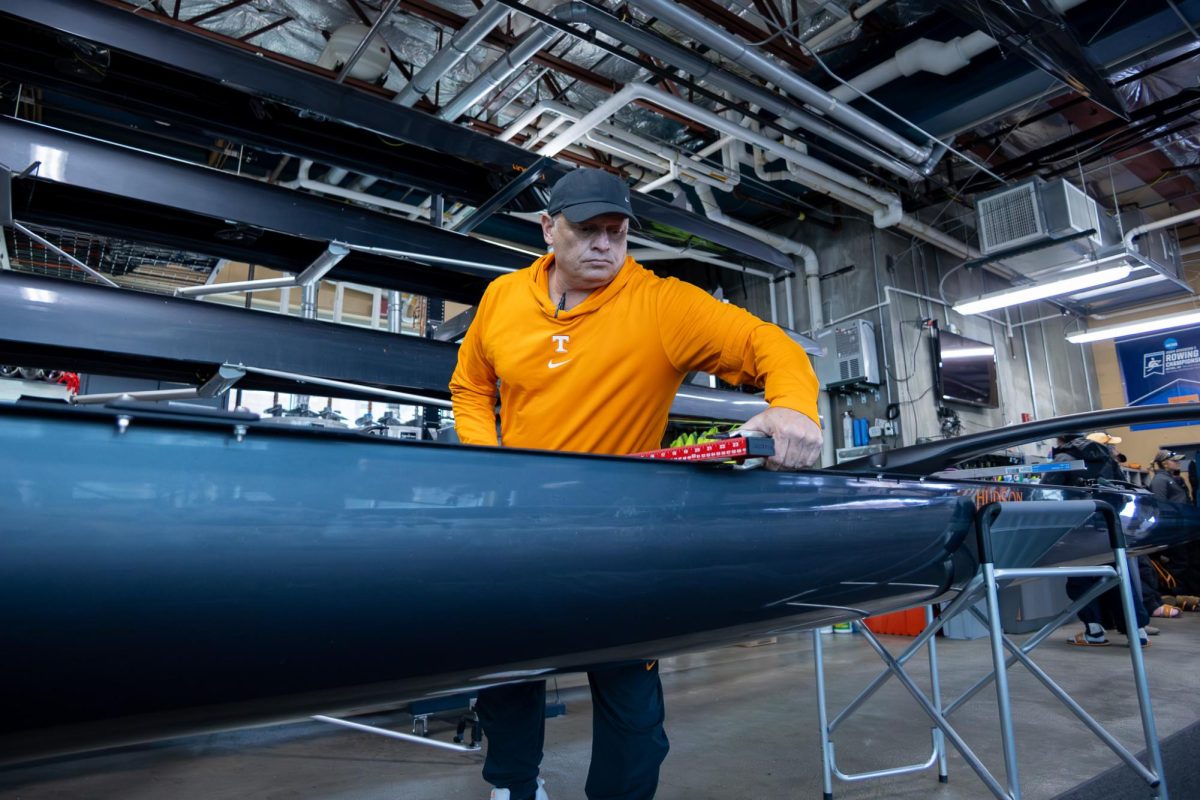
Randy Duffy has his hands full with a Craftsman I-beam level, spring clamps and a hex key tucked behind his ear.
It is 2 p.m. on a Sunday, 40 degrees, with rowers finishing up a mile-long warmup jog before practice begins. In the back of Wayne G. Basler Boathouse, Tennessee rowing’s secret weapon is in his element.
He’s calibrating the boats, installing equipment to track the athletes’ speed and power, while ensuring precision. Duffy is Tennessee’s boathouse director — a key component of the Lady Vols’ nationally ranked program.
“The people are the greatest, and I love what I do,” Duffy told The Daily Beacon. “And so that’s why I never looked elsewhere since I got into the sport. I love sports, and being able to work in it is not something that I expected, not something that I was pursuing.”
Introduction to the water
Duffy’s journey began far away from the sport. His background comes from a love of sports, with a degree of knowledge in putting things together. That’s because of a geoscientist license he earned after working in the drilling field — a stint that began during his time as a student at the University of Texas.
He spent 18 years working for Geoprojects International, Inc., in Austin, Texas, earning a project manager title before leaving in 2012. When family matters arose, he decided to move to Dallas without a clear plan for what came next.
Until his brother-in-law, then SMU rowing coach Doug Wright, needed some help in 2016.
“I had zero background in rowing,” Duffy said. “I’ve never rowed, but I’ve always grown up around boats and water sports, and I’m kind of a jack of all trades type of person.”
His work for Geoprojects International made the transition into the water seamless. He already had extensive knowledge of how to “MacGyver” problematic situations, as troubleshooting machinery and inciting perfection were already some of his previous responsibilities.
In fact, Duffy calls it a great pleasure to be involved in the aquatic environment rather than the drilling field.
“Sometimes you just kind of follow the path and end up where you didn’t expect but happier than you thought you would be,” Duffy said.
A staff change occurred at SMU, and Kim Cupini was named head rowing coach June 17, 2017. Just a year removed from being hired as boatman of the Mustangs, Cupini decided to keep Duffy on staff.
“He’s definitely like a MacGyver that could fix anything and work on anything,” Cupini said. “We didn’t have the most resources there at SMU, and we needed a lot of stuff that was fixed, and so he definitely jumped in and really was able to do some things that a lot of people can’t do with equipment.”
Cupini and Duffy achieved three consecutive AAC titles, earning three NCAA Championship bids. SMU finished 11th in 2021, 12th in 2022 and ninth in 2023.
Duffy’s highest-pressure moment came in the 2022 AAC Championship race in Oak Ridge. The First Varsity Eight boat had damage that needed to be fixed. The boat had been knocked out by a big log in the water, damaging the mechanism that holds the skeg in the rudder, the device that steers the boat and keeps it on a linear path.
After a slight delay, he pieced it back into racing condition, and the Mustangs raced for a 6:36.063 time — eight seconds ahead of second-place UCF — claiming the AAC Championship.
“We needed to win that race to lock up the championship,” Duffy said. “… If they wouldn’t have gone down the course, we wouldn’t have won the conference that year. And they went down the course, and they won the race.”
Accomplished in the Southeast
When Cupini took the job at Tennessee in 2023, she brought Duffy with her.
That meant another move for his family. Each of the Duffys bought in on the move to join Cupini’s staff with the Lady Vols rowing program.
“I wouldn’t want to work for a coach this long that didn’t fight to win,” Duffy said. “And that’s something that you can count on with Kim as your head coach. She doesn’t take her foot off the pedal.”
It’s a two-way street. Cupini brings success on the coaching side, while Duffy keeps the equipment in pristine condition. The behind-the-scenes work allows the athletes to focus on the race itself rather than the equipment.
“We’re pretty lucky to be able to show up and just get in a boat that’s perfectly set up for you,” Madelynn Long, a graduate assistant and former rower at SMU and Tennessee, said. “And any adjustments you need are quick, and Randy’s always on call.”
His always-on-call workload means the workday is inconsistent. The Lady Vols practice six times a week, leaving Wednesdays for the athletes to be students first.
Some mornings, it is a 4 a.m. call time to get equipment ready. Other times, it means staying until 1 a.m. to finish up a repair.
“When we get into the meat of the season, from now until Memorial Day weekend, it’s possible that I only get a couple of days off between now and then,” Duffy said.
He must maintain training equipment, like indoor rowing and biking ergs. He also must load and unload for travel.
Duffy is responsible for getting all equipment to each race site, too, which calls for a 12-hour road trip to Florida for a spring training meet against Louisville on Feb. 14.
“It’s always a priority to have everything ready the way the coaches want it for the next practice,” Duffy said. “The next practice is always the most important thing. And it’s a driving force for everything that happens here.”
“When practice starts, and practice ends, and boats come in, and nobody reports anything, that’s a great day for me,” Duffy said. “Because that means I can see my family a little sooner.”
Duffy’s abilities go beyond saving the coaches’ time. Cupini credits his know-it-all nature to saving the program money as well.
It is important for a non-revenue program that received $897,960 of institutional support but operated with $6,925,730 in expenses in 2025.
“When you have someone that knows how to repair the boat, you’re not paying other people to do the work,” Cupini said. “It’s all in-house, which is really nice.”
He and Cupini have achieved two top-five marks at Tennessee, including a program-best third-place finish in 2024.
Their successes together are what Duffy notes as personal success in a behind-the-scenes gig. His competitive nature is what keeps him going.
“I’ve won a lot of things on a personal level from my career in the past, just on a different measure,” Duffy said. “But nobody puts it in a win-loss column. They’re just personal victories or a project victory or just a life victory. But when you get to have that measure of a win-loss column, and we’re mostly in the win, that’s something that I really enjoy about it.”
“I could go get a job doing something somewhere else,” Duffy said. “But I don’t think I’ll ever find one that has the reward of winning.”