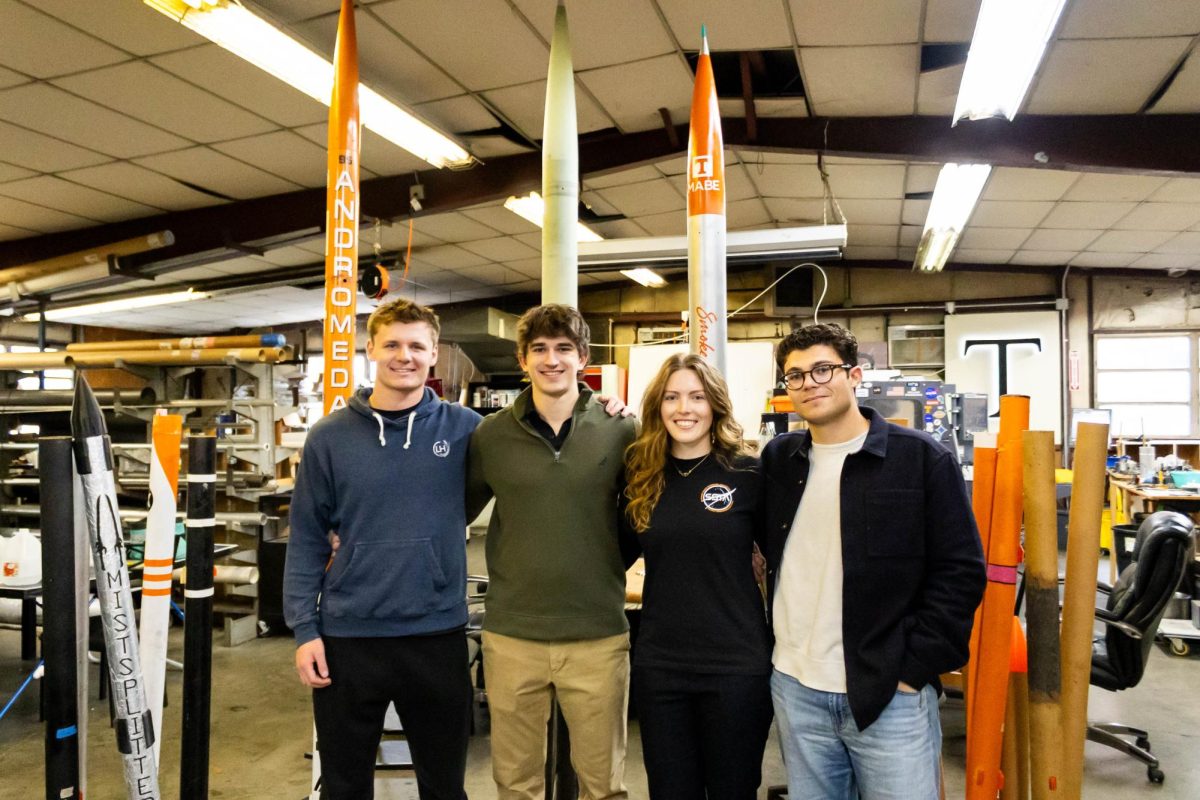
The email arrived on a Wednesday night in January just before 10 p.m. It caught Jackson Dendy, an aerospace engineering junior, by surprise.
“I got the email on my phone, ‘Winners, congratulations, you’ve been selected!’ and I started jumping up and down in the shop,” Dendy said.
After many long nights designing hypersonic vehicles in a nondescript building on the west side of campus, University of Tennessee undergraduates saw their work finally pay off.
Founded in 2015, UT organization Student Space Technology Association is focused on bringing practical experience to students across many disciplines as it relates to the space frontier. One of its teams recently competed in the 2025 Undergraduate Hypersonic Flight Design Competition — and won.
The Joint Hypersonics Transition Office, and it’s subset, the University Consortium for Applied Hypersonics, held the competition, representing the dual intentions of the competition: to develop the workforce of future hypersonic aerospace engineers and to propose a design for the Department of Defense’s hypersonic acquisition program.
The competition is set up in an online portal, and Dendy, who serves as the club’s chief engineer and the team’s hypersonic lead, began working on it in February.
“We just assembled the team from there,” Dendy said. “The goal of the project was to design an unpowered hypersonic glide vehicle, which pretty much means … [it] flies above Mach 5, and glide vehicle, highly maneuverable. … The design we went with was meant to be shot out of a rail gun at Mach 8 and then fly pretty much as far as possible.”
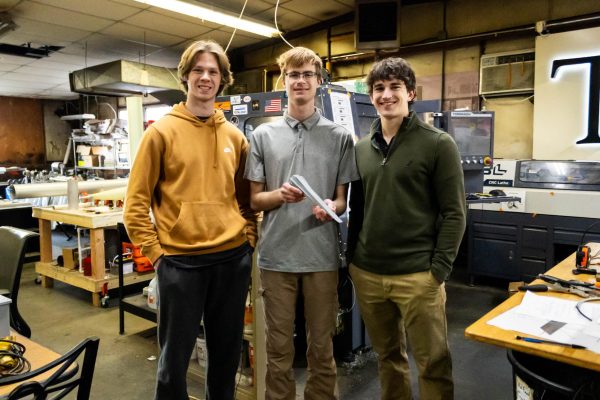
The hypersonics team did not consist of seniors, so its members had not taken classes in compressible flow yet, a critical part of hypersonic engineering.
“The people that did persist through the project were pretty incredible, that we were able to put this together with 10 people in four months,” Dendy said. “I think it’s unprecedented for the university, and given the praise we received from JHTO, it was pretty unprecedented for the competition, especially considering the fact that our team has no seniors. It was only sophomores and juniors. This was actually designed to be a senior capstone project.”
The team met weekly throughout that period to discuss progress and receive feedback from their mentors John Schmissuer, associate dean of the Tickle College of Engineering and executive director of the UT Space Institute, and project advisor Stefen Lindorfer, a research scientist at the UT Space Institute.
“I’m extremely proud of the effort and enthusiasm the SSTA Hypersonics team invested in their winning submission … UT is fortunate to have the SSTA to support student extracurricular professional development, and from what I have seen, the SSTA leadership has the group ready to produce championship-level work across the boards,” Schmissuer said.
“I am extremely impressed by how thorough their work was, and I am proud that they won the competition as a bunch of sophomores and juniors when most of their competition entered as a senior design team,” Lindorfer said. “As winners, they will now have the opportunity to perform additional wind tunnel tests at full-scale in the Calspan-University of Buffalo Research Center (CUBRC) 48-inch hypersonic Large Energy National Shock (LENS) tunnel and flight tests at the Army Research Lab (ARL) at Aberdeen Proving Grounds.”
All members of the team cited the significant input and support of their faculty mentors as a key component of their success.
The team moved through several rounds, including the semifinals and a final 30-minute presentation to prominent figures across public and private elements of the hypersonic engineering community.
The competition functioned as a mock Department of Defense contract process. In real practice, the DOD will issue a request and private contractors will submit proposals. The winner of this competition will have their design prototype produced and tested by the Department of Defense, utilizing their staff and resources to bring the concept to life.
“Now they’re actually going to build the thing and we’re actually going to do full scale testing,” Aaron Matheny, an aerospace engineering junior and the team’s analysis lead, said.
When Dendy learned of their win, he rushed to share the news with the rest of the team and the wider SSTA organization.
“It was very exciting – we were awake for several more hours out of excitement,” Isaac Smith, an aerospace engineering junior and the team’s test and instrumental lead, said. “We talked to our mentors Dr. Lindorfer and Dr. Schmisseur – they were both very excited for us.”
The success of the hypersonics team is just the latest victory for SSTA. The members see SSTA as an advancement of the capabilities and notoriety of Tennessee’s aerospace program.
“We’ve been operating behind the scenes for a few years,” Zach Marano, a junior studying aerospace engineering and the club’s president, said. “The school, on an administrative level, has in parallel been operating behind the scenes, pushing space research.”
Marano sees SSTA as an opportunity to provide invaluable experience to UT undergraduates.
“We want to give as many undergraduate students the opportunity to pursue deeply technical projects they can’t get their hands on anywhere else,” Marano said.
In September of 2025, U.S. Space Command moved its headquarters to Redstone Arsenal in Huntsville, Alabama. Marano seeks to take advantage of this regional opportunity.
“What are the implications of that for the Southeast, right?” Marano said.
He wants the organization to keep pursuing the edge of development and research in all fields related to space.
“Space as an economic and commercial domain is brand new,” Marano said. “So when you look at what economic policy look like in space or what international relations look like in space, there’s absolutely no precedent. There’s nothing to base it off of. So all the legislation and regulation around the space economy is totally new.”
Marano spoke to the club’s wide representation of over 15 majors across its 200 members.
“Step one was expanding the scope of the club and breadth,” Marano said. “Then, once you start getting big laterally, you realize that you need kids who do accounting, you need kids who know how to do social media and marketing. If you want to keep this engine churning, you start adding kids from the communication school and then Haslam … you end up with a super intellectually diverse group of kids.”
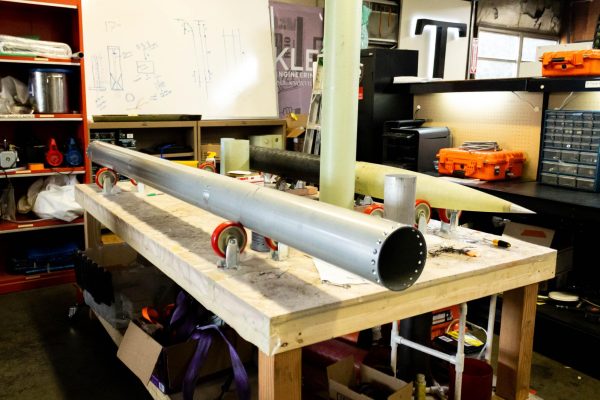
SSTA operates as an umbrella organization, the core of which provides financial and logistical support to several different teams focused on developing different prototypes and projects.
Caroline Czarnecki, a first year graduate student in systems engineering and the club’s vice president of business development, believes that the mission is to facilitate undergraduates getting hands-on experience in the field.
“There are very few opportunities as an engineering student to actually get your hands on a project like this without necessarily having a step-in at a great internship or co-op experience,” Czarnecki said. “This is essentially a student-run R&D lab. The unique thing about this location and the people in this club is that you’ll find them here all hours of the day, and that just speaks to the passion that they have.”
Marano hopes that the wider community takes note of what’s occurring in their program.
“If admin hasn’t seen that yet, in the next six months we’re going to make it very known to them,” Marano said.
Czarnecki sees the sky, literally and figuratively, as the limit to what SSTA can achieve.
“We want to push the envelope for what’s possible for Tennessee Aerospace, and that is SSTA’s mission,” Czarnecki said.