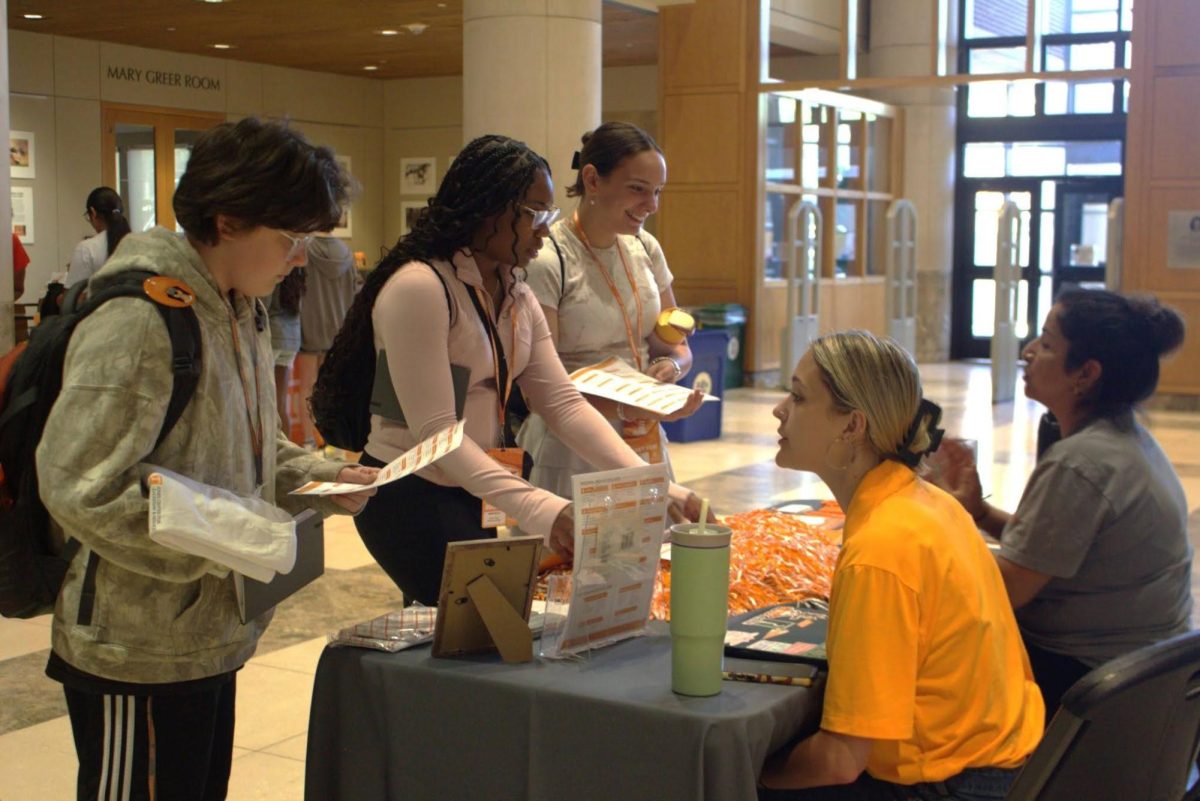
Teresa Jennings spoke to a full room in the UC on Friday. Jennings is the program manager of the Companion Animal Initiative of Tennessee, and her speech, “Knoxville’s Community Cats: Problems and Solutions,” presented the concerns surrounding the cat population in Knoxville.
Jennings defined and outlined the differences between pet cats, free-roaming cats and feral cats. She explained that the estimated population of feral cats is equivalent to that of free-roaming and pet cats combined, around 81.7 million.
Jennings’ statistics show that “the pet and free-roaming cats have a 85-percent sterilization rate, whereas only 2 percent of feral cats are sterilized.” This is one of the main reasons for the high feral cat rates.
The solutions for the problems found in the cat community vary in tactic and approach.
“‘Wait and see’ allows the cats to keep breeding, and this eventually causes more mortality,” Jennings said. All of the other options require human interaction, because the cats have to be captured.
“‘Trap, remove and euthanize’ creates a vacuum effect, because there is plenty of room and resources for the cats that avoid being trapped,” Jennings said. “Nowhere on the planet has this ever worked.”
The theory of trapping — removing the cats from their environment and relocating them elsewhere is rarely recommend. UT goes steps above the “trap, neuter and return” method endorsed by national organizations across the U.S. by using a “trap, rest, neuter, vaccinate, release and monitor” program.
Jennings also spoke about the myths and truths surrounding the cat population. There have been many accusations placed on cats for destroying birds and wildlife.
“Habitat loss is the No. 1 reason for the loss of the bird population,” Jennings said. She further explained that human activity has caused no less than 10 percent of the extinction of the bird population, and in some places of the world, 90 percent of the bird population has been removed because of humans.
Although human activity continually proves to be problematic to many aspects of the environment, UT is taking steps to further aid the cat community. Jennings referred to UT’s program as “Feline Fixin’,” and explains that caretakers collect cats and bring them in.
“We hope for 72 volunteers for each event,” Jennings said. “You don’t have to know anything about animals to help, because we will teach you everything you need to get your job done.”
Interestingly, the idea behind “Feline Fixin'” is to eliminate the entire feral community.
“We want zero feral cats, and you do this by educating people and by spaying and neutering the cats,” Jennings said. The idea is to slowly lower the feral feline community until there are low or no problems within these groups.
Lephan Le, junior in chemical engineering, was impressed with this presentation.
“In spite this not being my major, nor vocal point of career, I wholeheartedly believe that the variety of topics presented at this science forum are enlightening and show the great opportunities at UT,” Le said.
The UT Science Forum meets weekly and provides various viewpoints on a wide range of topics. At these events, UT attracts top researchers in their respective fields of study to inform those who attend.
The meetings are from noon to 1 p.m. in the dining hall of Thompson-Boling Arena.