The concept of religion has been present throughout humanity’s evolution through time, so it’s obvious that the human race has an affinity for connecting to the divine.
The term ‘religion’ has many different definitions, ranging from the service and devotion directed at a divine higher power to following a personal set of beliefs and morals to participating in certain rituals to not eating certain foods.
Our affinity with religion and our attempt to understand it from a neurological perspective can be traced back to the sixteenth century in France, the home of René Descartes. Descartes was considered a rather unconventional philosopher at the time because he put an emphasis on emotions and feelings. He tried to connect our feelings to what was happening in our brain, even though very little was known about our brain during his time.
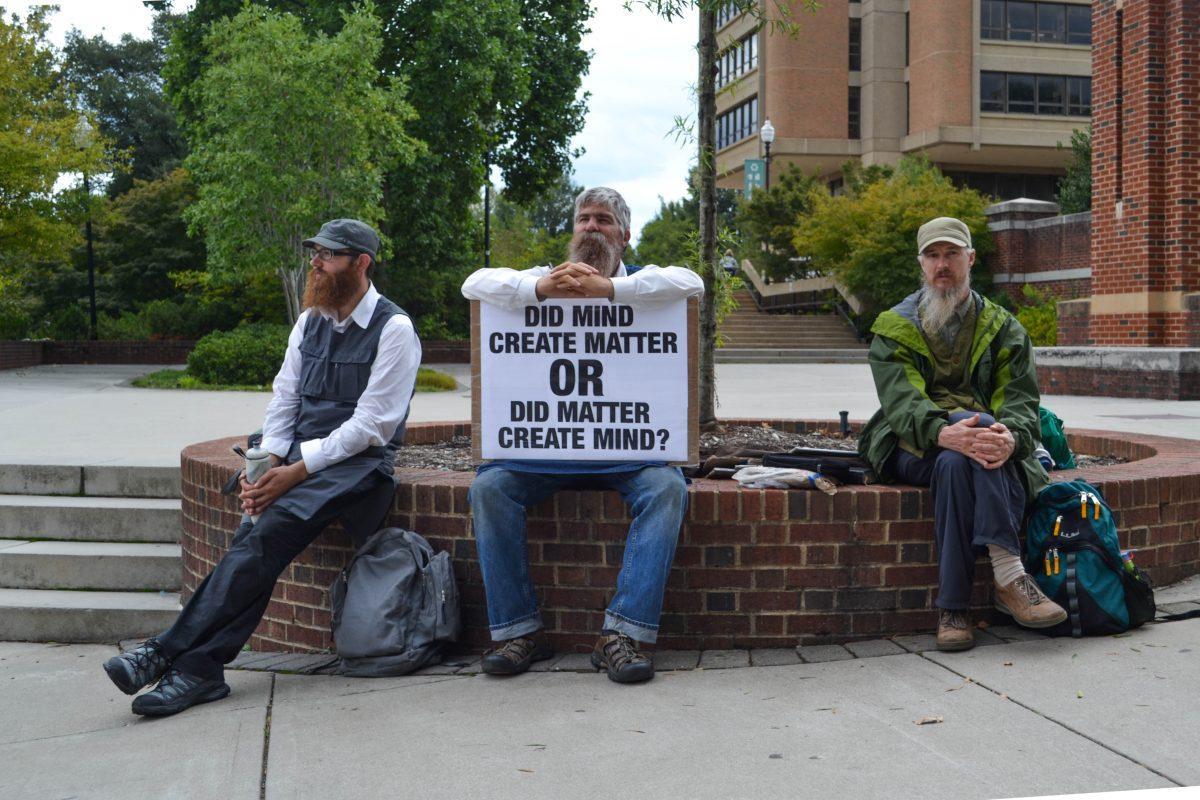
Descartes believed in something called “Mind-body dualism,” which states that each human being has a physical brain and a metaphysical soul, which he called “the mind,” that was given by a higher power. Descartes believed that the gateway between the soul and the physical brain was connected by the pineal gland, which we now know today is responsible for melatonin regulation and circadian rhythms. Descartes’ theory was widely rejected, but it provoked people to think about the existence of a soul and if we could biologically quantify it.
Since our species clearly had an early fascination with religion, it raises the question, “Was our brain shaped by religion?” It does not really matter what religion — just the concept of religion is enough. A 2014 paper published in Brain Connectivity attempts to tackle this question.
Dr. Gopikrishna Deshpande, assistant professor in the department of electrical and computer engineering at Auburn’s Samuel Ginn College of Engineering, teamed up with NIH researchers to study how different brain interactions could give insight into someone’s personal beliefs. They specifically looked at the theory of mind, or ToM, which is the ability to interpret an individual’s state, such as feeling depressed and hopeless, rather than immediately interpreting it as an imbalance in neurotransmitter levels.
The ToM neural network, according to various neuroimaging literature, has been suggested to have certain areas that it occupies. These areas include networks in the prefrontal cortex and the superior temporal sulcus — the prefrontal cortex is responsible for higher order thinking, and the superior temporal sulcus is responsible for processing multiple types of sensory information. It is suggested (but not confirmed) that it also plays a role in social perception.
Deshpande and his team found through the use of fMRI that individuals with stronger ToM activity tended to be more religious, as was printed in Science Daily’s summary entitled “Evidence of biological basis for religion in human evolution.” Deshpande notes that this could be the reason why religion came into existence at the beginning of our evolutionary journey as a species.
Another study in 2016 implies that the ventral striatum and nucleus accumbens are the reasons why devout followers of a religion stay devout. It notes the connection between having an elevated mood and having a connection to others, specifically those sharing the same religious beliefs. The nucleus accumbens acts as a reward system; when engaging in activities that are associated with the belief, neurotransmitters like dopamine rush your system. The ventral striatum helps send signals to the amygdala, which might explain certain fears that a person can develop while practicing in a religion – such as the fear of certain entities or breaking a religious code.
Even though multiple parts of the brain were mentioned, there is not a specific area of the brain that is deemed religious. Several aspects of our brain take in information and reconstruct it in a way that makes sense to us. Also, every brain is coded differently and has unique experiences which either reinforce or inhibit certain behaviors.
Because of this, the nucleus accumbens can activate when giving to charity, playing with a dog or reading about an opinion that is similar to one’s own. As Jordan Grafman, the head of the Rehabilitation Institute of Chicago’s Cognitive Neuroscience Laboratory and theology professor at Northwestern University, explains: “As these societies became more co-operative, our brains evolved in response to that. Our brain led to behavior and then the behavior fed back to our brain to help sculpt it.”
Humans have always sought to understand the unknown, and that has aided our survival more than we realize. These bonds and cultures that we form around certain moral codes or divine worship styles has been the center of liberating movements and brutal wars throughout history. We must understand that the need for something greater — a greater purpose or a greater understanding – is common across all cultures and classes and that we have more in common with each other than we might think.