“It’s not life changing or anything, but it is kinda cool.”
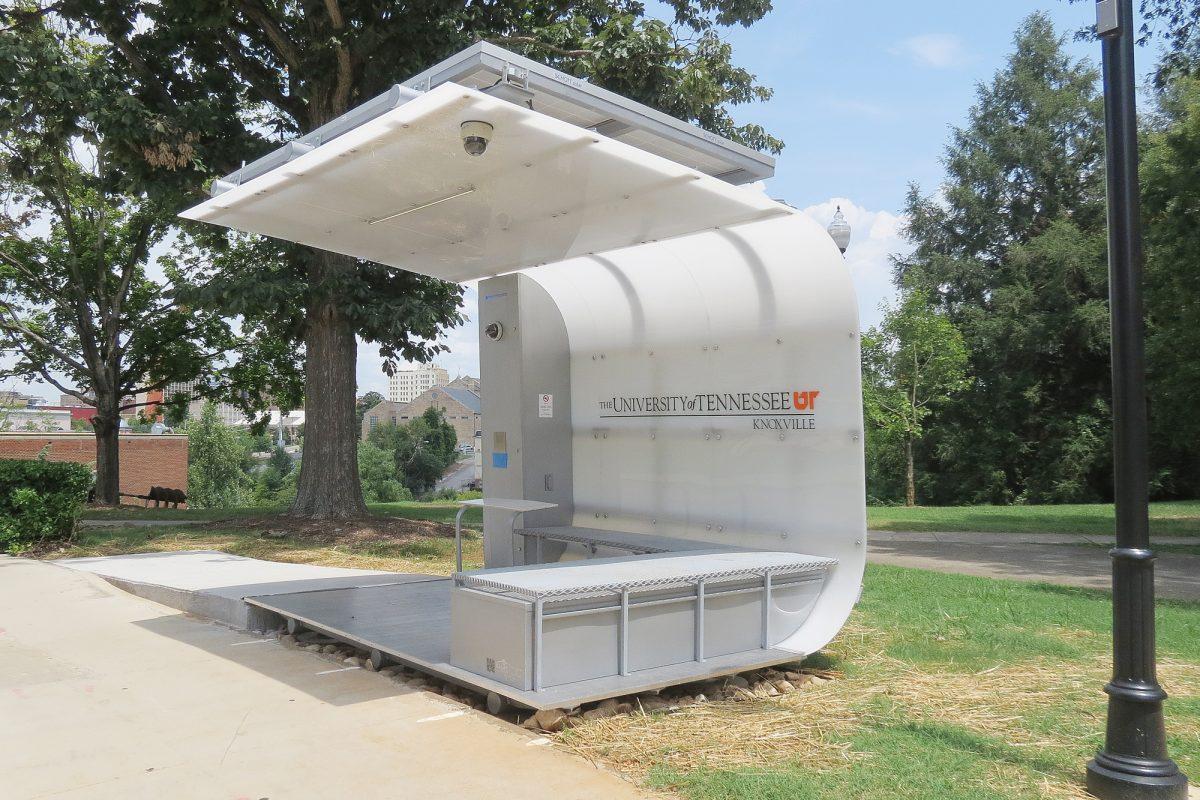
Wayne Davis, dean of the college of engineering discussed the new Solar Secure SunStation bus station located outside Perkins Hall on the Hill. The station was unveiled July 12, the first of its kind housed on a university campus.
Not your average bus stop, the SunStation provides shelter, seating, 24/7 lighting and Wi-Fi connection, as well as a charging station for laptops and cell phones.
While Solar Secure is a company based out of Seattle, the university agreed to act as a host for the shelter as a way to encourage local businesses. Davis said two local companies were involved in the production and design of the station.
“The idea is that we are cooperating with local companies that are building the system and a national company that’s marketing it,” Davis said. “It’s the kind of thing that we like to do.”
With hopes to market college campuses, the station is a part of a nationwide marketing stragedy. Davis said with permission from associate vice chancellor for facilities Dave Irvin, the unit was placed on UT’s campus as a kind of prototype, with changes being made according to feedback from students and staff, including Davis himself.
“It’s kinda the first one so what they’re doing is they’re using it to get feedback from students and us as far as how they can improve it,” Davis said. “We’ve already made some suggestions.”
Some of the suggestions are already being put into place as local companies work to redesign some of the issues brought to their attention.
“They’re going back right now and redesigning and when they get that designed, they’ll run over here and install it,” Davis said. “Ours will be the one that they always put the new modification on so it’s kinda the working model.”
Powered entirely by solar power through solar cells placed at the top of the structure, the unit is completely self-sustained. Davis said even though the bus line is not currently connected to the unit, he frequently sees students taking advantage of the space, even eating meals under the shelter.
“It has lighting all the time because the solar panels create electricity which charges the light,” Davis said. “It has a receptacle on it so you can walk out there if you have your laptop or your cell phone and plug your charger in and sit there and charge your cell phone while you’re sitting there if you want to because it’s all self contained.”
Though the bus line is not currently running to the station, plans are in place to make it stop in the near future. Davis said that construction has been a key issue, but that the changes should be in place during the fall semester.
“My understanding is that they’re going to open that back up around the time that classes start and then the bus will come back around the normal way and it would actually be in a place where people could sit out there and wait on a bus,” Davis said.
Kaitlyn Darby, a sophomore in material science and engineering said she noticed the bus stop prior to learning what it was all about. Darby witnessed the unit as it was installed and tested and curiosity brought her and a friend to the site to inspect.
“The idea is fairly appealing,” Darby said. “Solar power always sounds good. A place to sit in the shade sounds even better.”
The biggest issue for Darby was that the stop was not currently on the bus line. She even went to far as to post a meme regarding the issue.
“One of the first things I noticed was that buses never seemed to be stopping at this fancy new bus stop,” Darby said. “After checking the T’s website, I found out why. There were no buses passing through that area. It is a relief to know that the route will be changing to include this stop.”
Though Darby finds the idea of a bus stop where she can stop to charge her electronics or even do homework on the built in desk appealing, she is skeptical of availability as more and more people discover the conveniences of the stop. For Darby, the station is far more than just a bus stop; it’s a stepping stone to the future.
“I like the idea of a bus stop closer to most of my classes, and a stop with a place to sit will be great,” Darby said. “I also love the idea outdoor desks with power. The two ideas are awesome but may be better off separated. This seems like a step in a good direction; I just think there is much to be done before it affects very many students. The quantity is my main concern. Again, I don’t know about the technical stuff behind all this, but maybe an outdoor (solar-powered) commons is the next step.”