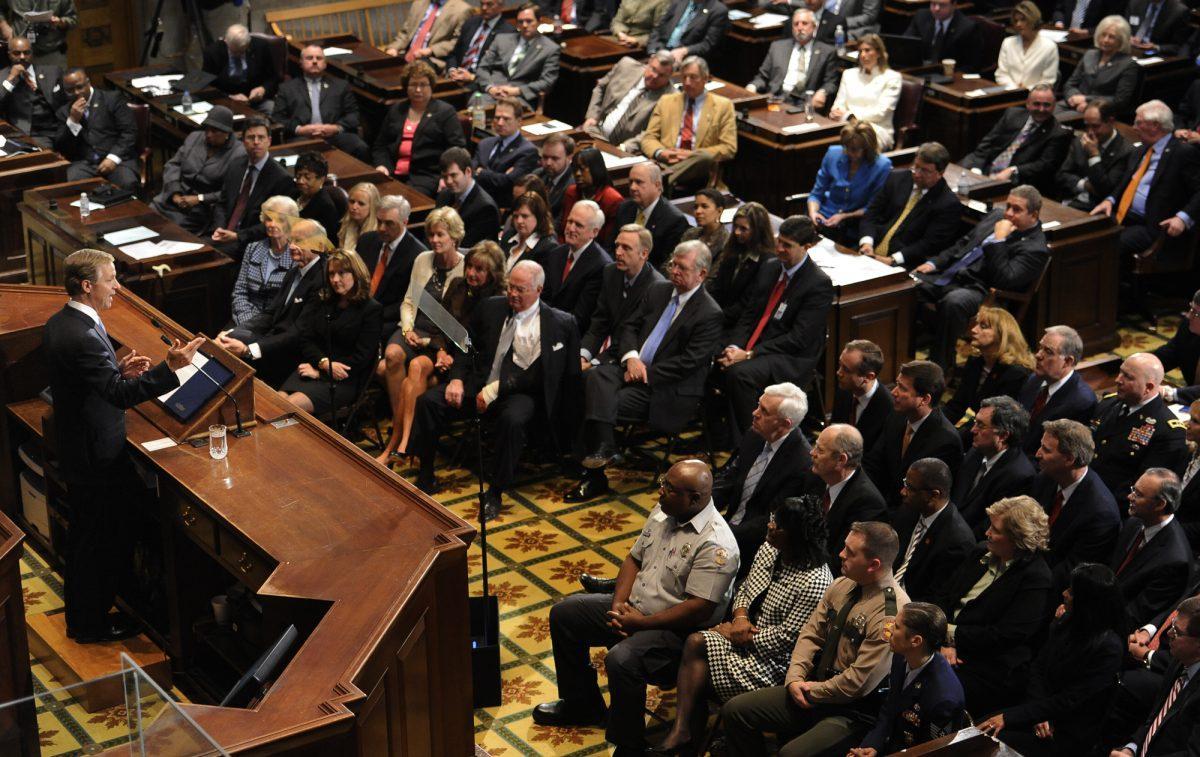
In his annual State of the State Address given on Jan. 30, Gov. Bill Haslam presented his balanced budget proposal for 2012 to 2013.
That proposed budget included a significant amount of money to be allocated to UT that will aid the university in improving its overall academic campaign.
“First of all — the State of the State Address — the theme of it was: ‘Believe in Better,’” Chancellor Jimmy Cheek said. “Believe you could be better, basically. And of course that’s what the University of Tennessee believes all the time, right? Because we can be a better place, and that’s all we want to do.”
Gov. Haslam’s budget allocates a total of $9.3 million to be given to UT. After factoring in the $3.2 million budget reduction the university experienced, UT will benefit a total of $6.1 million in recurring, which is operating money from the governor’s proposal.
The money given to the university will be used for three main purposes. First, there will be a 2.5 percent salary increase for university faculty and staff.
The new money given to the university will also add $4 million to the overall funding formula for higher education. At UT, the funding formula is determined by a number of different factors, including how many students are able to successfully complete credit hours, how many students are retained at the university and how many students are able to graduate in a six-year time period.
Adjustments for insurance and retirement cost are also factored into the $9.3 million budget allocation.
Second, the governor began funding Tennessee Higher Education Commission request for new buildings on university campuses.
Haslam proposed to fund the first building to be built at UT, focusing on the sciences and STEM program.
“It’s a $94 million renovation of Strong Hall,” Cheek said, “and that $94 million, the state will pay 75 percent of that debt service, and we will have to pay 25 percent of that debt service. That building will house science, laboratories and teaching classrooms and faculty offices, but it will be a science laboratory building.”
Both Chancellor Cheek and Vice Chancellor Nichols commented that UT’s emphasis on the science building ties directly into the university’s top 25 initiative to advance UT as a research institution.
“But that doesn’t say that the other parts of the campus aren’t also important,” Cheek said. “It’s just this is our most critical need.”
The growth of the STEM program at UT in the last five years has played a large factor in the university’s decision to build more science-focused buildings.
“Our STEM majors are up 28 percent,” Nichols said.
Along with funding an initial science building, the governor also proposed $3 million of planning money for the construction of an additional science building.
“So we not only got a building proposed to be funded this year, but we also got money to start planning our next building for next year,” Cheek said.
Each building will cover over 200,000 square feet with the second building being built on a lot next to the Jessie Harris Building.
Third, $9 million has been proposed for deferred maintenance around campus such as electrical upgrades and miscellaneous issues.
Only three buildings in the entire state of Tennessee are being funded through the governor’s budget proposal — one at MTSU, one at UT and one at the University of Tennessee Health Sciences Center in Memphis.
Cheek added that the General Assembly still has to approve the budget, but the voting results should be known by the end of April.
Over the last four years, UT has endured a total of $60 million in budget cuts due to the economic recession, amounting to a 30 percent fiscal drop in what the state of Tennessee previously gave to the university. However, with a gain in $6.1 million with Haslam’s new budget proposal, Cheek said that UT can slowly start to regain its budgetary losses.
“So we’re moving in the right direction now, but we’ve really lost a lot of money,” Cheek said. “And that’s why we have so much deferred maintenance on the campus. That’s why we have fewer professors on the campus, that’s why we have fewer classes taught, (and have) larger classes because we we’ve got a few more students than we’ve had, and we’ve got less professors and less money.”
Cheek also assured that there are steps UT can take in the coming year, such as improving test scores, to increase the chances of the university receiving more funding in the future.
“The better we do in that, the more competitive we’re going to be,” Cheek said.
The chancellor also hopes that improvement in the overall economic atmosphere will aid UT in receiving more funding.
“Well we hope the economy continues to improve,” Cheek said. “And we hope that the governor will look at higher education as a place to continue to make investments. … Higher education is one place where you reduce budgets, but it hurts our educational system.”
Both Cheek and Nichols stressed the significance of Haslam’s budget proposal on the students and faculty at UT.
“First of all, a major new building on campus is just game-changing for us,” Cheek said. “If you’ll go walk through the Haslam Business Building or the engineering building and look at those two buildings and say, ‘Wouldn’t it be nice for us to be able to have this kind of facility all across the campus?’ We’re trying to do things like (renovation) on the campus to make our facilities much better, much more modern, much more effective, so we can do a better job at instructing and teaching students.”