America has no comprehensive plan to address the environmental problems plaguing our future, and Christine Todd Whitman blames politicians.
“There is an ongoing need to craft an energy policy that respects our environment, providing clean air and water,” Whitman said. “We won’t get the thoughtful discussion we need, unless we demand better. Political polarization has developed. Politicians … if they can’t get everything they want, they do nothing.”
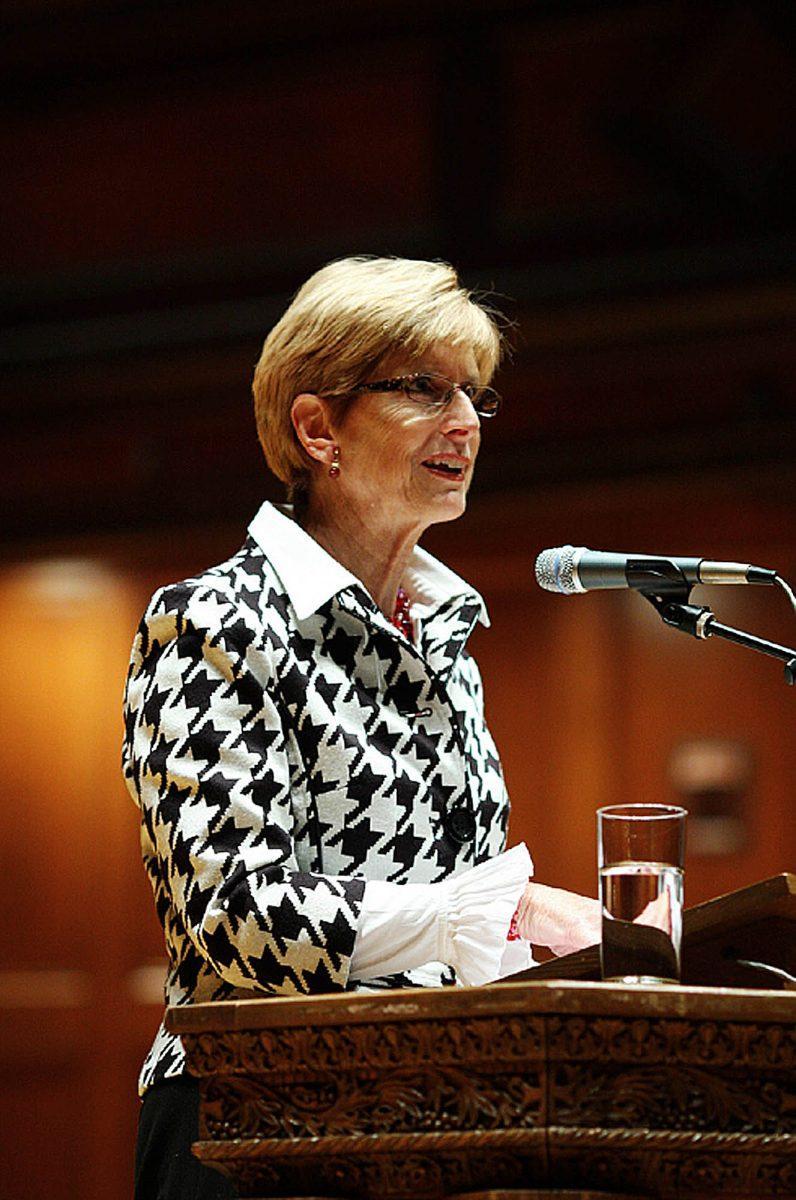
Whitman, former administrator of the Environmental Protection Agency under President George W. Bush, resigned her commission in 2003. Her lecture on Wednesday evening, “The Need for Climate Change in Washington: How Hyper-Partisanship Has Paralyzed Policymaking,” was standing room only.
Whitman is a realist when it comes to environmental policy. She supports regulations that can coexist with economic development.
“We are told now we can’t protect our air and water without crippling our economy,” Whitman said. “That’s simply not true. If you look back to the early days of the environmental movement, Republicans and Democrats came together to work on these issues. It was a time of enormous upheaval, yet our representatives realized they had to come together and create solutions. Our economy didn’t collapse, it grew.”
The former director sees an immediate need for reasonable individuals to work through these problems.
“It’s no question the U.S. faces a host of environmental problems today,” Whitman said. “We yearn for thoughtful discussion about how to return our economy to health. We need thoughtful discussion about how we protect this country here and abroad.”
Whitman blames the activists themselves for some of the stagnancy.
“What has happened to our environmental movement?” Whitman said. “Why haven’t we seen progress? So much of the environmental movement has gone too far with its rhetoric. The American people are smarter than that. Both sides now are doubted by the American public.”
She believes dialogue about the environment should be more inclusive.
“I’m convinced that people’s confidence in the environmental movement has been compromised by the arguments that have been advanced,” Whitman said. “Instead of talking about global warming, we should have been talking about climate change. Instead of blaming human activity, they should recognize the world has been changing from the beginning. They should welcome a public debate and raise the issues. When you have an honest discussion with the American public, you generally get some good answers.”
This kind of faith in the American public characterizes Whitman’s views.
“The modern day environmental movement was basically started by Rachel Carson in the Silent Spring,” Whitman said. “Average people said that they had had enough. It was people, everyday people, who stood up. We forced our elected leadership to act. We need to do better.
“A new generation of activism will be required. I would hope that if nothing else, we remember democracy requires participation.”
The Baker Center hosted Whitman as part of their series promoting interdisciplinary approaches to environmental policy.
“Whitman is a common sense supporter of environmental protection,” Matt Murray, director of the Baker Center, said.
“We want clean, green, affordable, reliable energy,” Whitman said. “I would let the marketplace determine the best ones.”