Greta Garbo called him her personal favorite. President Dwight D. Eisenhower and Thomas Edison considered him a friend. His films have received international recognition, both at festivals and private showings.
As one of the oldest League of Resident Theatres’ affiliates in the nation, the prominence of UT’s theatre company is widely known and celebrated.
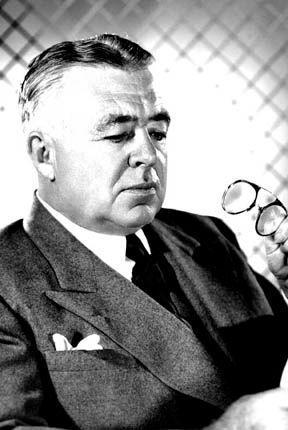
What fewer Knoxvillians remember is the elusive man behind the theater, the acclaimed Old Hollywood director Clarence Brown himself.
“I don’t think to this very day people in this community know who Clarence Brown was, other than that it’s a theater on the campus of the University of Tennessee,” Tom Cervone, UT’s Professional MBA managing director, said. “Until we start telling tales of his success in Hollywood, that is. This guy was a real force in the early days of Hollywood, transitioning from silent films to talkies.”
But before he was a historically significant director, Brown was a bright kid growing up in Knoxville.
When he was 10 years old, his family moved to Knoxville where his father became superintendent at Brookside Mills. Brown attended the old Knoxville High School and was known for being a proficient orator.
“He was a short, sweet little guy and they called him ‘Shorty’ or something like that,” said Charlie Brakebill, a 90-year-old retired director of development at UT. “He was brighter than most; he wouldn’t say that, but you can conclude.”
Brown graduated high school and came to UT with special permission at age 15. In 1910, he graduated just before his 20th birthday with degrees in both electrical and mechanical engineering before moving to Birmingham, Alabama, to accept a job at a car dealership.
It was in this unlikely setting that Brown’s attention turned toward movies. A lunch break spent at a nearby nickelodeon sparked a life-long passion Cervone called “an obsession.”
“He was fascinated by the automobile industry but got sidetracked because he was so enamored with this new art form, and then because of his mechanical prowess he was able to put together a newfangled camera,” he said.
Suddenly, Clarence Brown the Car Mechanic was no more. In his place, Clarence Brown the Aspiring Filmmaker bolted for New Jersey, then known as the “East Coast Hollywood,” and studied for a time under the director Maurice Tourneur. He took a brief hiatus to enlist in the Army Air Corps during World War I before heading for California.
“(A director) got ill and so Clarence ended up finishing the film ‘The Last of the Mohicans,’ which then became his first film,” Cervone said. “The rest, as they say, is history.”
Brown spent time at both Universal and MGM Studios, going on to make more than 50 films. He was nominated for an Academy Award six times, although he never won (he’s tied with Alfred Hitchcock in this category).
His films featured some of Old Hollywood’s most beloved talent, including Elizabeth Taylor, Clark Gable, Jimmy Stewart, Rudolph Valentino, Gregory Peck, Jean Harlow and Mickey Rooney. He directed Joan Crawford six times and Garbo, who was to remain a lifelong friend, seven.
By 1967, Brown was a multimillionaire living with his wife, Marion, on a California ranch when his alma mater made an unexpected reappearance in his life.
Seeking funding for the construction of a new theater, then-UT President Andy Holt made arrangements for Boling, Brakebill and him to meet with Brown in California.
But there was one problem.
“Dr. Holt didn’t want to be hosting anything where alcohol was served, that was his philosophy,” Brakebill said. “I went to Ed Boling and I said, ‘Ed, I don’t know much about Hollywood, but every actor or actress I’ve seen has got a cigarette in one hand and an alcoholic drink in the other.’”
Afraid Brown “might have a heart attack if he didn’t have a drink before dinner,” Brakebill and Boling convinced Holt to approve the purchase of bourbon, scotch and gin for the meeting, and the group set off for the Century Plaza Hotel in Hollywood.
The plan backfired, though, when Brown turned down Brakebill’s offer of a drink.
“He put his finger up and said, ‘Young man, I’ve been out here this long and I haven’t taken a drink of alcohol during that time, so I don’t guess I’m going to start tonight,’” Brakebill recalled.
Despite this initial faux pas, the dinner went well enough that Holt called Brown a month later and asked for the $500,000 needed for the planning and building of a theater at UT.
“Clarence was real nice and said, ‘Well, let me talk to my financial advisors. Marion and I will talk about this,’” Brakebill said. “He didn’t say no, he didn’t say yes.”
After a week, Holt received a letter from Brown saying he had spoken with his advisors and chose not to commit any money at the present time.
“So we thought, ‘Okay, we tried,’” Brakebill said. “I carried proposals from New York to L.A. and back. I didn’t think we were ever going to get a theater built.”
But not long after, Holt received a second letter from Brown — his wife had convinced him.
“It was a $50,000 check and a commitment to give the $500,000 to start building the Clarence Brown Theatre,” Brakebill said, smiling. “Marion had said to him, ‘You ought to go ahead and do that in memory of your mother and father, because being in Knoxville and you having the chance to go to the university meant a lot to them.’”
In the following years, Brown was highly involved with the theater’s construction, making several trips to Knoxville and sending architects to Princeton and UCLA for inspiration.
UT administrators, like Brakebill and his wife, Joyce, “treated the Browns like family,” something Brakebill said the Hollywood couple appreciated immensely.
“Joe Johnson had a dinner at his new house, and the Johnsons didn’t even have all their furniture there yet. But they had the Browns and a half-dozen theatre students over,” Brakebill said. “Clarence Brown sat down on the floor in the living room with those students and poured his heart out. They just sat there and had a ball. That was a breakthrough, in my opinion.”
The Clarence Brown Theatre for the Performing Arts was formally dedicated in November of 1970, with the Browns and many Hollywood figures in appearance. Several times, Brown called the occasion “one of the greatest moments of my life.”
“Marion said that Clarence’s involvement with the theater, with the students and getting reacquainted with some of the old-timers in East Tennessee — all of that was like a second life to him,” Brakebill said. “Now, when you had a life involving that many major films, you’d think he had already a pretty important life.”
For the next nearly 20 years, Brown continued to make donations to the theatre company and funded a few scholarships. But it wasn’t until after his death in 1987 that the full extent of his generosity was revealed.
“I was just coming out of graduate school and being hired by the theatre department in 1993 when (Brown’s) will was probated,” Cervone said. “We found out that the Clarence Brown Theatre was on the receiving end of $12 million, the largest single gift to any academic department at that time. It kind of rocked the world for us.”
Cervone said the resulting endowment still has a positive impact on the theatre, and the university as whole, today.
“Without the endowment, I don’t know candidly how the theatre would really function at the level they do at this point,” he said. “That money allows our students to have precisely what Clarence Brown envisioned: the opportunity to work side-by-side with professional actors, designers and directors.”
Today, Brown’s life of accomplishments and generosity has lent the university a legacy of success, Brakebill said.
“It’s a big piece of history, and it all started right here in Knoxville at the University of Tennessee.”