What do you call a woman born in Mexico to a Russian immigrant and an American art student?
Aliza Nisenbaum calls herself an artist.
“I am very much a mutt of all these different cultures,” Nisenbaum said. “I guess I have the sense of being from everywhere and yet from nowhere, so then I find my identity in being an artist more than a nationality in some ways.”
Nisenbaum came to the United States at age 21 after studying psychology in Mexico City for two years.
“I wanted to do something practical,” Nisenbaum rationalized. “But then art was what I had always wanted to do.”
As a child, she watched her mother create large flower paintings in the Mexican artistic tradition, which her family then critiqued over the dinner table.
Like her mother, Nisenbaum draws inspiration from styles unique to Mexican art.
“I think of my work much more in relation to the Mexican realists, but the French intimists with the textiles and the patterns that they use have always influenced me as well,” Nisenbaum said. “I think of my work as a combination of these totally disparate influences.”
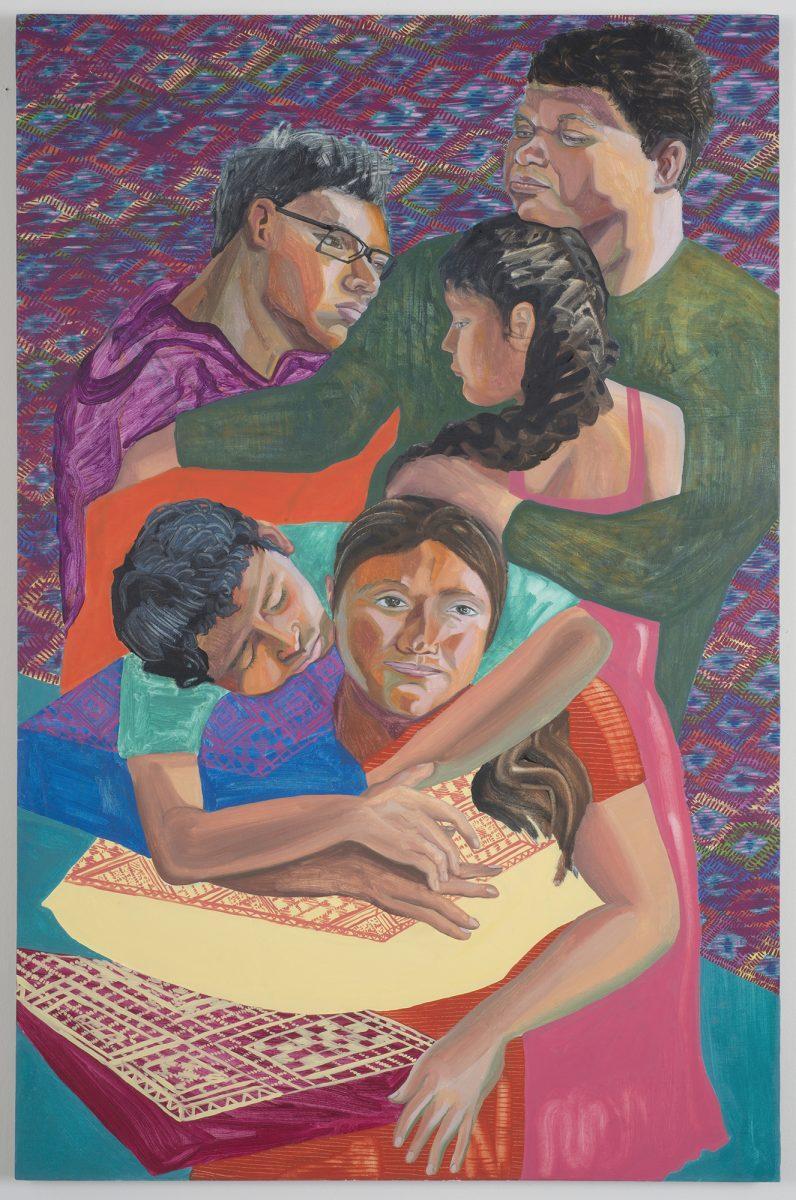
Although she now lives and works in the United States, Nisenbaum remains connected to her roots. Her most recent project was a collection of portraits of undocumented immigrants living in New York City.
“I was first volunteering in this space that was opened by an artist in Queens, which was giving a space for rights and for community,” Nisenbaum explained. “I initially was volunteering in her space teaching a group of women English through art history.”
After developing a close connection with many of her students, Nisenbaum conceived the idea for her next project.
“Through that class I got very interested in their stories, so I asked them if they would sit for me so that I could paint them,” Nisenbaum recounted. “That’s a way of really sitting for a very long time with someone and getting them to open up for you.”
For Nisenbaum, having a connection and personal experience with her subject is essential. She views a painting as more than a depiction; it’s an encounter.
“There are very few opportunities that you have in life to spend six hours staring at something,” Nisenbaum said. “Painting really lets you do that. Whether it’s a still life or letters or a person, it’s an intimate encounter with something.”
Nisenbaum’s portraits feature her models set in a nondescript, patterned background.
“I was thinking of placing them in some type of dream space where it’s not necessarily like a real room or real deep space,” Nisenbaum said.
For Nisenbaum, this reflects the actual experience for undocumented immigrants of “being in an in-between space.”
Showing the subject of the portrait as detached from his or her objective reality also draws the viewer’s focus directly to the model themselves. In doing this, Nisenbaum hopes to convey the deeper, subjective world of her models.
“It’s really difficult to depict an interior nowadays with a sense of how social media has infiltrated into both our public and private space,” Nisenbaum said. “I think that quite often the models are depicted in moments of intense interiority, where they are absorbed in their own activity.”
Nisenbaum proposes that each of us, undocumented immigrants especially, experience much of our time as being “instrumentalized.”
She tries to create “a time of asking somebody to just sit and be engaged in their own reading or watching a movie or something in a moment of non-instrumentalized time, where you’re not for anything else but for yourself and for me trying to document that in the painting.”
Here at the university Nisenbaum hopes to extend her project and produce more portraits on UT campus.
“I want to do portraits of the very unique social configuration that happens with professors at the university,” Nisenbaum said. “They are my surroundings now; it’s the same face to face encounter with this work force which is the University of Tennessee art faculty.”