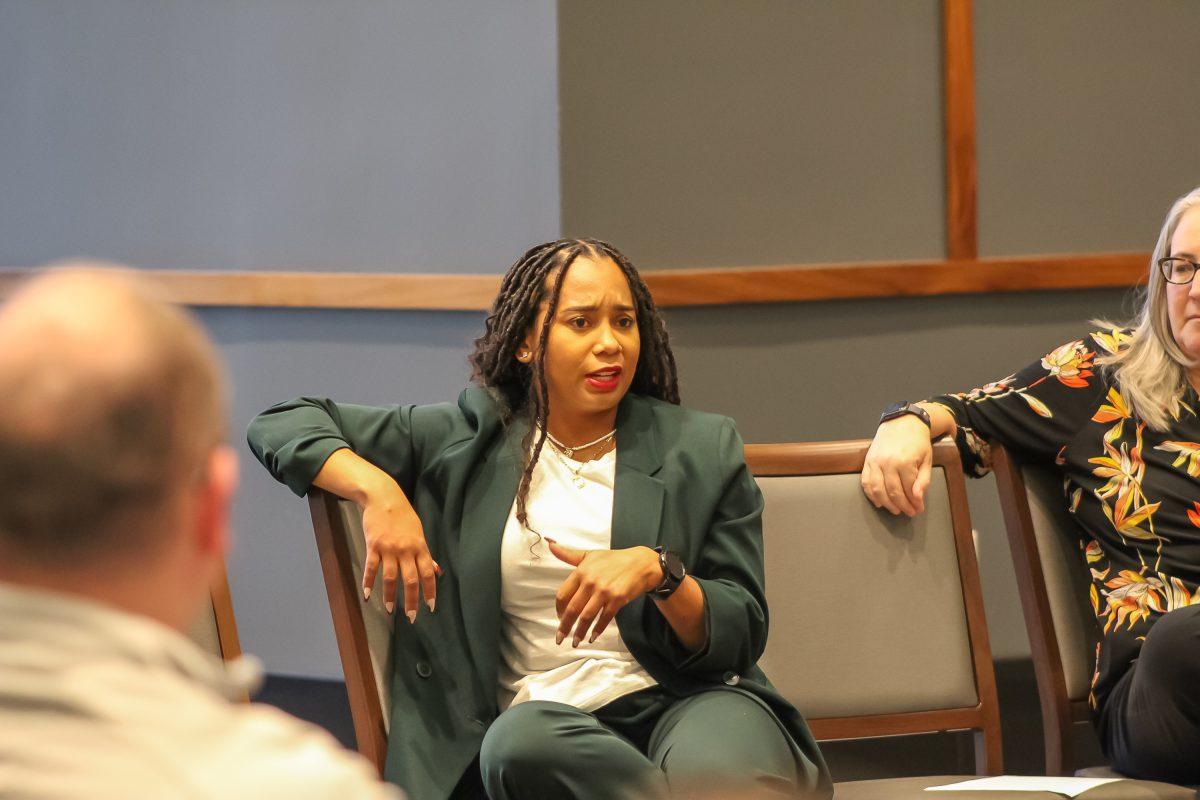
On Thursday, Oct. 19, Lacretia Carroll, an assistant professor at the University of Tennessee Health Science Center, spoke about the power of allyship and advocacy. She earned her bachelor’s degree in nursing from the University of Alabama-Huntsville. At UTHSC, Carroll’s research focuses on health equity and sexual and gender minority adolescent populations. The event was held at the Student Union and was open to all UT students and staff members. The purpose of the session was for it to feel intimate so people could open up about personal questions they have in a safe space.
Allyship means not being a part of a community that is poorly treated but remaining sympathetic and understanding of them. That is where the advocacy part comes in: giving a group of people full support for their cause. Carroll spoke about how allyship can be misinterpreted.
“Allyship is not a noun. It is a verb and requires action,” Carroll said.
Carroll talked about her background story and how it got her to where she is today. She grew up in a small, conservative town with her good friend, English Fields. The town did not incorporate much room for inclusivity. However, in high school, Fields told Carroll that Fields was questioning her sexuality. Carroll was shocked by this response and did not know how to support. This unfortunately created harm to their friendship.
When Carroll worked as a nurse, she saw repetitive cases where girls had genetic conditions that produced too many male hormones, and she also saw a mental health crisis. Further, children struggled with identity issues and how to come out to their parents. Carroll spoke on how these mental struggles reminded her of Fields.
“In those moments, I was taken back to where Fields told me about her experience and she did not have anyone to talk to,” Carroll said.
After coming to that realization, she talked to Fields after years of no contact and hoped her apology would be accepted. After her work in the clinic and her first-hand experiences, she saw how big of a social issue this was for many individuals. Therefore, her career as a nurse ignited the work that she does today.
A woman in the audience spoke about her concern for her transgender daughter, wanting to respect her but not out her. In scenarios like that, it can be difficult for loved ones to know the right words to say and the right thing to do, Carroll said.
“It is a process, so do not feel bad. The more you do it the easier it becomes. You are supportive and you are trying,” Carroll said.
What matters most is that the mother of the trans daughter is trying to help, Carroll noted. One of the best things one can do is be an ally and support their loved ones going through a difficult transition.
“Do not stay on the sidelines,” Fields said.
Carroll wanted to teach and show the importance of how to deal with this type of social change. She shared her story from 2007 to reveal that times have socially changed. By sharing her story of losing her friend who went through an identity transition, she wanted to model the vulnerable behavior in these situations. She is aware of what she could have done differently at that time and does not want other people to make the same mistake. She spoke to the people in the session that this process from both sides is not linear.
“We are still learning,” Carroll said. “It is not about the destination. It is about the journey.”