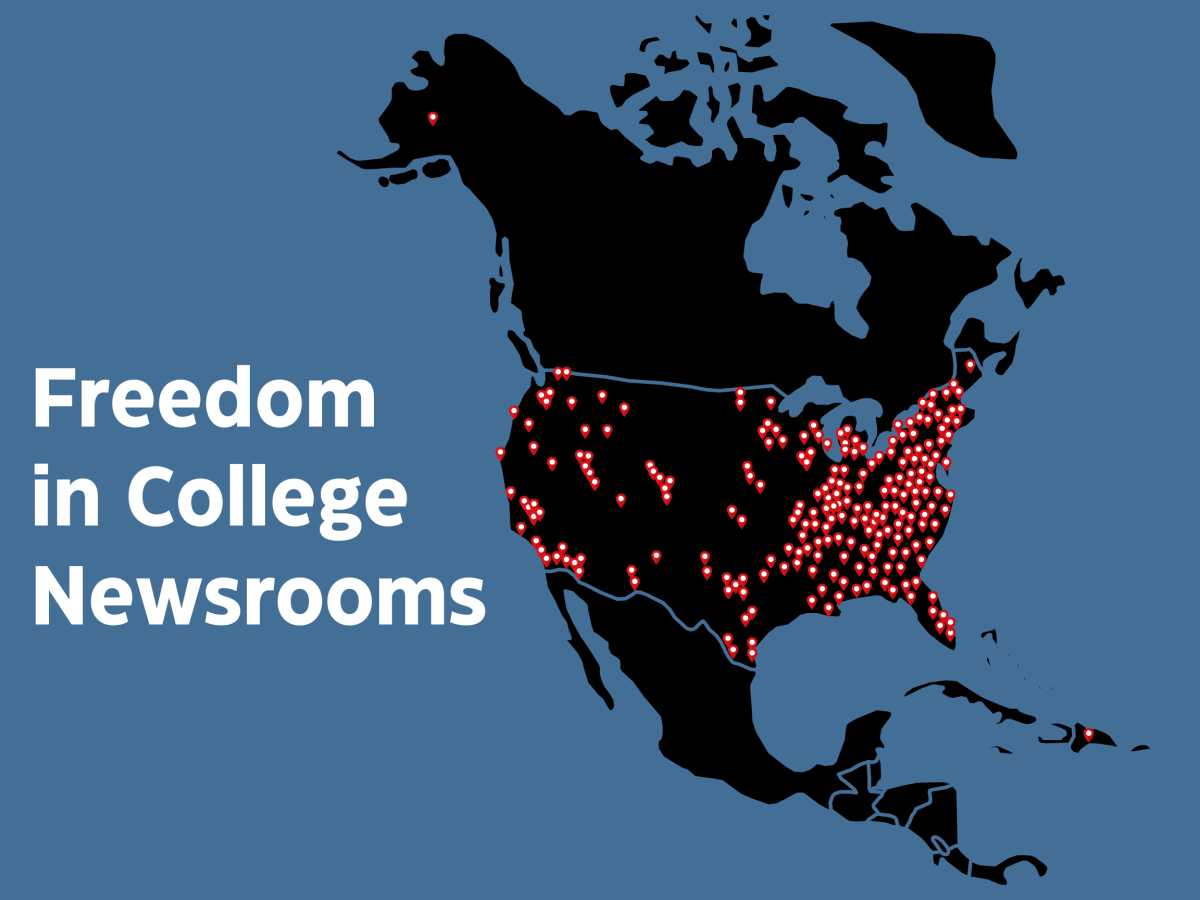
Student newsrooms across the nation face limitations and scrutiny based on the structure in which they are set. The Brechner Freedom of Information Project was funded by the Lumina Foundation to bring the internal struggles of newsrooms to light and bring affordable and accurate information to the hands of student journalists.
In 2021, the first survey was conducted in a pool of 525 outlets, and on the eve of the project launch, 13 of those newsrooms no longer existed due to structural, financial or editorial discrepancies. Student newsrooms vary in size and support, but they all have a common goal: independence.
While pursuing her Ph.D., Jessica Sparks served as a media advisor for the Savannah State newspaper, Tigers Roar. As an advisor, she saw newsroom threats firsthand as the Savannah State administration viewed the student newspaper as a “marketing outlet” and not an editorially independent source. Sparks saw a need for respect and transparency within student newsrooms, and thus, the Brechner Project began.
The Brechner Project was originally meant to assess how college media survived the pandemic, but as the research went on and more outlets got involved, Sparks found that newsrooms were so isolated that they were unfamiliar with the different structures and operations their peer newsrooms experienced. The Brechner Project became less of an evaluation of the current state of newsrooms and more a story about awareness and unity amongst student newsrooms across the nation.
“A lot of the outlets don’t know what other outlets like them are doing as far as how they are structured, what they’re doing for revenue, how they are remaining stable,” Sparks said. “And then, of course, how are they remaining independent? That was really how all this came through.”
The structure of newsrooms
There are three main layouts for student newsroom independence including editorial, structural and financial. Each system varies in how outlets receive funding, advisors and editorial advice. A majority of newsrooms receive allocated funds from student government or are supported by the university itself. The least popular but most hands-off structure are the newsrooms protected by a 501(c)(3) — a tax-exempt nonprofit organization — where the outlet receives funds from donors and alumni to cover operational costs.
“We have to have a pretty involved alumni base or group of people who are really passionate about keeping the news outlet free and autonomous,” Sparks said. “A lot of schools won’t allow student groups if they are separate from the institution to participate in recruitment fairs, get a space on campus or be able to use computers or software.”
Financially independent newsrooms are tasked with fighting for space, access to the student body and functional equipment but have the advantage of complete autonomy.
Structural support is a medium between financial support and complete independence while bearing the luxuries of support from an advisor. Structurally supported newsrooms don’t have to worry about what Sparks calls “keeping the lights on.”
“There’s a lot of associated costs with being truly independent … like having a facility and newsroom that’s in a campus building with free rent,” Sparks said. “That is structural … things that you don’t really think about until you have to think about, like, who keeps the lights on?”
Lastly, editorial independence is the foundation of student newsrooms. Writers, photographers and creatives in between can portray a story without risk of university implications. Of the newsrooms surveyed for the Brechner Project, all are editorially independent.
Are newsrooms at risk?
There comes a time when someone poses the question, “What if?” For student media outlets, “What if?” comes about more often than you think. “What if we get a big interview?” “What if our story goes viral?” “What if we get shut down?”
Under the structural setup, newsrooms are overseen by university-paid advisors who offer editorial advice without dictating what goes to print. Advisors are seen as champions of the student work produced within the newsroom, but when it comes to the business operations of keeping a newsroom afloat, the advisors are obligated to side with the university.
Although most advisors do not interfere with the editorial process, 58% of the surveyed outlets have a university-paid advisor which can lead to several opportunities for university interference.
“It’s okay right now — until,” Sparks said. “Until the wrong person steps in … there’s a whole bunch of different scenarios that might make the outlet very vulnerable as they get university funding … or if they’re in a newsroom that’s on the campus or if they have a website that’s hosted by the university. All of those things that just kind of open up opportunities for the university to take control if it wanted to.”
Advisors serve as a liaison between the newsroom and the university. They do not come between the student and what goes to print. Advisors can advocate in support of the students’ need for equal access to public information especially at a public institution.
A fight for public information
The Freedom of Information Act is a protection act to maintain the integrity of newsrooms by exploring the access to public information of federal agencies. David Cuillier, the new director of The Brechner Center for the Advancement of the First Amendment, prioritizes the newsroom right to public information by supporting and informing journalists on how to access public records.
Student newsrooms make an effort to emulate the working environment of real-world outlets, and the Brechner Center protects that.
“Campus press outlets across the country faced a lot of control by the governments they cover. … Funding can be yanked, or their advisors can be fired,” Cuillier said. “Imagine your local city newspaper or TV stations. If the mayor could yank their funding, we wouldn’t have a free press would we? And that’s the situation we have on universities all around the country with students trying to learn how to do good journalism.”
Private universities face a greater need for independence as they are not protected by the First Amendment. The right to free press protects government institutions from intruding on speech and press but excludes private institutions like universities.
“We need laws actually covered by the universities. That’s the right thing to do,” Cuillier said. “We need police forces at private universities to be subject to public record laws because they have enforcement laws … so they should operate transparently.”
A call to action
The interactive map titled “Freedom in College Newsrooms” is one step in uniting outlets that face similar adversity. Student media entities are legitimate news outlets that desire the same need and access to information. This Student Press Freedom Day, support your local outlets’ efforts to bring you accurate and timely information.