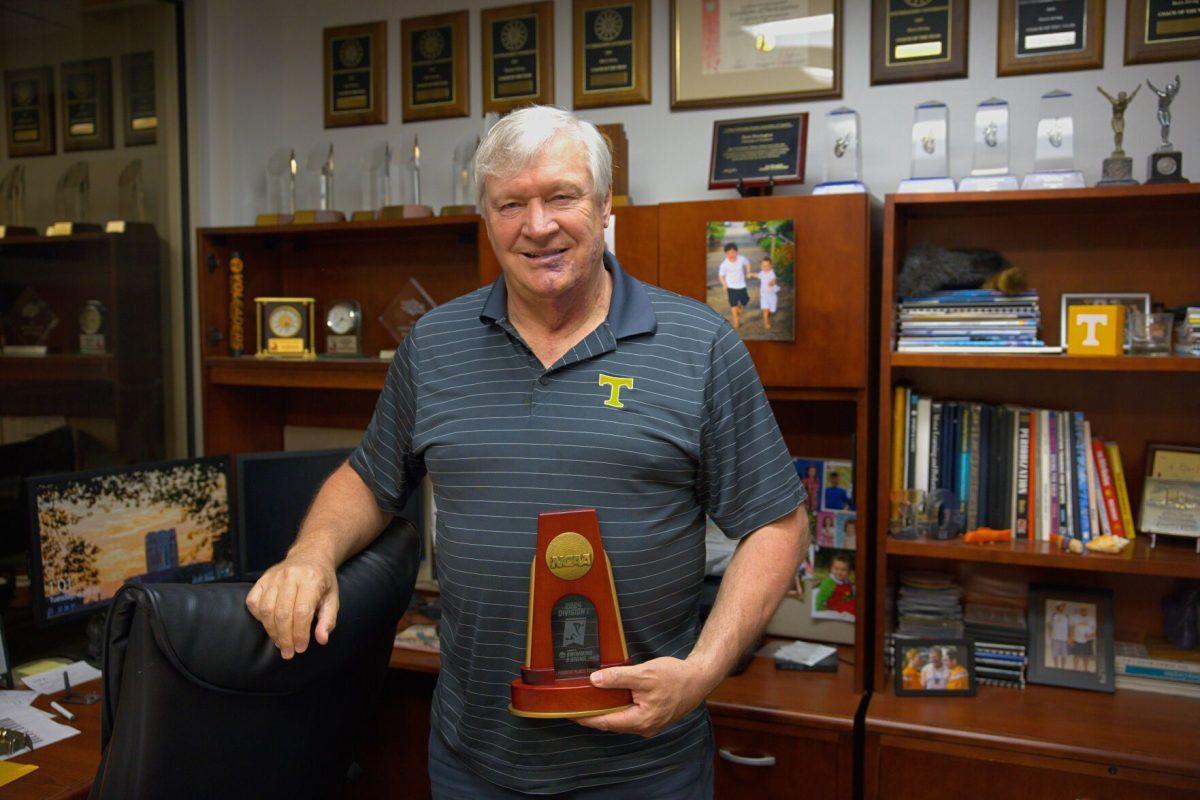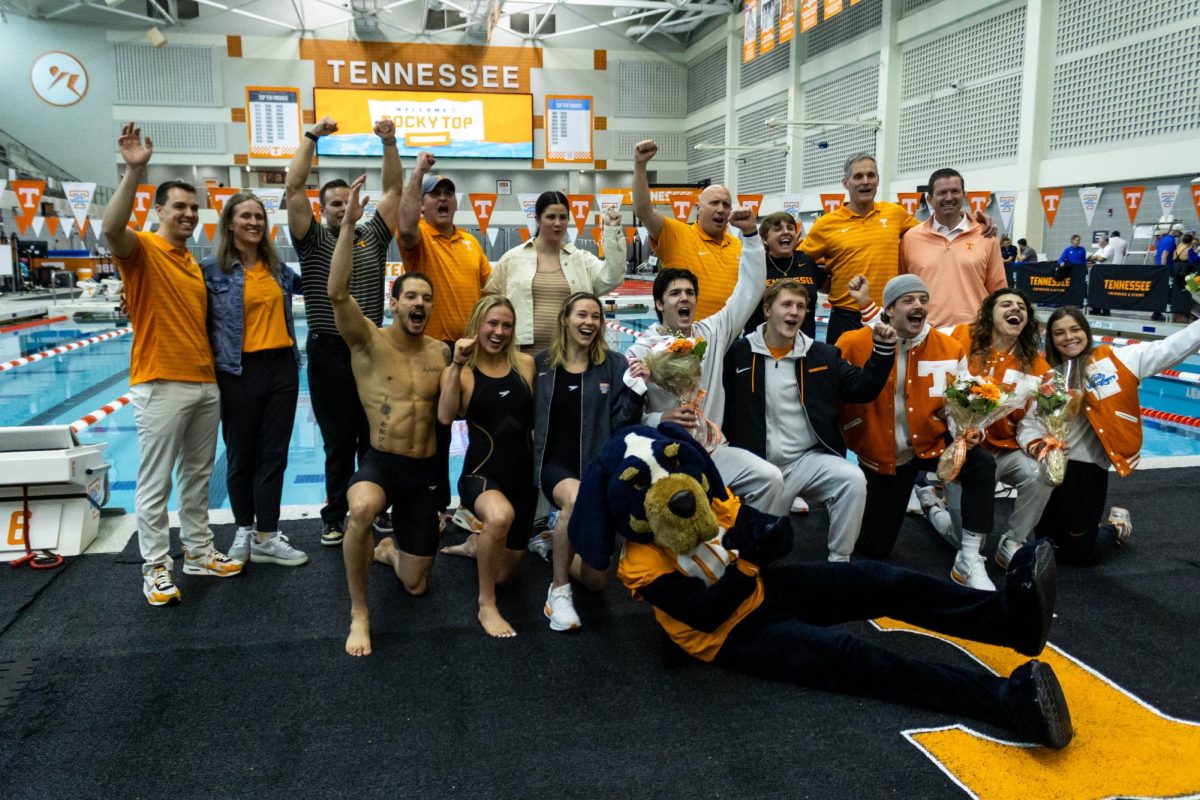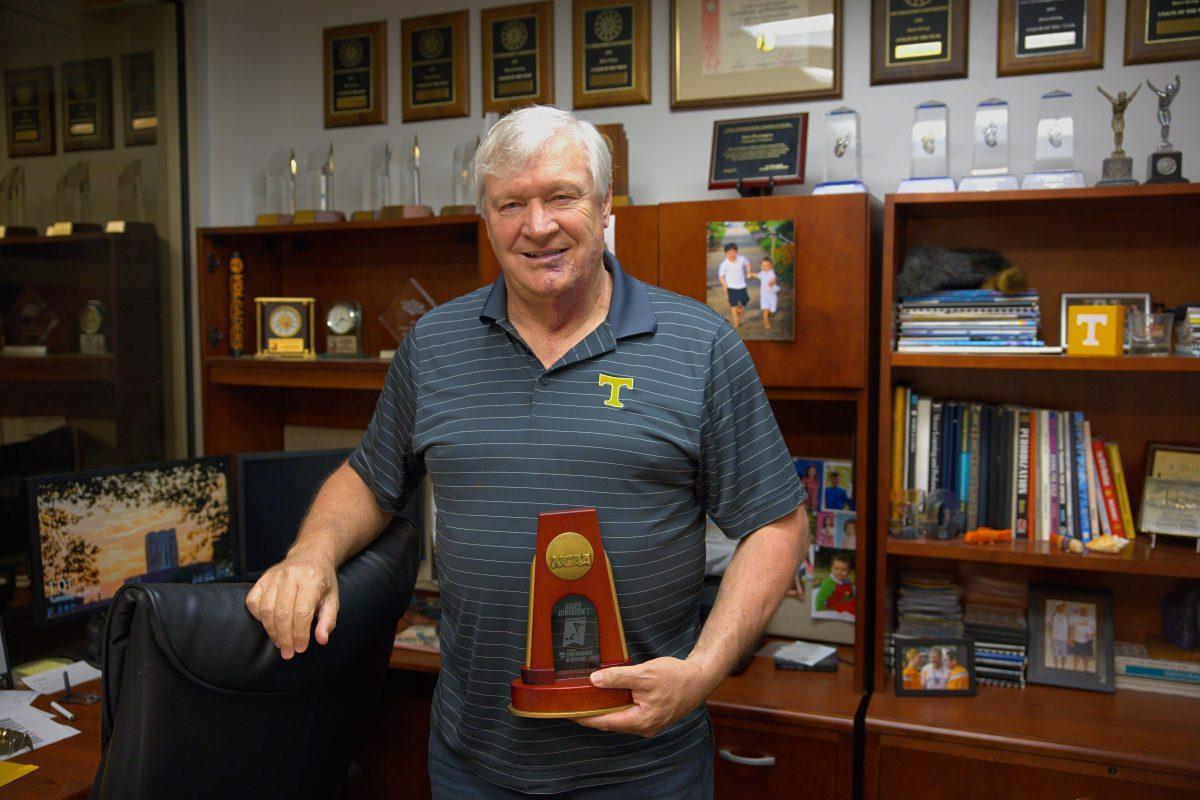
After 35 seasons at the helm of Tennessee’s diving program, Dave Parrington’s voice still echoes off the walls of the Allan Jones Aquatic Center with the same rallying cry that has followed every team win for decades.
“Winning is living.”
It’s not just a post-meet chant. It’s a team tradition, a cultural cue, a signal that — for the moment — the countless hours of repetition, preparation and mental battles at the edge of the board paid off.
“Since I first got here, the men’s swim coach at the time, John Trembley, came to me right after we won the first tournament, said, ‘Hey, we’ve got this tradition,’” Parrington told The Daily Beacon. “So it actually wasn’t mine, but I’ve done it for the last 35 years, so I guess it’s been attributed to me.”
Those three words have come to embody the heart of a program that has thrived under Parrington’s leadership. But for the coach who’s expanded upon an SEC diving powerhouse over 30 years, it was never about catchphrases or celebrations.
It was about the people.
“His tagline of ‘winning is living’ — that was Dave, even early on,” Hanneke Faber, CEO of Logitech and a former diver under Parrington, said. “But at the same time — super kind — cared about his team and his people.”
A destiny awaits
Aquatics were in Parrington’s blood from the start. His mother, Lillian Preece, was a British Olympian in 1948 and 1952, while his father, Frank, coached Olympians — including Lillian — before they married.
Born in Great Britain, Parrington relocated with his family to Rhodesia in 1959 when his father accepted a position as pool superintendent at the Mabelreign Municipal Pool in Salisbury. The existing British cultural influence in the region eased the transition to Southern Africa. For young Parrington, it began his aquatic journey at the age of four.
“I grew up around it,” Parrington said. “In fact, I was a swimmer as a kid and a national team water polo player. I was in the water all the time. I just grew up in it and just knew that this is what I wanted to do.”
With no original plans to attend college after high school, Parrington elected to join the military. As Southern Rhodesia fought for independence in the late 1970s, his athletic career took a near-four-year hiatus as he embarked on a career as a police officer.
Due to political tensions and the inability to compete internationally for Rhodesia, Parrington decided to pursue a diving career in the United States after one of his father’s former swimmers reached out. It was the thrill of diving that caught Parrington’s teenage eye, moving away from his swimming roots. After considering multiple offers, he accepted a partial scholarship to attend the University of Houston to move forward as a diver.
That move is where Parrington began making a name for himself.
“I competed after my sophomore year in the 1980 Olympics, but that particular Olympic Games had a huge influence on the rest of my career, both as a diver and particularly in my coaching,” Parrington said.
He learned what it took to compete at that level, paving the way for his 42-year coaching career that began while he was still a student.
Learning and leading
Coaching came naturally to Parrington — even at 14, he coached peers when formal coaches weren’t available. After exhausting his athletic eligibility at Houston but needing more credits to graduate, an opportunity knocked.
After the season ended, he took a semester off to go back home and explore the job market. Then, he came back to the U.S. to continue finishing his education degree. Right before his last semester began, his diving coach predecessor left for a new job.
Because of the coaching change, athletes considered transferring. Parrington saw a solution.
“I just went to the coach and said, ‘Hey, I got one more semester of school, but if you hire me, they’re not going to transfer,’” Parrington said.
From there, it was history.
While still finishing his degree, Parrington took over as head diving coach, beginning a seven-year stint that launched his legendary career.
A lasting impact
Staying in a leadership position for over four decades is no small feat — it’s a testament to his ability to inspire, lead and foster success. Parrington did just that, racking up a resume that rivals anyone in the sport.
In 1990, fate intervened again. Parrington met Lady Vols athletic director and swimming and diving head coach Dave Roach at the NCAA Championships. Former Tennessee dive coach Jim Kennedy had just retired, and Roach asked Parrington at breakfast whether he’d be interested in taking the job.
“I said, ‘Sure,’” Parrington said. “So they brought me out for interviews, and I liked everything, and then they hired me.”
An already established program in collegiate swimming and diving, Parrington elevated Tennessee to new heights.
In his time coaching Vols divers, he guided them to nine NCAA titles, three CSCAA Diver of the Year selections, 47 SEC titles and 19 SEC Diver of the Year recipients. He also coached one world champion and one world bronze medalist, three Olympians, eight USA Diving national champions and two Commonwealth Games gold medalists.
Through all the accomplishments in the pool, there is not just one that Parrington can single out as his favorite — they all played a part in his story.
“Every single time we win, it’s very special, especially that I know it helps the whole team,” Parrington said. “But really, just to encompass the whole thing, working with the student-athletes, and it’s not all hunky dory along the way. It’s hard work, and for the coaches and for the student-athletes alike, for everybody involved.”
Part of being a college coach includes shaping the teenagers into adults — turning boys and girls into young men and women.
After over 40 years in the industry, Parrington’s most significant takeaway is not coaching up Olympic champions but instead being a pillar in the lives of many. It’s one of the things that he loves most about the job.
“As they move forward into their lives and continue to actually receive calls from them well into their careers, saying, ‘Hey, thanks for this, thanks for that.’ Or, ‘Can you give me a bit of advice here? What do you think?’ Parrington said. “Being a part of all of their lives, at a very influential part of their lives.”
When Parrington announced his retirement in early April, one of his former divers took to LinkedIn to pay tribute to what he meant to her. Faber dove under Parrington while he was at Houston.
As the executive officer for one of the world’s largest tech corporations, Faber’s journey began with Parrington. The two spent three seasons together, where his lessons guided Faber to the corporate world.
Risk-taking, a glass-half-full approach, storytelling, empathy and caring about the whole person are all lessons that Faber can take away from Parrington’s coaching approach.
While diving was important, Parrington understood it was not the end-all, be-all for his divers. That’s just who Parrington is as a person.
“He fully cared about diving,” Faber said. “Diving is his life. That’s his life, his mantra. But he realized that we were not going to be diving forever and that very few people become diving professionals. Some go in like Cirque du Soleil or something, but we were going to be professionals in something else. So he always asked about our classes, about our family, about our friends.”
Now, as Faber leads a billionaire global corporation, she can still lean back on lessons she learned in her teenage years, coming from overseas to the States.
“When a team believes they can win when a dive team believes they can dive well, but when a business team believes they can gain market share and grow their business, that is such a critical foundation,” Faber said. “And Dave just always gave us that confidence by telling us what we did well and only then working on what we didn’t do well.
It was Parrington’s guidance that put Faber on the path to success. As a 17-year-old out of Amsterdam in the pre-internet era, the recruiting pitch to get her to Houston had to leave a lasting impact on Faber’s parents.
Since none of them had ever been to Houston, the Fabers were skeptical of sending their daughter to an unfamiliar region they had just located on an Atlas. For Parrington to get through, he sent a letter to the Fabers’ household inviting them to take a visit.
Rather than coordinating a family visit, her father, Mient Jan Faber, elected to fly himself to Houston to meet with Parrington.
“My dad came home and said there was only one thing in the fridge, which was beer,” Faber said. “My dad and him got along great.”
Hanneke had never been to Houston before enrolling as a student. Her first visit to the city came only when she arrived to begin her studies. The entire journey was made possible by the impact Parrington had on Mient Jan during their visit.
Thirty-seven years later, the impression was not only left on her parents, but it has impacted Faber’s life as a whole.
“He gave me a chance to come here, and it really changed the trajectory of my life,” Faber said. “So I’m extremely thankful.”
Moving forward
Parrington will remain around the Allan Jones Aquatic Center on campus until the end of June before his retirement becomes official. Still, that’s not the end of the road for Parrington’s knowledge.
While he gets out of a collegiate coaching gig, Parrington will not be moving on from the sport entirely. He still plans to offer consulting services. Additionally, he intends to get out and travel, reconnecting with family and friends around the world.
As Parrington walks away from the Allan Jones Aquatic Center, his legacy will endure, not in the banners that hang above the pool, but in the countless lives he’s shaped. His influence goes far beyond the pool deck, cementing his pillar in Tennessee athletics.
When he leaves it behind, it’ll signify the next chapter.
“It’ll be a little sad as I walk out the door, but I’ll be around town, and I’ll be dropping in and that type of thing,” Parrington said. “But it’ll be cool to watch the divers moving forward, trying to get themselves a banner up there as well, and to be a part of such a pretty elite company.”
After 35 years of diving, discipline and devotion to the Tennessee dive program, Parrington isn’t chasing one final accolade.
He is living.