The University of Tennessee sits on the ancestral lands of the Eastern Band of Cherokee Indians, the Cherokee Nation of Oklahoma, the United Keetoowah Band of Cherokee Indians, the Muscogee Nation of Oklahoma, the Euchee (Yuchi) Tribe of Indians, the Absentee Shawnee Tribe of Oklahoma, the Alabama-Coushatta Tribe of Texas, the Coushatta Tribe of Louisiana, the Kialegee Tribal Town, the Shawnee Tribe and the Thlopthlocco Tribal Town.
In January 2025, the McClung Museum of Natural History and Culture unveiled its new exhibit, “Homelands: Connecting to Mounds Through Native Art,” a contemporary art exhibit featuring Native American artists from four federally recognized tribes.
The idea for this exhibition came from Lisa King, an associate professor in the English Department who specializes in the rhetorics of cross-cultural sites such as Indigenous museums and cultural centers. Currently, she works to explore the rhetorical practices that surround and produce public representations of Indigenous people within the United States in museum and performance spaces.
“So much of education for a number of Tennessee students basically ends with the Trail of Tears,” King said on a tour of the exhibit. “People know Tennessee as a removal state. They don’t know Tennessee as Native homelands. The idea here is to re-establish that Indigenous peoples and Indigenous artists are alive and they still feel the deep connection to their homelands here.”
UT is situated on the ancestral homelands of Indigenous peoples. Out of 11 federally recognized tribes invited to participate in the exhibit, four responded: the Cherokee Nation, the Coushatta Tribe of Louisiana, the Eastern Band of Cherokee Indians and the Muscogee (Creek) Nation.
There were two questions that King pondered as they worked on the exhibit.
“How can you decolonize the space?” King said. “How can you mold space for Indigenous peoples?”
The entrance to the exhibit is designed to be immersive, laid out so that it feels like you are walking through the woods into a mountain valley.
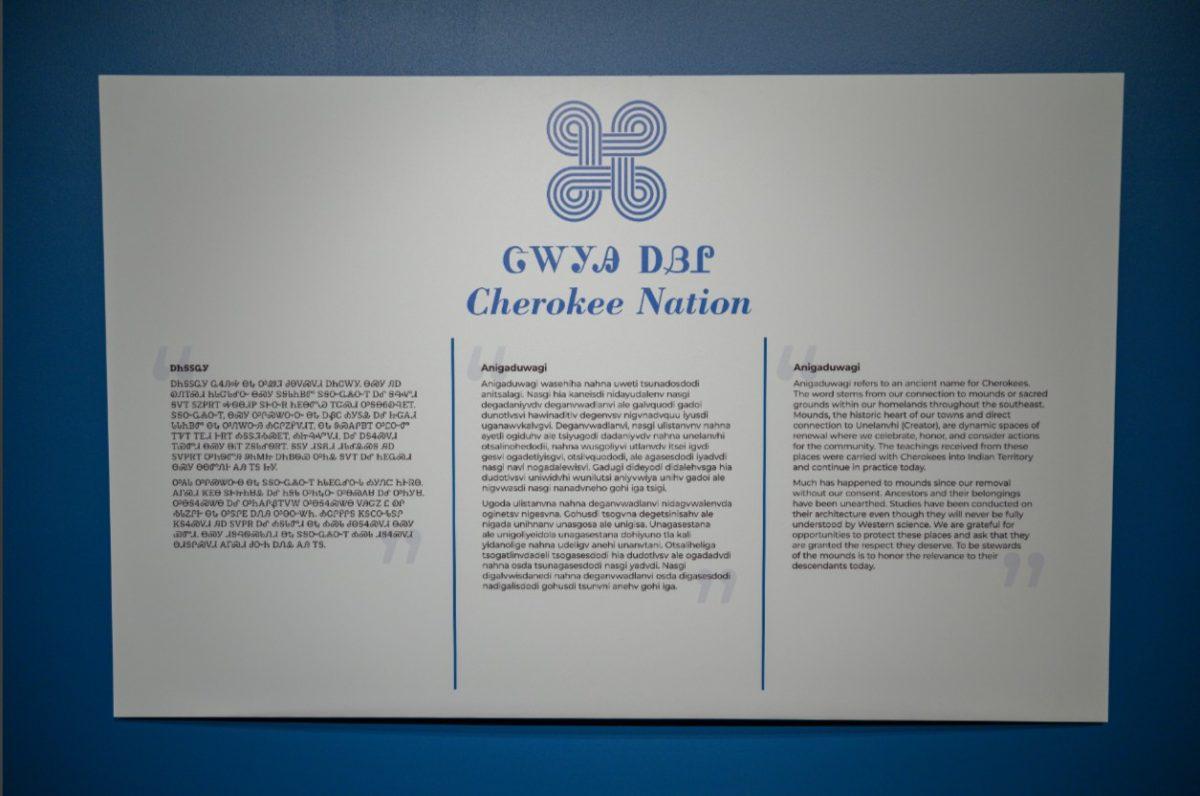
Throughout the exhibit, there are four statements from each tribe’s co-curators, each sporting a different color. Each color was pulled from the tribal seals of each nation, according to King. The statements also feature translations from Indigenous languages. It had been requested early on that Indigenous language be a part of the exhibition. Three of the four nations provided translations on their panels.
“One of the most interesting things we found out is that people don’t understand the connection between Indigenous language and land or why language is so important,” King said.
The creation of this exhibit involved extensive cooperation with Native partners to ensure that each culture was displayed accurately and respectfully.
“We had to ask ourselves, how can we make this exhibit about reciprocity, not just extraction?” King said.
King hopes the exhibit can serve as a resource for students and educators alike.
“One of the reasons that teachers don’t teach more about Native Americans in their classes is because they don’t feel like they have the expertise or resources,” King said.
Accompanied by King on a tour of the exhibit was Sadie Counts, the curator of Indigenous Collections and assistant curator of exhibitions at McClung Museum, and a co-curator of “Homelands.” She discussed the exhibit’s focus on mounds, a significant aspect of Native American culture. She also highlighted that part of the inspiration for the exhibit stems from the existence of a mound located on UT’s campus. Although it is seldom discussed, it is one of the oldest landmarks on campus.
While it was requested that no photos of the mound be included in the exhibition, there are many artistic renderings.
“I think a lot of folks only know about burial mounds and while burial mounds are extremely important sacred sites, there are other forms of mounds,” Counts said. “Mounds are extremely important to Native peoples today because they are literal tangible pieces of their ancestors and the work that their ancestors did in these homelands.”
This exhibition also hopes to raise awareness to the existence of mounds and increase their protection.
“Part of protecting mounds is making sure that contemporary Native Nations are the ones that have access to these mounds and are the ones interpreting them and telling us how to interact with them,” Counts said. “These are descendants of the folks who made these mounds. They should be treated as sacred spaces, just like we might treat any other sacred space from any other culture. Not being disrespectful, not walking on mounds, never digging into mounds, never leaving trash.”
Counts also emphasized that not all mounds may be for the public eye, and that should be respected.
“Allow tribal partners to speak on behalf of themselves,” Counts said. “Respect their sovereignty and allow them to tell you what is and is not appropriate to share.”
The exhibition features art from all contemporary Native American artists, as they aim to emphasize that Native American people and their cultures are not just a historical lesson.
“The main takeaway I want people to get is to understand that Native folks are still here and they’re still connected to their homelands, despite where they may be living now,” Counts said.
“Homelands” will be featured in the McClung Museum until December 2027. The museum is open Tuesday through Saturday from 9 a.m. to 6 p.m. and Sundays from 10 a.m. to 5 p.m. Admission and parking are free. The museum is open to students, faculty and non-UT affiliated parties alike. The museum is also currently working on a digital catalog of “Homelands,” which will be accessible through their website in the future.
For more information, visit the McClung Museum’s website, which features a list of upcoming events hosted by the museum.
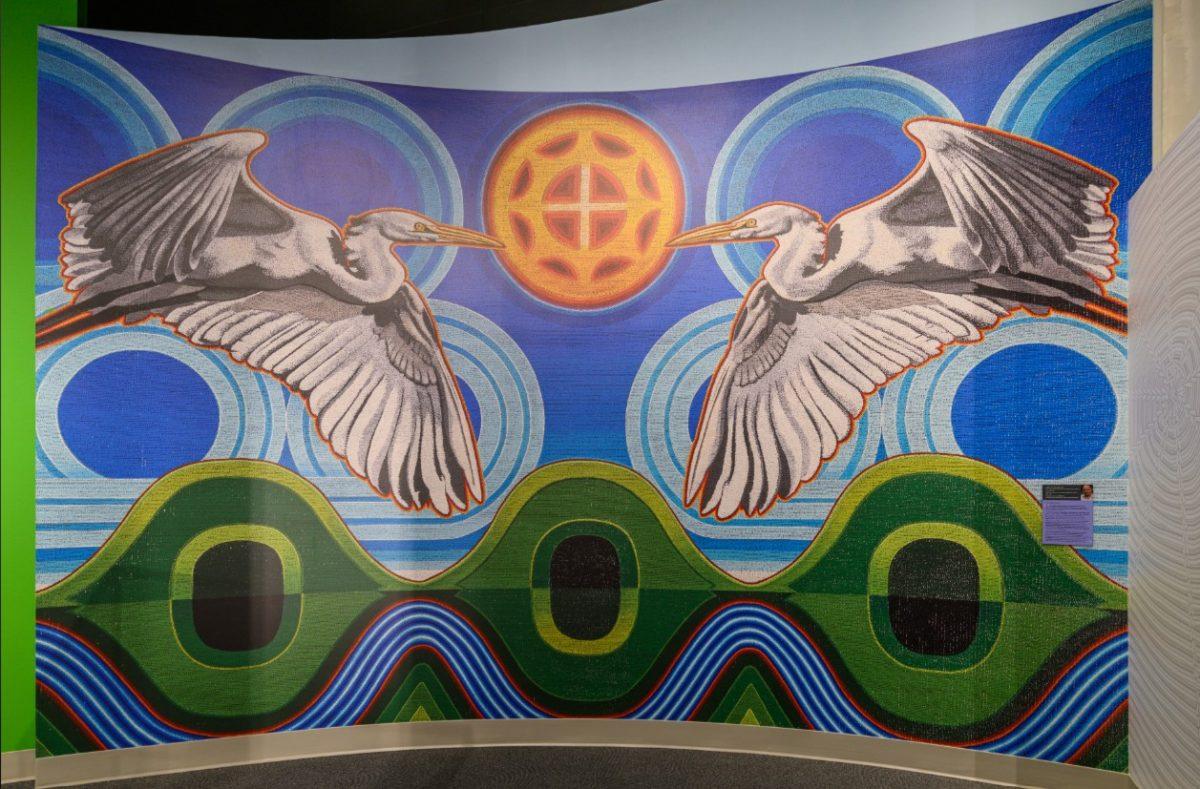
A mural by artist Starr Hardridge of the Muscogee (Creek) Nation. An artistic rendering of pre-Columbian mound sites in Knoxville, depicting the mounds with a river running underneath them.