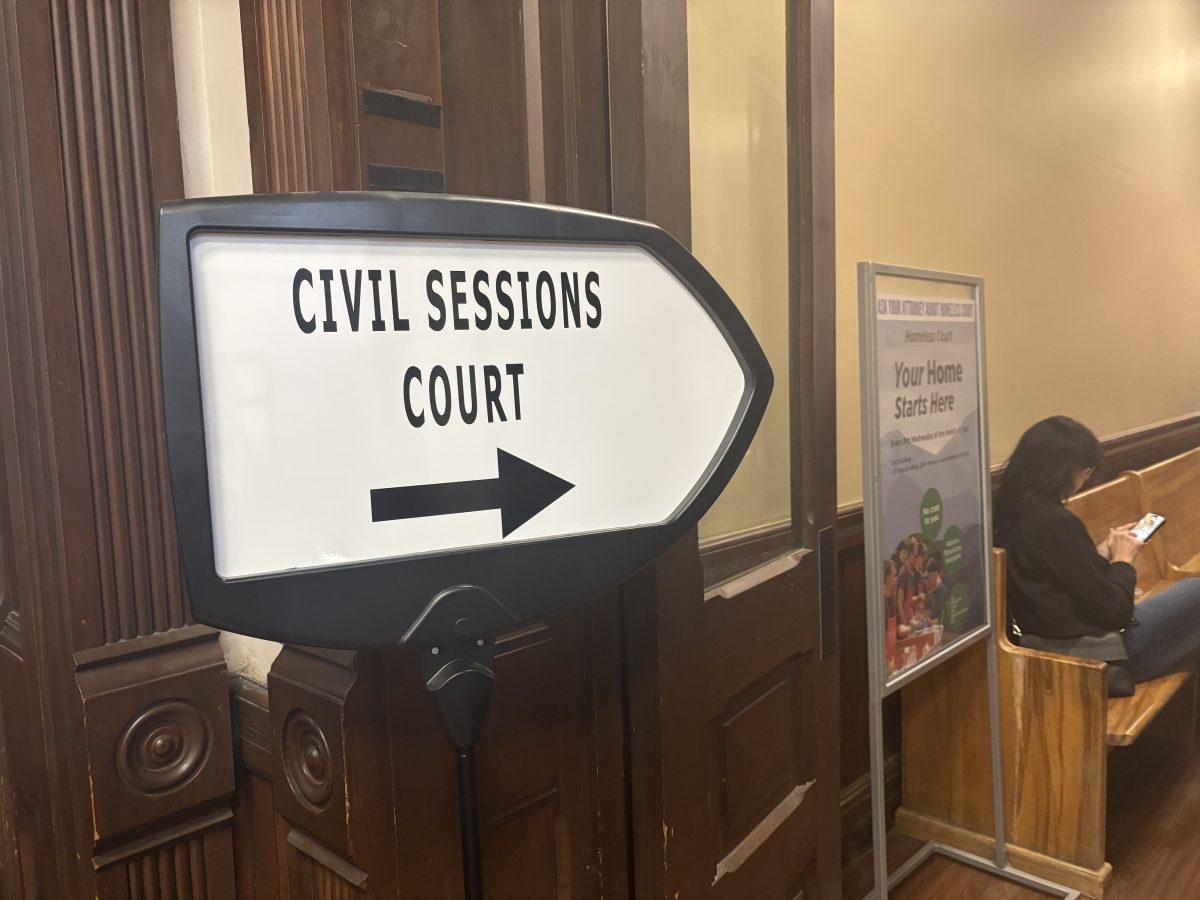
Imagine this — the air is chill and damp as you make your way down Gay Street to the Old Knox County Courthouse for a hearing at 8 a.m. You’ve never been to the courthouse before, but you assume there will be some kind of signage telling you where to go.
When you arrive, however, there are no signs, and you pause momentarily, wondering if you’re in the right place. You open the large, wooden doors of the courthouse and are greeted by security, who pat you down and let you through, motioning that you should go upstairs. As you walk up the old stairs, you can smell the humid outside air seeping in through the skylights, and a roaring drone of chatter begins to fill the upper level.
As you walk through the small holding area outside the courtroom, you make uncomfortable eye contact with strangers sitting on the benches and notice how different everyone looks.
One woman looks no more than 25. Her hair and clothes are neat and tidy. She looks like she just came from the office. The man sitting next to her is old, with a crooked back, a few missing teeth and dirty clothes. A middle-aged gentleman in a suit is crouched next to him, explaining how he can help him.
You take a seat on a cold, hard bench and listen intently through all the echoey chatter for hours, waiting for your name to be called. Time feels as if it’s standing still as you stare at the broken clock on the back wall, and now you have to go to the bathroom.
When you return from the bathroom, you find that your seat has been taken by someone else, and the entire room is at maximum capacity.
It’s now louder than ever, and you decide to see what’s taking the court so long to get to your case.
“I’m sorry, but your name was already called, and since you were a no-show, the case was defaulted,” a woman tells you.
Your heart sinks. When did they call your name? Was it while you were in the bathroom, or did you just not hear it in such a noisy room?
Whatever the case, it matter. Now you’re homeless.
Knoxville has long taken pride in being an affordable place to live. However, the COVID-19 pandemic has dramatically altered its housing landscape. Now, every Tuesday at Knox County General Sessions Court, the wooden benches fill with families, single parents and elderly residents — many unsure why they’re there, while others are wondering what will happen next as they face eviction.
With the increase in remote work post-pandemic, people moved in from more expensive states, such as California and New York, drawn by East Tennessee’s low cost of living and natural beauty.
“They could suddenly work from anywhere,” Solange Muñoz, a professor at the University of Tennessee working with the Appalachian Justice Research Center, said. “And so they came here — but our housing stock didn’t grow to meet the demand.”
In 2022, apartment occupancy in Knoxville reached almost 99%. Prices soared and never returned to pre-pandemic levels. The result? Longtime residents, already living paycheck to paycheck, could no longer afford their rent.
“We weren’t ready for it,” Muñoz said. “And now, can’t make rent in a city where $7.50 is still the minimum wage.”
The Knoxville housing crisis has reached a tipping point after eviction court cases heard on a single day reached an all-time high last month.
Across Knoxville, residents are grappling with a housing market that is becoming increasingly unaffordable. Since 2020, rents have increased by over 56%, far outpacing wage growth, which has risen by only 3.4% during the same period. While inflation has hovered around 20% nationally, the disproportionate rise in local rental costs reveals a deeper structural issue.
One of the most harmful misconceptions about homelessness is that it stems from personal failings like drug addiction or poor decision-making, according to Caroline Grossman, a UT student working with Statewide Organizing for Community eMpowerment.
“That’s just not what we’re seeing,” she said. “These are everyday people — teachers, service workers, parents — who are losing their homes because they can’t afford rent. That’s it.”
Grossman has seen people evicted after falling behind due to bureaucratic delays in housing assistance. In one case, a woman recovering from heart surgery was served her eviction notice while still hospitalized.
“She showed up to court the next day with bandages on her chest,” Grossman told the Beacon. “She was living in a hotel when I last checked in with her.”
Grossman recalled asking the woman if she would consider fighting her eviction further. The woman simply replied, “‘I’m just so tired’ … she told me, ‘ I’m just so tired that I could fight it, and I’d be a richer woman if I did (fight back), but I’m so tired, and I have to work like I have no time … so I’m just gonna leave it alone.’ And that’s what so many people do,” Grossman said.
What researchers like Grossman and Muñoz are finding is that eviction isn’t just a legal issue — it’s an emotional and physical trauma that reverberates through families and communities.
“There’s so much stigma,” said Muñoz. “But when you sit in those courtrooms and talk to people, you realize — it could be any of us. A medical emergency, a job loss, a mistake in the system — that’s all it takes.”
The court system itself adds another layer of trauma to the eviction process. Both Grossman and Muñoz describe eviction court as deeply confusing and disorganized.
“There’s no signage. No one to explain the process. People wait for hours, unsure when their case will be called,” said Muñoz. “If they miss their name — even if they just went to the bathroom — they can get a default judgment against them. Just like that.”
The toll extends far beyond physical conditions. Each week, approximately 150 households in Knox County face the threat of eviction. With limited legal resources available, most tenants navigate the court process on their own — or fail to appear at all, often unaware of their rights and the court process.
Landlords typically come with attorneys, but Legal Aid of East Tennessee is one of the organizations trying to level the playing field.
Through emergency CARES Act funding, LAET was able to hire additional attorneys to represent tenants in court — often preventing evictions from being recorded on their permanent records.
However, that funding will run out by the end of May unless the Knoxville City Council reallocates it.
“Without that money, they’ll go from multiple attorneys back down to two,” Grossman said. “… Handling hundreds of cases every week — it’s just not sustainable.”
As budget hearings continue at Knoxville City Council, the future of eviction prevention efforts hangs in the balance. Advocates are urging council members to keep the program alive by allocating new funds — but the response has been mixed.
Councilwoman Gwen McKenzie and Vice Mayor Tommy Smith have shown interest in expanding support, according to Grossman. However, other officials, including Councilwoman Amelia Parker, are pushing for more direct investment in those already experiencing homelessness.
Grossman agrees the city needs a comprehensive approach — but also believes eviction prevention is a critical first step.
“So it just goes to show that this is a larger issue that we have,” Grossman said. “A lack of funding in a lot of places, and maybe a lack of organization in some places because they’re so stretched thin. They’re trying to do so many things and handle so many cases that some cases slip through their cracks.”
Evictions account for at least 21% of homelessness in Knox County, and the housing crisis in Knoxville reflects a broader issue — a system that is overstretched, failing to meet the needs of its most vulnerable residents.
The downstream effects are devastating, according to a public forum in the Knoxville Civic Auditorium on Tuesday, April 8. Here, the community action group Justice Knox gathered to ask both the City and County Mayors, Indya Kincannon and Glenn Jacobs, to agree to specific requests to improve the lives of community members who find themselves living on the margins — including those who face eviction.
Mayor Jacobs has promised to help preserve portions of the critical support provided by the Eviction Prevention Program in Knoxville and provide $300,000 of funding over the coming fiscal year.
“We have identified a revenue source. As long as that remains intact, we will do that,” Jacobs said.
In 2024, 72% of people who entered homelessness in Knoxville did so because of job loss, eviction or the inability to find affordable housing. Last year, over 5,000 individuals accessed homeless services for the first time. For many, it will take over a year to find stable housing again, according to Justice Knox.
As city leaders prepare to finalize their budget, advocates hope that a spotlight on the eviction crisis will translate into real investment — not just in affordable housing, but in the tools needed to keep people housed in the first place.
For Knoxville’s renters, time is running out.
“For people who are working good jobs, it’s still not enough,” Emily Cala, a LAET attorney, said. “If your rent jumps 50%, there’s no way your boss is going to give you a raise to match that. Meanwhile, wages have only increased about 3% in the same time period.”
The situation is especially dire for low-income workers. A person earning $10 per hour, working full-time, brings home approximately $1,600 per month. With the average rent in Knoxville hovering between $1,200 and $1,500, many end up spending more than half their income on rent alone, leaving little for food, transportation or medical care.
As of 2024, more than 50% of East Tennessee renters spend over 30% of their income on housing, exceeding the threshold set by the United States Department of Housing and Urban Development for being “cost-burdened.”
Knoxville’s housing market has become what advocates describe as “extremely high demand, low supply,” particularly for affordable rentals. For those priced out of the standard market — where landlords require background checks, income verification and good credit — the only remaining option may be substandard housing with few protections.
“Landlords in the informal rental market often skip inspections and won’t respond to maintenance requests,” Michael Davis, LAET’s managing attorney, said. “We regularly see units with extreme mold, structural damage, bed bugs, pests and no heat or air. It’s not just a housing problem — it’s a public health crisis.”
Lizzie Sherlin, a UT student researcher working with SOCM, recalled sitting beside a woman in eviction court still wearing her University of Tennessee catering uniform.
“She had to go to work after court. That’s the reality for many of our clients — teachers, nurses, hourly workers — people doing their best, still on the edge,” Sherlin said.
While emergency rental assistance programs funded by the American Rescue Plan helped thousands avoid eviction by paying up to 18 months of rent arrears, those programs are drying up as the federal funds they received since 2020 are expected to expire by mid-2025 with no guaranteed renewal.
These marks make securing future housing nearly impossible, even when tenants do everything else right, according to Cala.
In response to the worsening crisis, the EPP was created, fueled by nearly $50 million in federal COVID-19 relief funds. Between 2020 and 2024, the EPP assisted more than 14,000 households in avoiding eviction by providing emergency rental assistance, which often covered up to 18 months of back rent.
Yet, this critical program is also now set to expire due to dwindling funds and a lack of current plans for renewal.
“Once that program ends, we expect a huge surge in people who previously didn’t need legal aid because they had access to rental assistance,” Cala said. “We’re already stretched thin. Right now, it’s just three of us on the eviction prevention team.”
Before the staffing cuts, the team consisted of five attorneys and three paralegals. Now, Cala and Davis, along with one paralegal, handle most of the eviction defense in Knox County. Case reviews happen weekly — and each week, they turn away as many as 20% of applicants due to lack of capacity.
In a 12-month period, LAET helped 91% of its clients avoid a permanent eviction judgment, showing the tangible impact of legal support. Yet, with limited resources, their capacity to respond is shrinking at a time when it’s needed most.
“Eviction is often the first domino to fall,” Cala said. “If someone loses their housing, it affects their job, their health, their kids’ schooling. And once you have that eviction on your record, it’s incredibly hard to find new housing.”
According to the forum, more than 5,000 Knoxville households are on waiting lists for public housing or Section 8 vouchers offered by Knoxville Community Development Corporation. With this growing number, wait times for these subsidies can stretch into years.
With out-of-state investors buying up once-affordable properties, raising rents and skipping essential maintenance, tenants face a choice — leave town, go homeless or accept dangerous living conditions.
City and county officials have begun planning long-term solutions, including a five-year strategic plan through the newly created Office of Housing Stability. Advocates hope the city will move toward “functional zero” — a standard where homelessness is rare, brief and immediately addressed.
But reaching that goal requires more than vision. It requires sustained funding for eviction prevention, legal services and the construction of affordable housing.
For now, LAET attorneys continue to do what they can — offering more than just legal defenses, often connecting clients with local ministries, shelters or immigrant resource centers.
“These aren’t typical legal duties,” Davis said. “It’s part social work, part legal defense, but that’s what’s needed. If we had more staff, if we could hire a dedicated social worker, there’s so much more we could do.”
Experts and advocates agree that Knoxville needs more affordable housing units, enhanced eviction diversion efforts, and ongoing legal and social support systems to prevent families from falling into homelessness.
“Housing touches everything,” Davis said. “Without it, work, health, education and stability collapse. It’s not just a roof over your head — it’s the foundation of a functional, dignified life.”
Currently, the City Council is conducting its budget hearings, with the final budget set to be released on April 25. Read the Beacon’s previous article on Knoxville’s housing crisis, for more background information.
Keep following Shelby Wright, Editor-in-Chief, at utdailybeacon.com for updates on this story.