The journey to Top 25 glory just got a little longer.
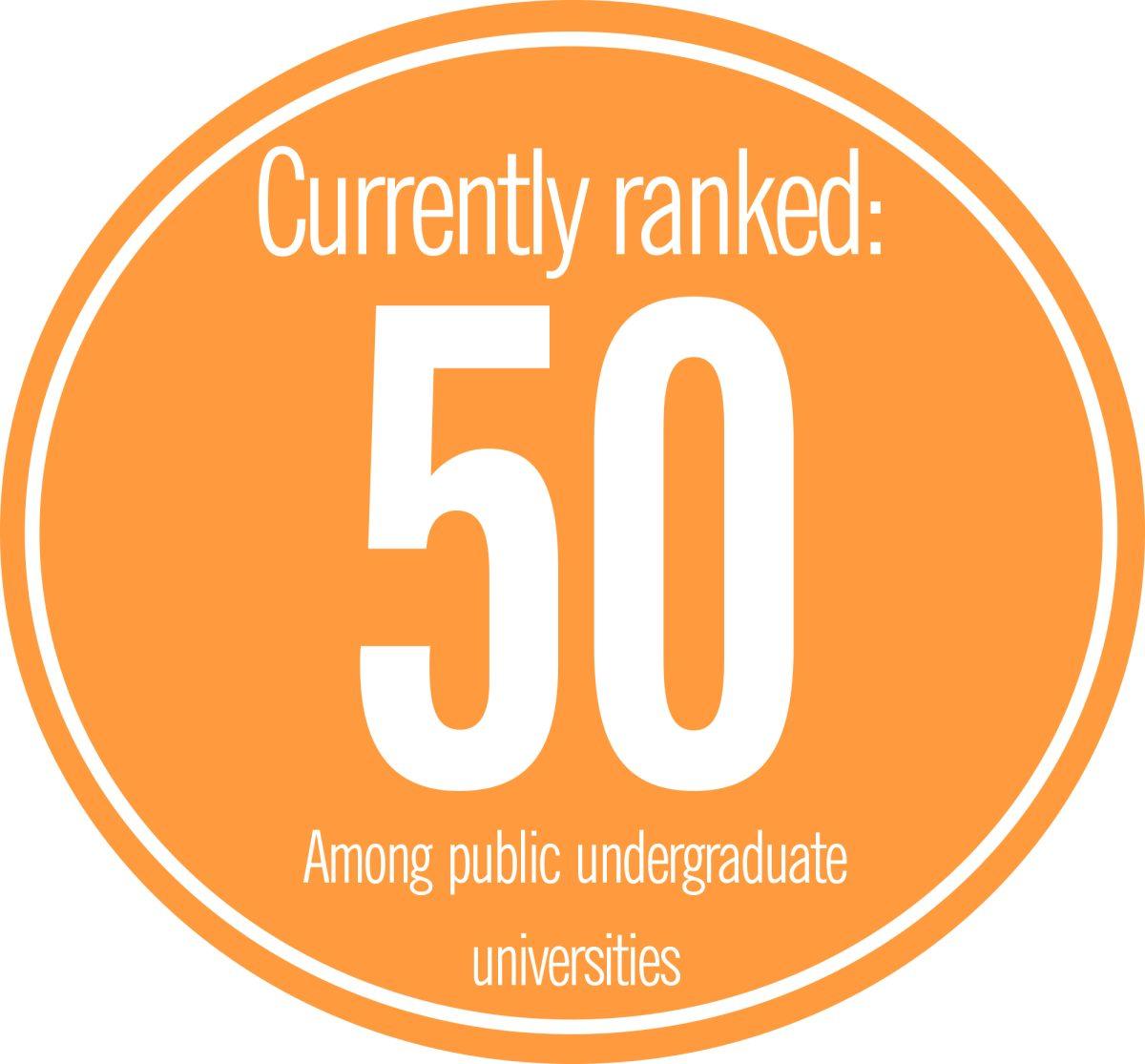
On Sept. 9, the U.S. News and World Report magazine released their annual “Best Colleges” report, on which UT ranked 50 among public universities and 106 in the nation.
Although UT ranked 47 among public universities and 101 nationally last year, specific programs demonstrated notable progress. UT’s College of Engineering now ranks 32 among public universities, a vast improvement from 57. In addition, the College of Business Administration’s supply chain management program now ranks third for public universities and fourth nationally.
“I look at our overall journey as the most important thing that we are concentrating on,” Chancellor Jimmy Cheek said. “We have a very ambitious goal to be a Top 25 research university, and in every metric we measure on this campus, we are making significant, positive progress.”
Margie Nichols, vice chancellor for communications, credits the rise in ranking for the College of Engineering and the College of Business Administration to the fact that deans for the interdisciplinary colleges rank each other, giving them a fair assessment.
“(Deans) know more about each other’s colleges than say a chancellor or president or a provost knows about the whole university,” Nichols said. “With supply chain management, there aren’t that many programs, so it’s not like there are thousands like there are universities.”
The report reflected UT’s efforts to raise freshman retention rate and graduation rate. However, UT received a low peer assessment score – only 3.1 out of 5.0.
One factor in the overall rank of a university is their “reputation ranking,” a score determined by a peer voting system including the chancellor or president, provost and admissions director at universities around the country.
“It’s very hard to change people’s opinions of an institution,” Cheek said. “We are working very hard at it, but it’s one thing that we’ve got to do a better job in marketing and branding ourselves.”
Nichols expressed concerns that the method for determining the peer assessment score can be subjective.
“If you’re at Montana State, you may not know anything about the University of Tennessee, just like we may not know very much about Montana State,” Nichols said. “Then, when the chancellor votes on it, how is he going to vote if he doesn’t know if they’re good or bad?”
UT is not the only public university that fell in rank this year. From the national rankings, the University of Wisconsin fell six spots, Pennsylvania State University fell 11 spots, Michigan State University fell 12 and Auburn University fell 12. Nichols mentioned that there may be a national trend in decreased public university rankings possibly related to states across the U.S.’ recent budget cuts for higher education and public universities.
“There is a shifting particularly of this group,” Cheek said, referencing the six public universities that tied with UT, such as the University of Kansas, the University of Oklahoma and the University of Oregon.
For Cheek, the overall ranking does not diminish his goal to become a Top 25 institution or the initiatives taking place on campus. The report placed UT at rank 24 nationally among colleges providing the best support for veterans returning to school and the undergraduate business program ranked at 31 among public universities and 51 nationally.
Cheek also cites the 9 percent increase in graduation rate, the 3 percent increase in retention rate, increased salaries for faculty and staff, progress in research and the relationships built with the Oak Ridge National Laboratory. He said UT has made these changes more rapidly than any other institution ever before.
“We are on the right path, we are making excellent progress and it’s going to take a while until that’s reflected in the rankings.”