Mayor Madeline Rogero was once heralded as a ‘road warrior.’
It was 1994 and she was driving home to change clothes for the following hours of door-to-door campaigning for Knox County commission re-election. She noticed that the woman in front of her was driving recklessly. Without a cell phone, Rogero had to wait for the right moment to box the woman in with her car, preventing her from driving any further.
The story was picked up by the local news outlets and gave Rogero a ready answer to her opponent’s question, “What has Commissioner Rogero done for you recently?”
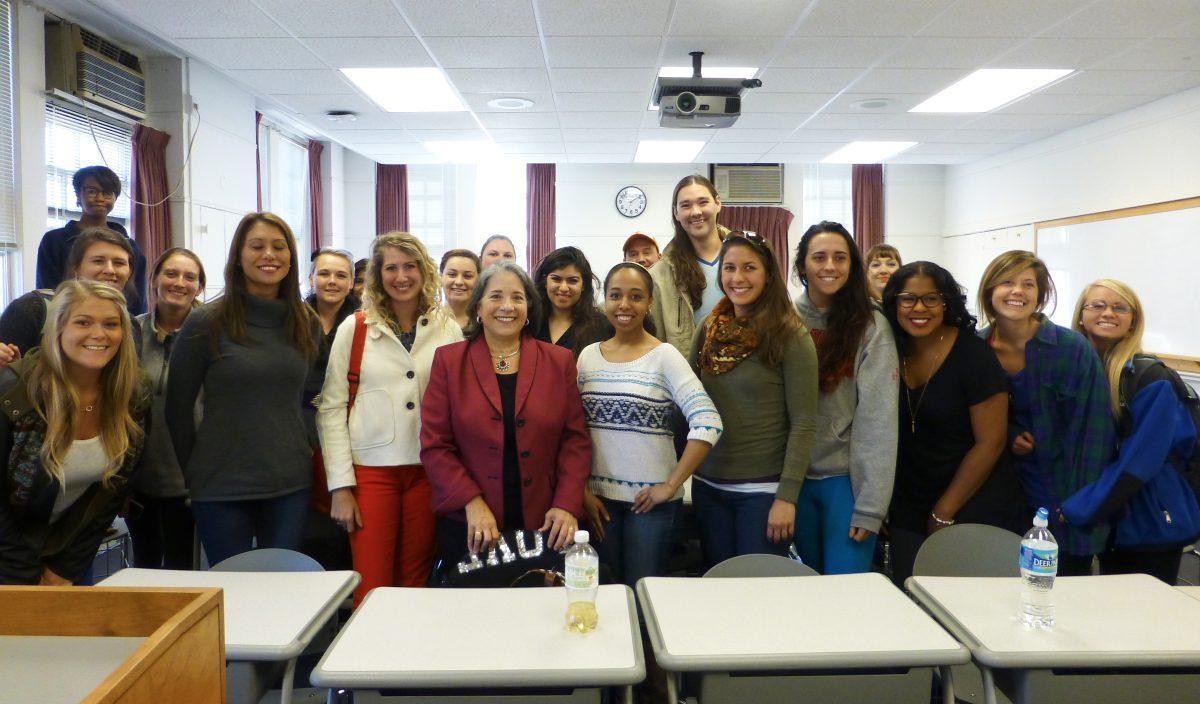
“I said, well, I saved your life,” Rogero told a group of more than twenty students in the Women’s Studies 340 class she visited last Thursday.
Students in the “Women, Politics and the Law” class, taught by Rebecca Klenk, were given the opportunity to hear about Rogero’s personal experiences and challenges as a prominent woman in Tennessee politics.
“Mayor Rogero’s journey to political office is truly inspirational,” Klenk said. “She has consistently greeted the twists and turns of politics and life with energetic perseverance, creativity and verve. And, as a leader, she is committed to finding common ground.”
Born in Jacksonville, Fla., Rogero took a circuitous path to her current position as mayor. After graduating from Furman University with a degree in political science in 1979, Rogero worked with César Chávez’s United Farm Workers, a labor union advocating for better wages and conditions for migrant farm workers.
In 1980, she moved to Knoxville and attended graduate school at UT. She obtained a master’s degree in urban planning and immediately started working with community-based organizations, addressing issues related to sustainability, housing and social justice.
When it was suggested that she run against 24-year incumbent Jesse Cawood for a seat on the Knox County commission, Rogero was skeptical.
“My first reaction was I’m not sure I’m qualified,” Rogero admitted. “But they said ‘oh, no, look into it and you’ll see you’re very qualified.’”
Challenging an incumbent came with certain disadvantages, Rogero said, but noted they often worked in her favor during the campaign. Rogero attended every community event she could, while her opponent felt less pressure to show up. She opened a campaign office, knocked on doors and reached out to contacts in the five Roladexes she had built up over her decade of community involvement. She raised about $6,800, a “fortune back then.”
It was obvious to Rogero that her opponent did not take her seriously. He often introduced her as his “purdy” challenger.
“So what do you think I did?” Rogero asked the class. “I smiled as pretty as I could. I thought as long as he thought I was this pretty little girl, he wouldn’t really do much to oppose me. And that’s what happened.”
In the end, Rogero won by a “landslide.”
“My opponent was quoted as saying, ‘Well, we just don’t know what happened,’” Rogero said, inducing laughter from the class.
Since then, people have stopped taking Rogero for granted, she said. When she ran for city mayor in 2003, she lost to now-Governor Bill Haslam by six percentage points. Rogero said the attitude toward female politicians in Knoxville shifted after that election, and a woman mayor no longer seemed improbable.
Rogero, who is running for re-election in 2015, said she is proud to have been the first female mayor in Knoxville and the first woman to hold that office in any of the “Big Four” Tennessee cities. However, that’s not what she wants people to focus on.
“Don’t vote for me because I’m a woman,” she said. “Vote for me because I know the job, because I have a vision that you believe in.”
Since her inauguration in 2011, that “vision” has included revitalizing Knoxville’s infrastructure and downtown area, supporting local businesses, focusing on the city’s environmental-friendliness and increasing the legal rights of same-sex partners.
“I’ve really tried to balance the neighborhood interests, the business interests, the environmental interests – all that,” Rogero said. “It’s all a balancing act, and the more you bring people together and move them along together the more successful you’ll be.”
Rogero, who has made progress for gay rights on the municipal level, said she hopes to be able to officiate a same-sex marriage during her tenure as city mayor.
“I’m not afraid of taking on controversial issues, but I do pick my battles,” she said.
Currently, one woman serves on the 11-member Knox County Commission and one woman is on the nine-member City Council. Rogero attributed this absence of female representation, in part, to a lack of women running for election, not a lack of success by female politicians.
“Times have changed, and women really do have a great opportunity,” Rogero said. “If you do your homework, you run a good campaign and you present yourself well, you have a good chance of winning.”
Often, Rogero explained, qualified women decide not to run for political office because they dread facing the public exposure and criticism that can come with campaigning. Rogero, who often avoids the negative comments on blog posts, advises women to focus on the issues that matter. When people criticized her hair and clothes, instead of her political platform, Rogero reacted with a humorous attitude, joking that they should create a game called “Dress Madeline Rogero.”
“If you want to make a difference in your community, you have to toughen up,” said Rogero, who is now 62 years old. “You have to be prepared to take the criticism and to learn to not let it slow you down.”
Headway still needs to be made for women in Tennessee politics, Rogero told the class of young women and, as she called them, “enlightened men.” She pointed out that the state has not seen a female governor or U.S. senator and gave encouragement to those in the room who might have political aspirations.
“Unfortunately there are a lot of ‘firsts’ that need to be done,” she said. “But it is possible today.”