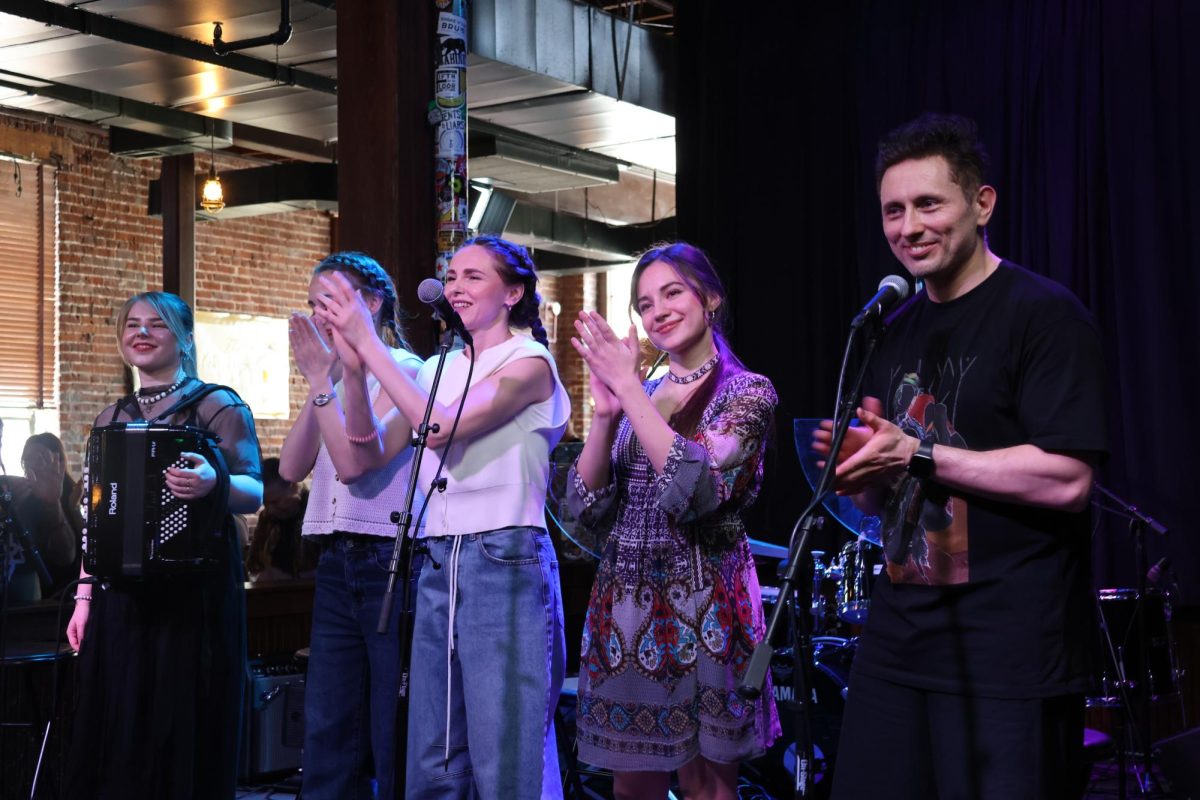
Alternatively described as indie pop and psych folk, Local Natives brought their fresh, harmony-driven jams to Shaky Knees Music Fest Sunday night. The California-based quintet’s star power is irrefutably on the rise despite a surprisingly lean discography consisting of only two albums. Culminating their most recent tour (which included a sold-out April performance at the Bijou Theatre) at Shaky Knees, the band will soon embark on recording a highly anticipated third album. Ryan Hahn and Taylor Rice, both vocalists and guitarists for the multi-talented group, gave insight into the new record, touring and more in a Daily Beacon exclusive.
Daily Beacon: You are two of the three band members who met in high school, correct?
Ryan Hahn: We met in junior high, actually.
Taylor Rice: It’s too complicated to give the whole layout, so we just say we met in high school.
RH: Like, Kelcey (Ayer) went to another high school, so you just don’t even want to get into all that.
TR: Ryan and I met the first class of the first day of 7th grade. We sat next to each other in science class.
 DB: What was the first thing that bonded you?
RH: We had to make a bridge made out of paper and stack pennies on it to see who could build the strongest bridge. I don’t think we did very well.
TR: I think we did alright. We weren’t the very best, but we were near there.
DB: That’s commendable. As a band, what are some of the advantages and disadvantages that stem from having roots that go back that far in terms of creative development? Do you feel like you all naturally tend to be on the same page or do you have to put effort toward that?

TR: Our musical identities are so fused together. We’ve been playing music since we were kids together, so I’m sure if you look at it from a broader perspective, we’re very attuned musically. But when we’re in the midst of songwriting, like right now as we’re working on a new record, we’re like, ‘What’s the direction of this? Where do we want to push this song?’ Those discussions can become heated, to say the least. Very passionate debates.
DB: In regards to your new album, ‘Hummingbird’ was a little heavier in nature because of the environment in which it was formed and those experiences, but where are you all going with this third album? Will it still retain that darker sound or what are you guys foreseeing?
RH: I definitely don’t think it’s going to be the same as either record. It’s going to be an amalgamation of all these things we’ve learned over the last few years, all the different influences… It’s tough to say what exactly it’s going to be because, like you said, we’re still kind of forming it. But it’s just going to be different, I think. We have a lot of new ideas in the mix.
TR: And I feel with ‘Hummingbird’, we didn’t have a really unified direction for an idea of what the record would be in that it is a very cathartic record for us. I feel it was sort of moving through things, and I feel that is cathartically sort of out of us. The space we’re in now, it’s not so much that we’re just dealing with pain.
RH: It’s kind of like we came out the other side. Now things are a lot clearer.
DB: When it comes to Shaky Knees, you all have toured with Edward Sharpe and spent a lot of time with Aaron Dessner (of The National), living with him as he produced ‘Hummingbird’. What’s it like to be playing a festival with a lot of these artists who have cropped up throughout your career?

TR: It’s awesome. Sadly we didn’t get to hang out with The National, they were just here Friday. But it’s still cool to be able to have friends on tour. It’s a very weird life that we lead, kind of far less glamorous than people would probably suppose, and the cool thing about it is having friends you meet up with at a festival.
DB: What are some of the unglamorous elements of your touring lifestyle?
TR: Oh, we’re not going to tell you that. That would spoil all the fun. We like you to suppose that it’s more glamorous than it is. If you can imagine living, for example, on a bus with 12 people where everyone kind of has their tiny space, it’s sort of insane living quarters. No one really lives that way in the real world, even in the craziest renting situation. Nobody lives that many people per square feet.
RH: And spending that amount of time with people, both working and hanging out. No one sleeps really at all, so you’re just kind of sleep deprived for, like, weeks on end. That’s probably the hardest part, I guess.
DB: I’m picturing the smallest college dorm ever on wheels.
TR: Except we’re all adults.
RH: Or more like grown-up children.
TR: I think it is more like grown children.
DB: But other than that, it’s all very luxurious, right?
RH: It’s the coolest thing in the world that our job is to play music and we get to write and share it with people.
TR: We do love touring; we tour a lot. We wouldn’t trade it for anything. It’s just that people think it’s way easier than it is.
DB: For a lot of West Coast bands, there seems to be this idea that they have to fulfill some kind of authentic West Coast sound. Do you feel you do get a lot of inspiration from your geographic, external surroundings, or is the inspiration more of an internal, emotional process?
RH: It’s funny because I don’t think we thought about that at all until we made our first record and people started asking us that question. I think it just kind of slipped in subconsciously. Like, we have lyrics about sitting in traffic, and that’s just something that really doesn’t happen as much in other parts of the world more so than L.A.
TR: Apparently Atlanta actually has insane traffic, like some of the worst in the country.
RH: Really? Then I guess Atlanta people can relate. But also, just being able to see the sun and have that positive influence, especially when we made our first record– yeah, I think it definitely came in the mix.
TR: I very much agree. I think our lifestyle in Southern California, especially now that we’ve travelled a lot more and seen other parts of the country, actually has a pretty big effect on just how we feel about life, and I think that goes into the music.