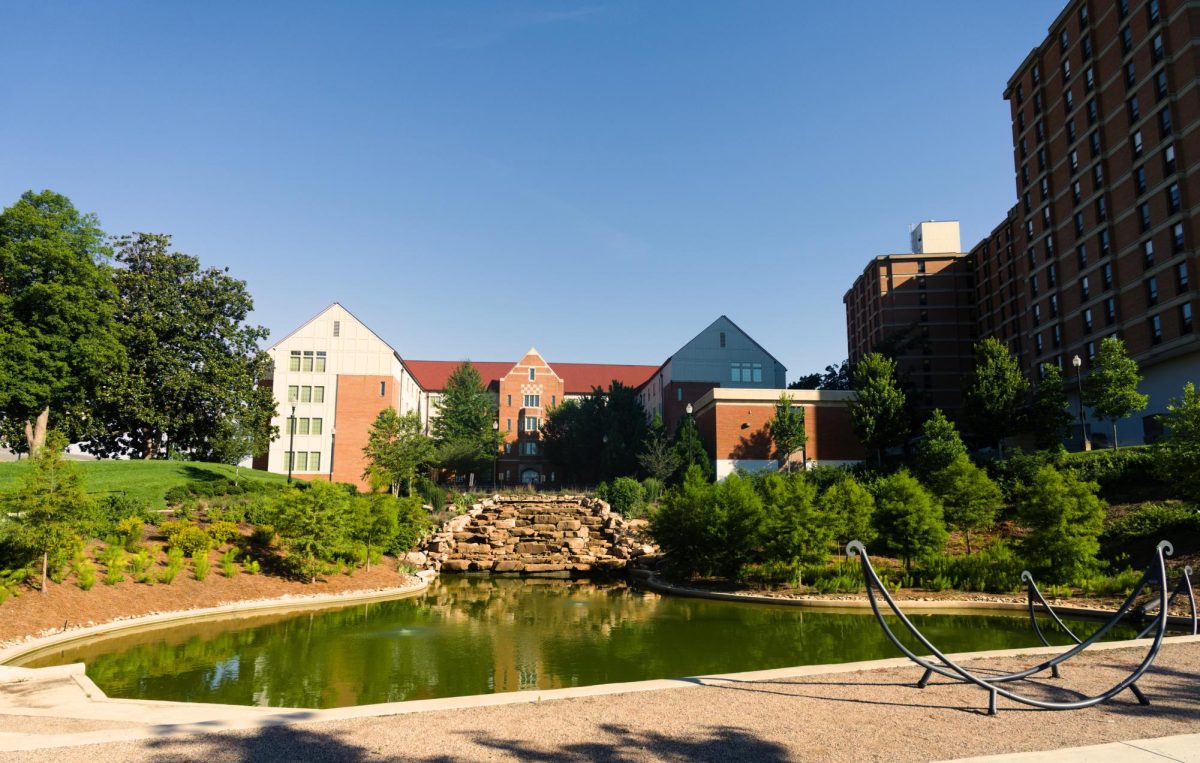
Rabbits spring from tufts of tall grasses as water cascades, filling the basin beneath it. People mill about, gazing intently at the rushing waterfall.
While this may sound like a woodland paradise, it’s really the regional stormwater storage facility at the University of Tennessee.
Located in front of Robinson hall, this oasis from the monotonous concrete buildings and sidewalks not only provides a great study spot for students, but also aids the campus in managing stormwater runoff, flood control and plant irrigation.
University sustainability initiatives
Urban development drastically impacts how rainwater runoff moves through the landscape. Due to UT’s expansion, investing in sustainable infrastructure has become a growing priority.
As of 2015, all campus redevelopment projects greater than one acre are required to adhere to the university’s runoff reduction policy, which states that the “first inch of rainfall must be 100% managed with no Stormwater runoff being discharged to surface waters.” So, when it rains less than an inch, nothing will be contributed into the storm system.
Irrigation and wildlife
The idea for the pond and waterfall was dreamt up in 2016 by UT stormwater manager Garrett Ferry and was originally designed to sit where Boyd Hall is being constructed.
Completed in 2024, the pond can hold around 155,000 gallons of water with an additional 60,000 gallon detention area underground, but can flood up the amphitheater outside the pond up to 380,000 gallons.
The water system extends further than just the boundaries of the storage facility. Runoff is collected from Rocky Top dining hall, Carrick Hall, Presidential Court and nearby walkways and is recycled to irrigate a large region of campus.
“When it rains a lot, that pond is too full, so we pump water in front of Brown Hall into the dry riverbed,” Ferry said. “Some infiltrates into the ground, and some makes its way back to the detention vault and gets pumped back into the pond, so we have this giant water cycle happening.”
The water is collected and filtered with ultraviolet light to eliminate bacteria every 24 hours. It is then used to irrigate landscaping and nearby vegetation, creating a habitat for a variety of native wildlife species.
Sightings of rabbits, geese, ospreys and even a bald eagle have been reported. Non-native triploid grass carp were added by the stormwater management team to control algal blooms in warmer months.
Green spaces and student life
As Knoxville’s campus has become urbanized, natural areas are heavily sought after for their relief from the bustling city.
Findings from the World Health Organization indicate beneficial mental health outcomes associated with time spent in green and blue spaces. Green spaces are areas filled with plants and vegetation, while blue spaces are those with visible water features.
The stormwater retention pond combines both into a place of refuge, where students can enjoy the tranquil sounds of a waterfall and observe wildlife.
Callie Hudson, a junior studying food and agricultural business and agricultural leadership, shared what she loved about the space.
“I think it’s a great place to study and to just kind of get outside, hear the water rather than the noise of campus,” Hudson said. “It’s a great place to just go hang out, read a book, study, do whatever you need to do.”
Complete with hammock stands, tables and seating areas, the regional stormwater retention facility enhances the student experience but also plays a vital role in the university’s sustainability endeavors.
“The bigger story to what we’re doing on campus is providing not only an aesthetically pleasing thing to look at and accomplishing an infrastructure need,” Will Luke, stormwater coordinator for UT said, “but it is giving a little bit of relief to what is an urban campus.”
Outreach efforts
Given the magnitude of this innovation, it is critical to inform the public on the importance of this infrastructure.
Calli Crawford worked as a sustainability intern on the stormwater pond for the past year, focusing on education and outreach.
“One of our projects involved creating educational sidewalk stickers around the pond. The stickers explain some of the environmental benefits and help connect students to sustainability projects happening on campus,” Crawford said. “We wanted to help students understand what the pond is actually used for, since a lot of people walk by it every day without realizing it’s more than just a decorative water feature.”
The facility provides real-world applications to major programs at the university, as it combines various fields ranging from environmental sciences, engineering, natural resources and construction.
Hudson said, “Being able to see what we’re studying in our classes in the School of Natural Resources translated into main campus and into real life stormwater management is really important for students to know, not just agriculture students, but everybody.”
Looking ahead
With the success of the stormwater pond and waterfall, there may be new opportunities for green infrastructure on campus.
Ferry said, “We hope to replicate this type of system elsewhere, because it seems to be very beneficial.”
Examples of ecologically conscious designs can be found all around campus from green roofs to rainwater recycling in university housing. According to facilities services, the new student success center will also feature a green roof.
“(Office of Sustainability) are constantly looking at improvements in ways that they can further our stewardship at this campus,” Sam Ledford, communications manager at UT facilities services said, “not just for the students that are here now, but for the students in the future, and for the entire state of Tennessee.”
This redevelopment project is a shining example of how sustainab ility can add vibrancy and joy to daily life.