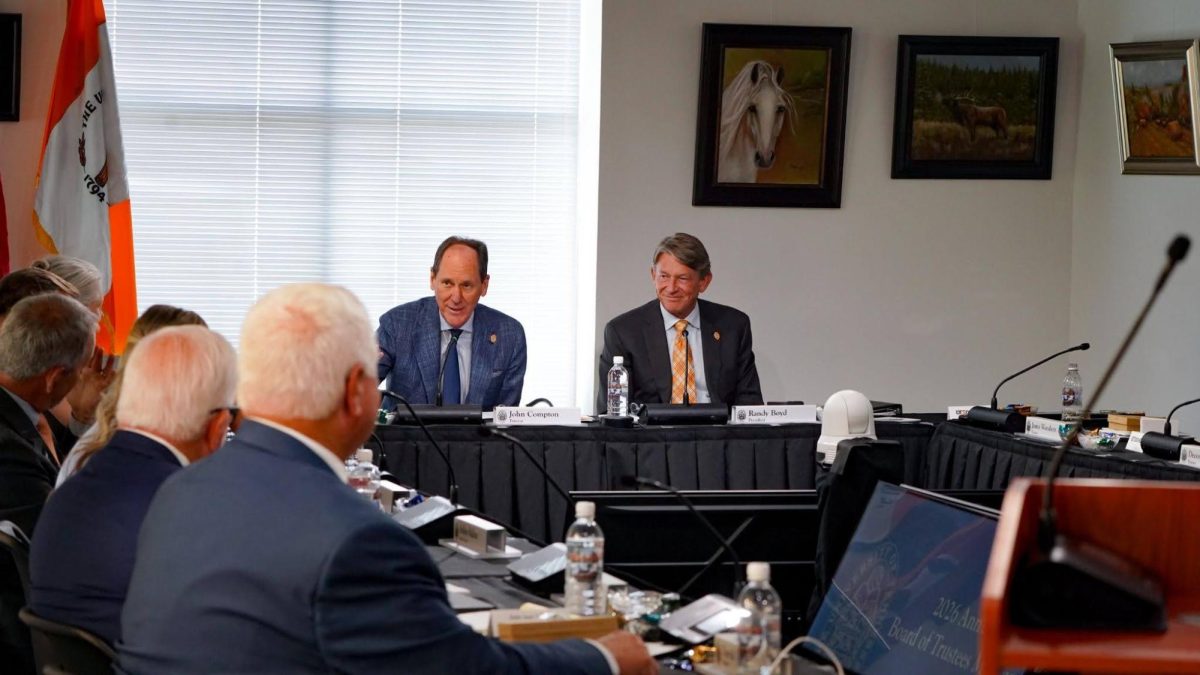
UT faculty and staff gathered in McClung Tower Thursday afternoon to attend the English Department’s first academic lecture of the year.
The lecture was presented by Professor Brian McHale of Ohio Sate University and was titled “‘Things then did not delay in turning curious’: Some Versions of Alice, 1966-2011.” A professor of humanities at Ohio State, McHale has traveled across the United States and around the world — including Germany and Singapore — delivering his presentation, which speaks about the cultural resonance of “Alice in Wonderland.”
McHale is the author of more than 50 articles and chapters in which he discusses the transformation of narratology and its influence on today’s society. McHale was also the first speaker in the English Department’s Literature and Textual Studies series.
In his presentation, McHale introduced various books, films and television shows dating back to 1966 that either alluded to the “Alice in Wonderland” story or created entirely different versions of the timeless classic. McHale also discussed the different types of personas Alice has taken on over the past 45 years and analyzed how they have influenced our interpretations of the original novel written in 1865 by Charles Lutwidge Dodson under his pseudonym Lewis Carroll.
“There has been a turn of Alice since the middle of the 1960s; it’s diversity,” McHale said. “Before 1966, versions (of ‘Alice in Wonderland’) stuck to the original version; after 1966, versions engaged with at least one previous version. Alice goes viral after 1966.”
McHale noted how in each new version of Alice, her character advances in age, and the levels of plot and narration also become more deep and more intricate. He also demonstrated how “Alice in Wonderland” has become highly marketable in the past 40 years because of its ability to transcend across a wide range of cultural levels. McHale then continued with his analysis of Alice as a symbol of post-modernism because of the types of narrative transformations she has undergone throughout the years — most of which are characteristic of post-modern traits.
“Post-modernist Alice is post-modernism in a nutshell,” McHale said.
Around 40 people attended the lecture, including Associate Professor in English Amy Elias.
“I think it was a fantastic turnout,” she said. “I’m glad to have some Alice enthusiasts, and I’m glad some came out (to attend the lecture).”
The English Department sponsors three specific Speakers Series every year, including the Literature and Textual Studies Series of which Professor McHale was a part. The Speaker Series Committee selects esteemed speakers to present each year, generally trying to choose individuals who can present lectures tied to specific historical periods. The committee selects a speaker by asking for departmental suggestions and evaluating the nominations until a final decision is reached.
“I thought it was an excellent turnout (for the lecture),” McHale said.
McHale commented on why he chose to focus so comprehensively on Alice and her story.
“I’m not sure why I chose her,” McHale said. “I think she chose me. (The different variations and interpretations of Alice) was a side issue I noticed.”
McHale also touched upon Alice’s double receptions by both adults and children alike, noting how her story is able to transcend various levels and genres of fiction and film.
“I really enjoyed it,” Kimberly Lynch, junior in English, said after the lecture. “I love ‘Alice in Wonderland.’ (The lecture) was fascinating, and the approach he took was unexpected. Tying together all of the different versions (of Alice) shows how prevalent she has been in culture.”
The English Deparment will continue to hold academic lectures throughout the 2011-2012 academic year. The next lectures within the Literature and Textual Studies Series will occur in the Spring Semester. This series includes guest speakers professor Joseph Roach of Yale University, professor Marjorie Levinson of the University of Michigan, and professor Richard Rambuss of Brown University.