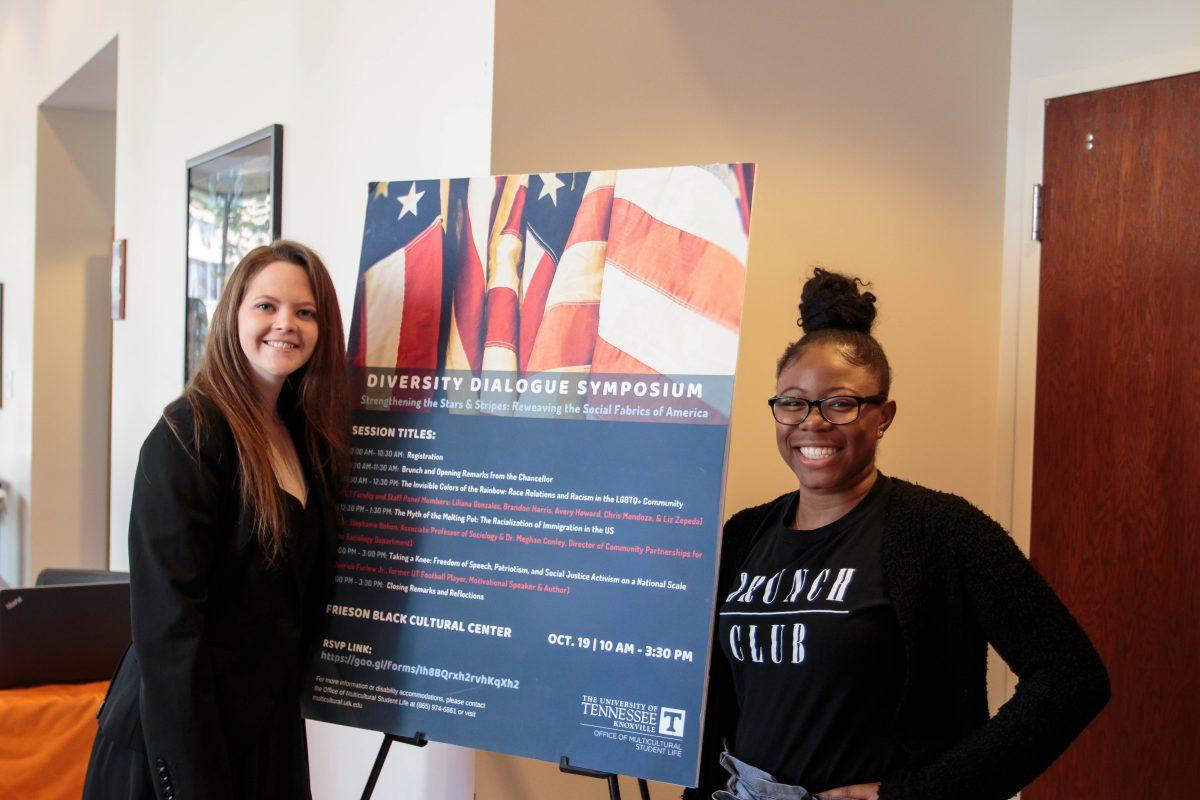
The Diversity Dialogue Symposium is a two-part series presented by the Office of Multicultural Student Life. For well over 25 years, MSL has been pivotal in shaping the experience and education for Black students and other persons of color on the University of Tennessee campus.
The annual Diversity Dialogue Symposium is done over the span of four days with one to three sessions each day. To kick off day one of the fall symposium, Michelle Brown, a criminologist and member of the panel, led the conversation around the topic “The Reality is… Racism is ingrained in the History of the United States.”
Brown opened up this conversation surrounding social facts and its importance as it relates to mass incarceration. Brown proposed the question on whether or not America is really challenging it and questioning the system the way it should be, or is it becoming a normative part of the culture, the environment and the political context of the United States that many are okay living with.
When speaking on mass incarceration, Brown emphasized the idea that while there are well over two million people behind bars and, being the largest country incarcerated, it may not specifically be connected to the crime.
Brown shared that the time when there were two million people in prison was also the time of what was called the “Great American Great Decline.” This term meant property crime, violence and homicides were all trending downward.
Brown furthered the conversation by saying this does not mean certain areas, certain cities or certain parts of the U.S. have not had rising rates. In general, crime has gone down nationally, and it is very important to note that.
At the start of the dialogue, Brown added emphasis on how mass incarceration was not done so or influenced by crimes that were committed, but insisted that it had everything to do with race.
“It is not really about crime. It’s about a lot of other things, and working through that we also want to add a bunch of other things. All of this is occurring in a way that is defined by the criminalization of race and systemic racism at every stage of decision making and what we call the criminal justice system,” Brown said.
“We could look at a variety of things but at this moment, we can look at police stops as well as how white people are being more likely to call the police. So, we see the inversion there right away. I mean, we could spend a lot of time looking at the actual numbers and the disproportionalities.”
An example Brown referenced during the symposium was police stops as they relate to New York.
In 2019, New York had around 15,000 police stops, which was a big decrease from the 500,000 they were doing a few years before. More than half of those stops were innocent, but statistics show that 59% of those stops were Black, 29% were Latino and only 9% white. However, the hit rate for the people that were actually doing things that might constitute criminal activity was predominantly among white people.
This symposium topic could not have come at a more relevant time. Police brutality and incarceration have still been constant issues as they relate to Black people and other minorities.
When asked by an audience member whether the U.S. system would change in spite of the individuals, no matter how much training each individual received, Michelle Brannen, sociologist and member of the panel, shared her thoughts.
“Well, it depends. Is it an individual level of change or a systemic structural level of change? I’m a sociologist, so my answer is both. As they are foundationally related together — structure, agency and accountability — I think we struggle in the U.S., because we are a high individualist culture and we use individuating discourses,” Brannen said.
“Whether it is policing, prisons or helping services, we are largely looking at the level of the individuals to change them as opposed to the conditions around them.”
This symposium was put in place to educate people on mass incarceration and how it is viewed as a form of modern-day slavery. Not only did MSL create this session to inform, but also to start a conversation amongst individuals who may have not been aware of the current state and direction the U.S. was moving as it relates to policing and its prison systems.
The next session to follow for the Diversity Dialogue Symposium will be all about public health and how it fails to measure up in BIPOC communities. This will take place Thursday, Oct. 1.
You can find more information regarding the sessions at the Office of Multicultural Student Life’s website under the Diversity Dialogue Symposium 2020 tab.