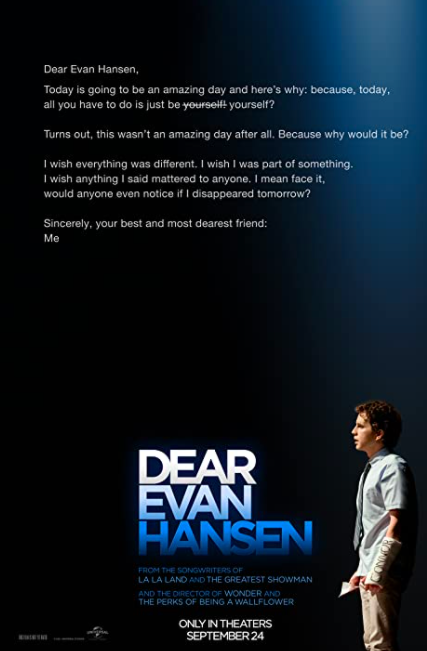
Dear Evan Hansen, today isn’t going to be a great day and here’s why: The movie wasn’t very good.
“Dear Evan Hansen” is a film adaptation of the Broadway musical of the same name. It was directed by Stephen Chbosky, best known for “The Perks of Being a Wallflower” and “Wonder.” It was written by Steven Levenson, who also co-wrote the stage musical.
The film follows socially awkward and anxious Evan Hansen, a senior in high school with no friends and a broken arm. He’s picked on by Connor Murphy, a social outcast, who steals one of Evan’s letters that he writes to himself, which mentions how he could disappear with no one noticing. However, when Connor dies by suicide, his family believes that Evan was his only friend, so Evan keeps up with the lie as it spirals out of control.
“Dear Evan Hansen” is a frustrating film. At times, it almost works as a compelling drama. But the age of Ben Platt, the intrusive music numbers and the under usage of film as a medium hold this movie back.
A quick note, I have not seen the original musical. Everything is based upon my experience with the film.
That being said, the film discusses suicide, mental illness and drug use. Included are the National Suicide Prevention Hotline (800-273-8255) and the Substance Abuse and Mental Health Services Administration phone number (1-800-662-4357).
Notably, the film stars Ben Platt as Evan Hansen, reprising his role from the original stage production. Platt is pretty good in the film. His singing is personal, and his performance is fittingly awkward. But to echo what everyone else has said, he just looks too old.
Frankly, it looks creepy, especially opposite of Kaitlyn Dever who plays Connor’s sister Zoe. Even though the age gap isn’t that far off, Platt looks noticeably older, and it provides a gross feeling at times. Both perform excellently, but it’s hard to get over that hump.
The supporting cast has some stellar performances as well. Amandla Stenberg plays student activist Alana, Amy Adams plays Connor’s mother Cynthia, Julianne Moore plays Heidi Hansen, Nik Dodani plays Evan’s friend Jared and Danny Pino plays Connor’s stepdad Larry.
Everyone performs to the best of their ability, nearly elevating the film above itself. If the film was presented as a standard drama, these performances would excel it above some dramatic films.
But this is a musical, and one that doesn’t translate well into film form. By themselves, most of the songs work well. They are emotional and help the characters outwardly express their feelings. This works best with the sequences for the songs “Requiem,” “The Anonymous Ones” and “A Little Closer.”
There is a sharp disconnect between the musical elements and the rest of the film, especially since the movie doesn’t acknowledge that the songs even happen — it’s implied that they take place in the characters’ heads.
More often than not, this results in scenes that are undercut by the inclusions of the songs. A dramatic scene will play out, but instead of letting the emotions, characters and audience breathe, the songs disrupt the intent of the scene. This is something that potentially plays out better on Broadway, but for a film that is tackling serious and emotionally heavy subject matter it fundamentally doesn’t work.
The absolute worst example of this is the musical sequence for the song “Sincerely, Me.” At this point in the film, Evan must fabricate emails between him and Connor to show Connor’s family after he took his own life. It is a starkly upbeat and out of place song, filled with jokes at the expense of the two characters and the LGBTQ+ community.
This scene feels like a parody sketch that “Saturday Night Live” would create to make fun of the musical. It is out of place, tone-deaf and insulting.
This leads into what the film’s story covers. For the most part, it treats the topics of suicide and mental health relatively seriously — barring that last example — and discusses everything with an acknowledgement of how serious the situation is. That still leaves the matter of Evan Hansen as a character who exploits the situation, essentially, for his own merit.
It’s disappointing because the film doesn’t do enough to make him a sympathetic character, as he continues to become complicit within his own actions.
Even when he does face the consequences of his actions, it’s too little too late and doesn’t carry the right weight for him or the audience to atone for his sins. Despite that, the movie mostly works as a compelling drama with broken characters within a bad situation. Just keep his character in mind as one not to root for, which could be argued means he isn’t a good main protagonist.
As much as the dramatic aspects work, the movie doesn’t do enough outside of that to justify the transition to film. This is made obvious with the cinematography. The camera work is dull. The muted colors are boring and don’t elicit any emotion. Finally, the lighting is uninteresting.
However, there was a single instance of a creative spark that burst through the screen. During Alana’s “The Anonymous Ones” sequence, there were two usages of a dolly zoom — aka theVertigo Shot — that conveyed character, feeling and story. It was a shock that the movie did something, anything, to use the medium of film to tell this story. But it was a fleeting moment, gone as fast as it appeared, and the movie continued with its boring camera composition.
“Dear Evan Hansen” is a musical drama that doesn’t connect. Even if everything is great by themselves, nothing works when brought together.
Most of the songs are good. The performances are great — even if they should’ve casted someone else as the lead. The story has drama and stakes. They all work well separately. But brought all together, it creates a disjointed mess where the emotions don’t land, and everything clumsily continues forward.
Worst of all, it does nothing to convince the audience that this needed to be a film. Other than bringing the musical to a wider audience, it doesn’t justify this transition. It might have worked if they cut all the songs and did it as a more straightforward play adaptation, but this is clearly for fans of the stage musical. Which creates a question: Why not just film the play and release it that way?
Ultimately, this dedication to preserving the musical element of the play holds the movie back. It keeps the film from becoming anything more significant, ruining any intention or sincerity that the movie has.
In that light, you might as well go see the stage musical instead if you like it that much. Otherwise, this film has nothing substantial to offer.
2 of 5 Torches