Throughout the month of January, the University of Tennessee’s Downtown Art Gallery will be home to an exhibition of over 50 historical violins, formerly the instruments of Jewish musicians during the Holocaust.
The exhibit, titled “Violins of Hope: Strings of the Holocaust”, preserves the stories of the instruments and their owners: accounts of immense suffering, loss and adversity, yet also testaments of beauty and its resilience, even in the worst conditions.
Restoration of the instruments began over half a century ago, when Amnon Weinstein, a master violin maker and restorer, received a violin case filled with ash.
The remains of the instrument belonged to a man who, like many captive violinists in the concentration camps, had been forced to perform as Nazi soldiers marched men, women, and children, to their deaths.
Weinstein saw the need to preserve the memory of individuals such as this man. He set out to restore as many violins from the Holocaust as possible.
Fifty years later, Avshi Weinstein, co-founder of the “Violins of Hope” project, in conjunction with Knoxville’s Jewish Day School, the UT Downtown Art Gallery, and celebrated designer and architect Lou Gauci, have brought the ensemble to Knoxville.
Since January 4, UT’s Downtown Art Gallery at 106 Gay Street has devoted the entirety of its space to the exhibit.
According to Mike Berry, manager of the gallery and impromptu guide to the exhibit, the installation is, in part, arranged to mirror the experience of a victim of the Holocaust.
Upon entrance, the softly lit, contemplative space is divided by tall wooden boxes that compel the visitor to take either a left or right turn, alluding to the arbitrary left or right turn in Nazi concentration camps, which determined if prisoners were to be subjected to the merciless conditions of the camp or murdered outright in the gas chambers.
Beyond this anticipatory space, the visitor enters a rectangular, nonlinear chamber, approximately the dimensions of the cattle car by which prisoners were moved.
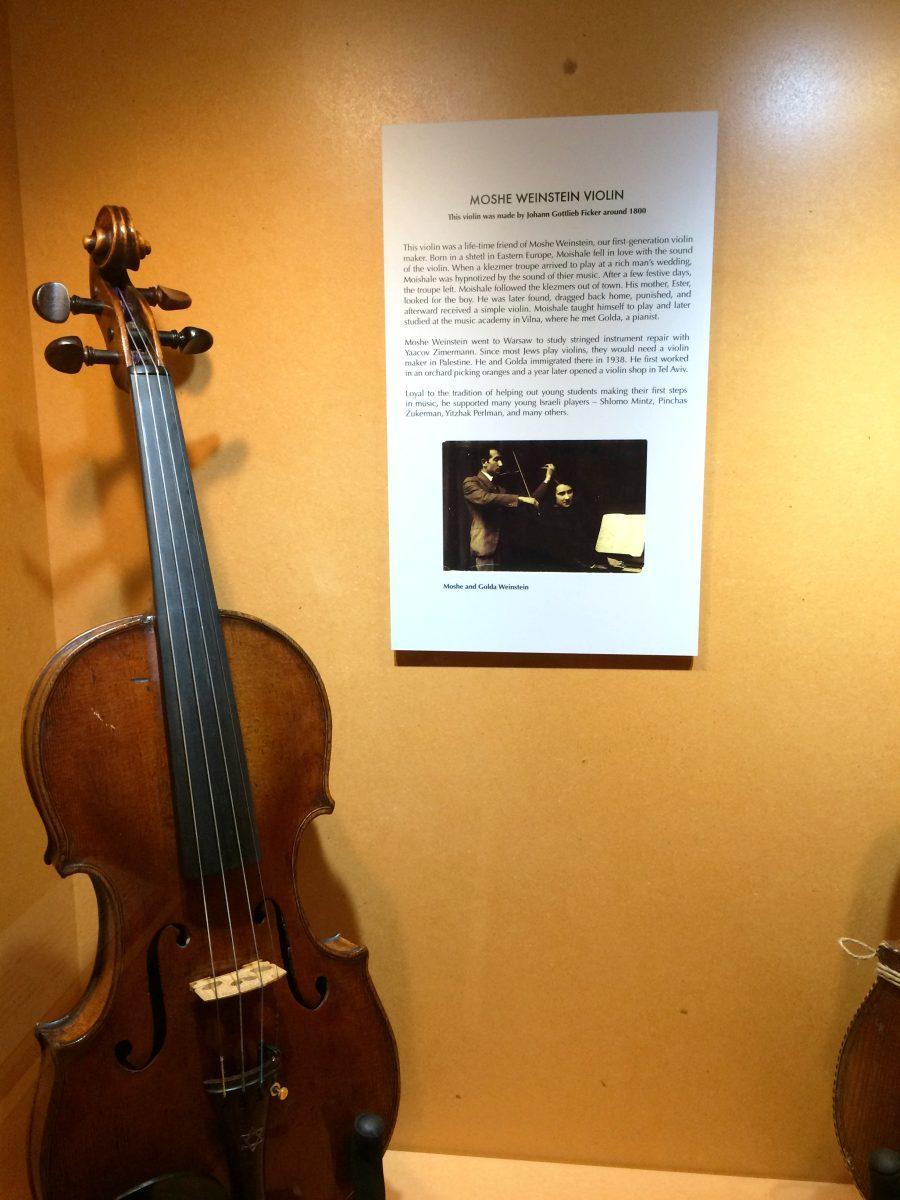
Violins sit behind glass, the restored varnish on each instrument shining. Each violin bears a plaque, explaining the point of origin and its journey throughout the Holocaust.
The violins in the collection hail from across Europe. Some originate from Poland and Eastern Europe, while others were crafted in Switzerland, Germany, Italy and numerous other countries.
The stories of the instruments are as varied as their origins.
“Some of (their stories) we know, some of them we don’t,” Berry said.
Of those that are known, however, one theme prevails: their persistent ability to generate hope and beauty, even in the face of seemingly insurmountable suffering. More often than not, the violins are family heirlooms, long forgotten and rediscovered treasures that tied survivors to their lost relatives.
Soon, Berry explained, Avshi Weinstein will be taking the instruments on tour. “He’s got these things booked now till 2022… all major cities (and) all over the US,” Berry said.
Due to the limited availability of the violins, explained Berry, the open hours of the gallery have been extended to every day of the working week, from 11:00 am to 6:00 pm, as well as 10:00 am to 3:00 pm on Saturday and 1-4 pm on Sundays.
“When it’s all said and done, this is going to be almost three and a half weeks long. Why would we be closed three days out of the week?” Berry said. He is intent on sharing the exhibit with as many Tennesseans as possible.
Garnett Rush, a native of Maryville who visited the gallery with her daughter, expressed how the restored violins affected her. “These beautiful violins and the injustice that was done to the people who owned them, both of them make me cry,” Rush said.
“It’s extraordinary,” Mike Twardy, another visitor to the exhibit, remarked. “It’s incredibly humbling and sad, but hopeful all at the same time.”
For Twardy, the importance of the exhibit is its power to educate the present of the past.
“Any time we can look at the atrocities of the past to hopefully learn and prevent them from happening in the future — that’s an important thing to pursue.”
The violins are destined to do more than act as silent exhibits, however; on January 23rd and 24th, a select number of the instruments will be featured in performances by the Knoxville Symphony Orchestra in the Historic Tennessee Theatre, also on Gay Street. After all that the Violins of Hope have endured, they will have a chance to create beauty once more.
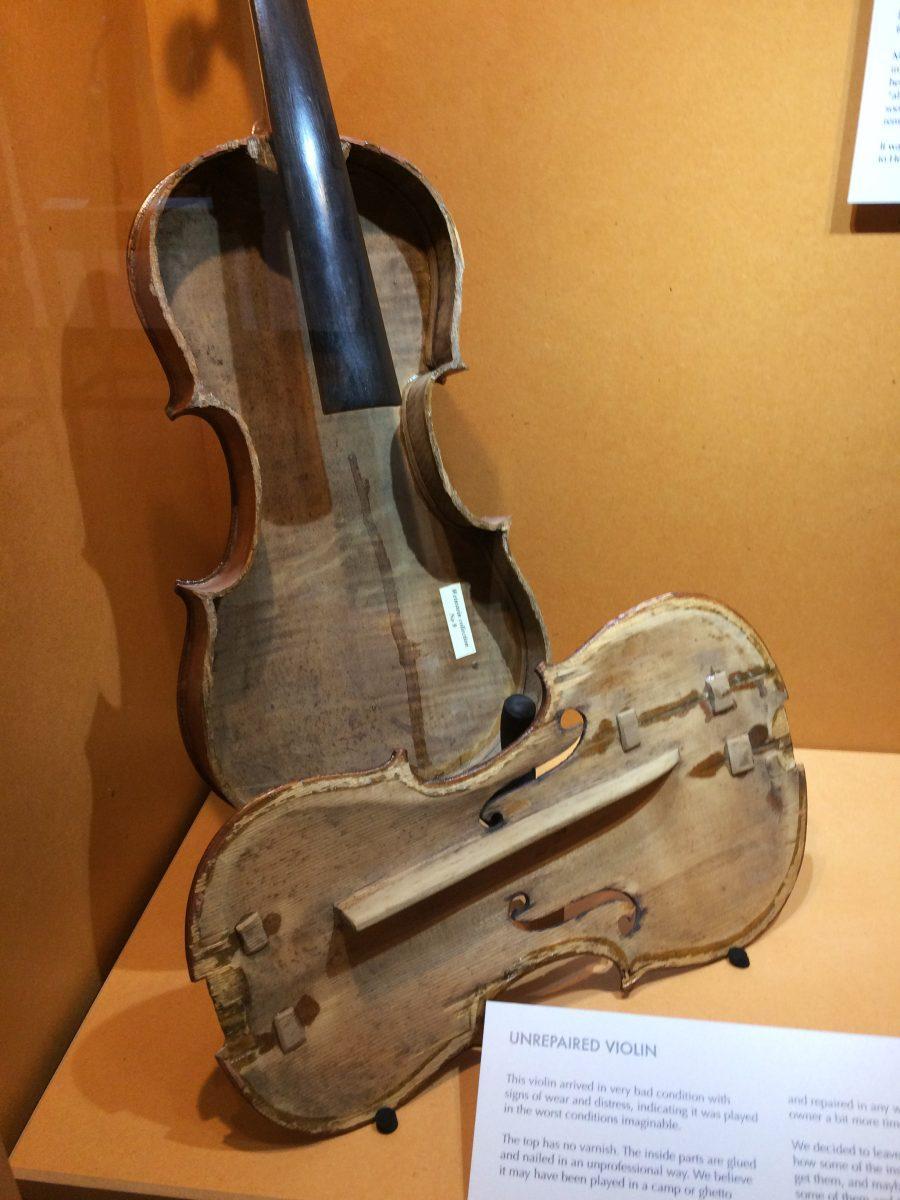
An un-repaired violin is on display as part of the "Violins of Hope: Strings of the Holocaust" exhibit in UT's Downtown Art Gallery.