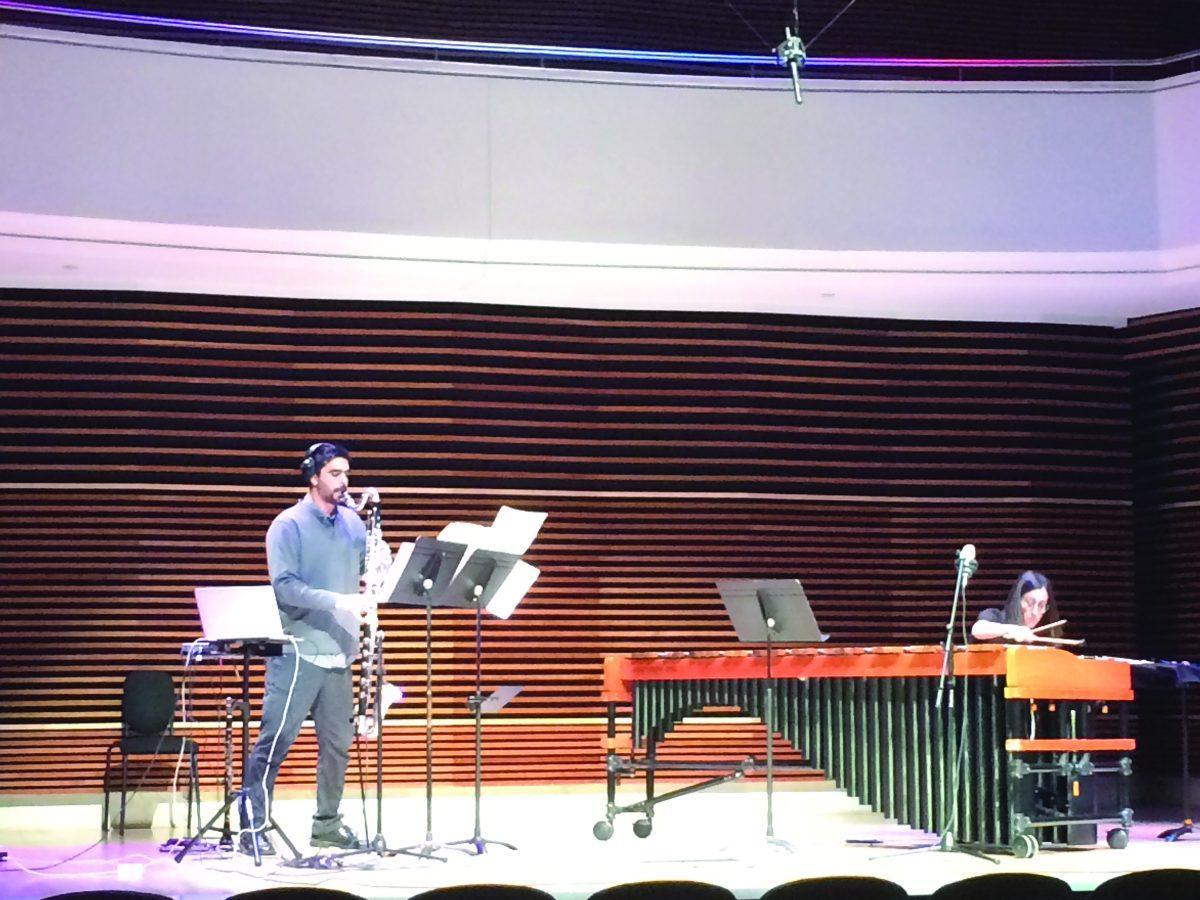
Jorge Variego and Abby Fisher presented a joint recital of contemporary percussion and electronic music at UT on Tuesday evening. The recital, titled “New Music,” featured duets for bass clarinet and marimba, a solo vibraphone piece and a trio for viola, bass clarinet, and marimba.
Variego is an adjunct assistant professor of music theory and composition at UT, while Fisher is a former UT faculty member, having served as a visiting lecturer in the music school’s percussion program in fall of 2017.
The recital also featured Hillary Herndon, associate professor of viola and professor of strings at UT.
Among the small audience were music students from both Variego’s and Fisher’s (former) respective departments.
As the concert began, the house lights dimmed, leaving only the stage lit in warm yellow, accentuated by soft chromatic back-lighting.
The opening piece, titled “Epidermis” (Dan Van Hassel, 2017) integrated airy riffs from Variego’s bass clarinet with forceful, pointed passages from Fisher’s marimba to create, in the words of the composer quoted in the program, “a single machine-like entity playing funky rhythmic patterns made up of percussive sounds with electronics forming a noisy protective layer around the players.”
Following “Epidermis,” Variego exited the stage, and a short, silent interlude ensued, in which the yellow overhead lights flashed in an oscillating, ponderous pattern across the stage.
Fisher broke the interlude by stepping up to the vibraphone and played an off-kilter solo, “Inner Blues,” composed by Variego himself. Variego explained, according to the program, that the piece is “a jazz ballad in sulfuric acid.”
“Inner Blues” was followeed by “De Kooning Movements”(Carlos Sanchez-Gutierrez, 2001), an abrupt, dramatic piece inspired by the Dutch-American composer of the same name.
“Thread and Fray”(Sarah Kirkland Snider, 2006) concluded the program. Herndon joined Fisher and Variego onstage for this piece.
Variego and Fisher presented music that is more organized around a specific concept than emotional impetus. It is from a vein of contemporary percussion composition, though Fisher admits that there was no definite theme in mind.
“Jorge and I were just looking for clarinet and percussion duos to begin with … that was the first battle: to find pieces that we enjoyed listening to and that we thought would be good to play,” Fisher said.
Fisher explained that the lights as a performance device was an innovation of Variego’s.
“Somehow he ended up playing around with the lights in this hall and he found out that he could manipulate them … he had this idea of starting in silence as a transitional period into what I’m playing,” Fisher said.
Fisher reflected that the song selection was borne of both their contemporary tastes as well as necessity of instrumentation.
“If there was sort of a ‘sound theme’ that people took out of it, it’s just because it’s in this ‘new music world’, meaning music being written in the 20th and 21st century,” Fisher said. “Maybe people writing in this time period are collectively writing in a certain way.”
While the music may not be immediately accessible to a mainstream audience, it has its devotees.
Samuel Holmes, a sophomore majoring in music education, noted that the music served as an educational tool for those in the music world.
“Once you start playing it, you realize … how much work goes into it, the artistry behind what the composer is going for,” Holmes said.
Holmes explained that he’s currently working through a book of etudes that experiments in similar ways to the music presented by Fisher and Variego, and that he’s coming across the same concepts in his theory classes.