The small towns that dot the landscape of much of Tennessee are often the object of scrutinization and stereotypes from the outside world. Stories of Appalachian and former coal mining towns riddled with drug abuse and a lack of diversity have stormed the popular media. However, these anecdotes often leave out the tales of the real lives of the people who have been born and raised in these towns.
One such former coal mining town is LaFollette, Tennessee. 26 years ago, Rob Heller, a photojournalism professor at UT, formed a connection with Larry Smith, the publisher of theLaFollette Press weekly paper, and Heller began taking his photojournalism students out to the tiny town of LaFollette for a two-day project. Smith was an adjunct professor at UT at the time and was very enthusiastic about the project.
During the first year of the photojournalism project in 1993, students gathered in the communications building at UT early on a Friday morning and then drove down to LaFollette, where they were hosted by citizens in the town. Students spent two days getting to know LaFollette residents and capturing photographs of their everyday lives.
The initial project was a success. Heller began taking students on the trip every other year, but after Smith expressed his enthusiasm about the project, the UT trip to LaFollette became an annual event.
Each April, the class is given a section of a weekly edition of the LaFollette Press, entitled “Eyes on LaFollette,” to fill with their photographs. Heller has editorial jurisdiction over the section, and he determines which photographs are most fitting for the paper. The project was initially a great addition to the LaFollette Press, which didn’t have a full-time photographer at the time the project began.
Today, the project still operates in many of the same ways it did at its inception. Students are still graciously hosted by LaFollette citizens during their weekend-long trip, and Heller still sorts through hundreds of photographs each year to determine which pieces are most fitting for the newspaper — Although nowadays, he’s sorting through digital pictures rather than developing rolls of film in a dark room.
Since 1993, Heller’s students have taken tens of thousands of photographs featuring life in LaFollette, and the trip encompasses more than just students walking into LaFollette and pointing their camera at the townsfolk. The town eagerly welcomes the students, allowing them to become one with LaFollette and authentically share the area’s stories.
“Eyes on LaFollette” has touched hundreds of students’ lives and has received national and statewide attention. An exhibit commemorating the 20th anniversary of the project was on display at the Tennessee State Museum in Nashville in 2013, and the trip was featured in the New York Times’ Lens blog.
This past spring, Heller mentioned to one of his photojournalism classes that it would be great to have an online source that compiled the best photographs from the past three decades of the LaFollette trip. One of his graduate students who attended the LaFollette trip in April Jules Morris thought that the website would be a great idea for an independent study project with Heller. She then recruited Kellie Ward, another graduate student of Heller’s who attended the LaFollette trip in April and is a web designer for UT Communications, to join her on the project.
Over the summer, the three of them set out to create a website to document the decades of LaFollette life that have been captured at the hands of UT photojournalism students. The project required sifting through thousands of photos to select the best images for the new site.
The time stamp of each photograph is unclear without explanation; style, development and time seem to move slower in small towns such as LaFollette, Morris explained. Only the changing faces of the townsfolk, captured so personally in those photographs, give clear evidence of the passage of time. The people depicted in the LaFollette photographs display memories of citizens who have since passed away, as well as those of children who have now grown to adulthood.
Morris actually owns land in LaFollette, so she was particularly interested to capture the unique lives of the people in the town which she knew so well. She was also eager to create the website as a way for the town to reflect on and remember its history. This summer, while she was looking through photographs for the website, Morris came across a picture of an older lady named China, once Morris’ close friend, who had since passed away.
In that moment, Morris was overcome with emotion while working on the project.
“You look up, and you see this actual little person that you know and that you loved dearly, and I was just sitting on my couch, and I was a mess because it just like hit me,” Morris said. “It’s not just a picture. These are people in their lives, and you’re protecting those photos; you’re protecting that bit of history or that moment in time for their family, for the community, for whomever, so it was a really dear and near project to me.”
Morris explained that in some manner, the trip is often an emotional journey for students, especially because they get to connect with their classmates they may not have previously known well. It’s a chance for students to set their differences aside and connect on the art of photography.
“You’re connecting on something that transcends age and where you are in life. It’s about photography and a good photo that kind of transcends all of the other differences that you have,” Morris said.
Through the website project and the 20th anniversary exhibit, Heller, who has been teaching at UT for 34 years, has gotten in touch with many of his former students whom he hadn’t spoken to in years. He explained that he is overjoyed by the large effect that this project has had on his students’ lives.
“They’re all delighted to be part of this, to be part of this thing that for many of them was the defining experience of their college years here at UT, which I’m so excited to hear that. That’s what I hope for it to be,” Heller said.
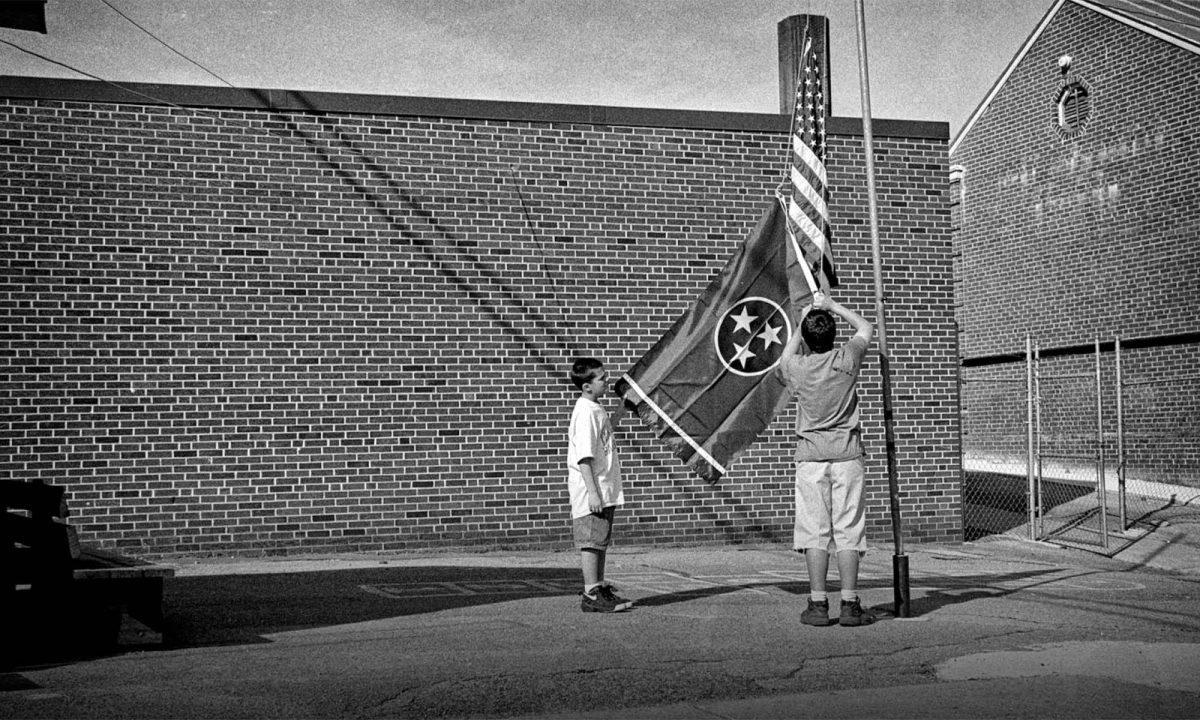
In terms of particular images captured in LaFollette, there is one special photograph that Heller loves and uses to represent the LaFollette trip. The picture, taken by former student Andy Ashby, depicts two young boys raising an American flag outside of their school. The photo appears at the top of the “Eyes on LaFollette” website’s homepage, and in the 20th anniversary exhibit, it was printed onto a 6-foot by 9-foot display.
The American flag photo on the website is uploaded in black and white, as are many of the other photos. Heller explained that posting the photos in black and white maintains the original effect they had when they were published in their respective editions of “Eyes on LaFollette;” towards the beginning of the project, the LaFollette Press was printed primarily in black and white.
“I wanted to keep the ones that were printed originally in black and white to still be in black and white on the website,” Heller said. “It has almost a timeless look to it.”
In addition to photographs taken by students, the LaFollette website also features a group photo of students from each year of the trip, as well as a copy of each year’s edition of “Eyes on LaFollette.” In the future, Heller plans to upload the audio and video files he saved from interviews with students who went on the trip. He also hopes to publish a book on the LaFollette project.
Although throughout the years of the trip, Heller has been to LaFollette countless times, he did not grow tired of the expedition. Every time he feels as if perhaps the trip has grown repetitive, he is reminded that with each trip, his students are experiencing the project for the first time.
“I stop and think, ‘wait a minute, it’s new for the students every year. It’s just the same for me,’” Heller said. “So I think, ‘no, I don’t want to stop that.’ As long they’ll have us up there, and as long as I’m teaching here, let’s just keep doing it.”