The modern music industry is defined by change. Fame graces an artist’s name for a decade, perhaps two, before the ceaseless engine prints fresh scores over old notes.
Yet, in the face of an era increasingly typified by on-demand, instantaneous access to the latest tunes, the works of late eighteenth-century composer Ludwig van Beethoven have persisted, lasting beyond such names as One Direction, Nickelback and Britney Spears.
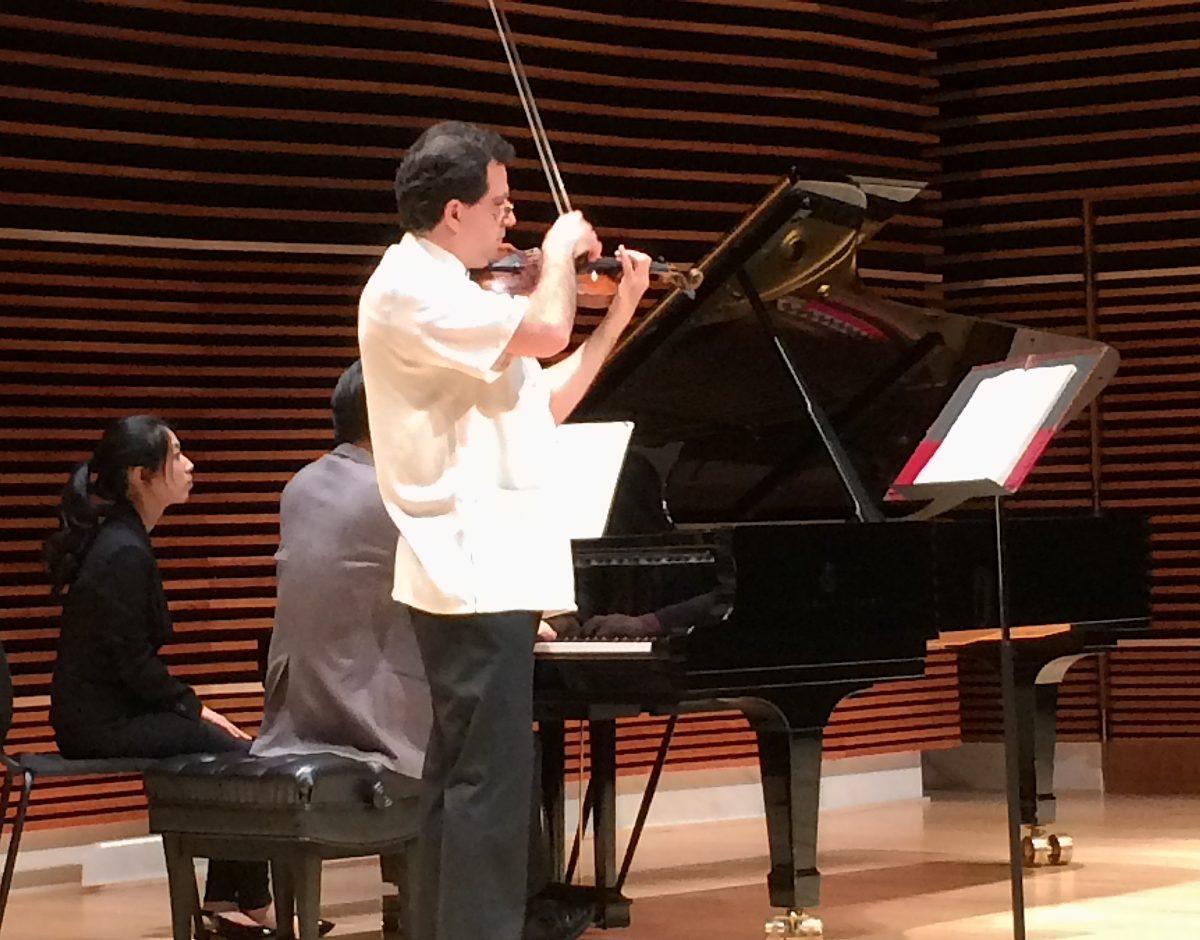
The year 2020 will mark the 250th anniversary of Beethoven’s birth. This Monday, Miroslav Hristov and Chih-Long Hu kicked off their trilogy of concerts in anticipation of the composer’s birthday.
Hristov is an associate professor of violin, as well as founder of the School of Music’s Ready for the World concert series. Hu is the Sandra G. Powell Endowed Professor of Piano and the artistic director of the New York International Piano Festival. Both Hu and Hristov are active performers.
Their concerts will span the month of February: the second concert will be performed on Feb. 18 and the concluding concert will take place on Feb. 25.
In an interview, Hu noted that it’s a momentous time to be a classical musician. “All over the world … people are programming Beethoven,” Hu said.
“The whole world is celebrating Beethoven at this time,” Hristov added. “So we wanted to do something.”
Monday night’s concert covered the first four of Beethoven’s ten violin sonatas: No. 1 in D Major, No. 2 in A Major, No. 3 in E-Flat Major and No. 4 in A Minor.
The sonatas run the gamut of technical and musical challenges — breakneck passages erupt within moments of delicate, dance-like figures and dynamics range from near-silence to furious forte.
At times the piano takes charge of the music, directing phrases, melody and dynamics like the intricate console of a tonal starship. In other moments, the near-human voice of the violin takes hold.
Throughout the concert, Hu and Hristov blended the disparate voices of their respective instruments, creating a musical narrative that, Hu felt, captures a highly specific character.
“You really have a chance to see Beethoven’s life … how he developed from a young composer into (adopting) a later, more mature style,” Hu said. “Each sonata is a different part of Beethoven’s life … you see what Beethoven’s going through at the time that he’s writing that music.”
Hu explained that these first four sonatas were written earlier in Beethoven’s career—the energetic, spritely sound is that of an ambitious young man. As the sonatas progress, however, the tone changes.
“Starting from the second one, you start to see something a bit more dramatic: something very troubled, a lot of contrast, a lot of color, a lot of pain and frustration and fire, the angel and the devil,” Hu said.
This narrative continues, Hu explained, throughout the sonatas that will be presented in later concerts.
Jacob DeFord, violinist from Pellissippi State Community College, remarked on the power behind Beethoven’s composition, especially in Sonata No. 4.
“Each phrase near the end of the piece didn’t quite resolve, so there was that unsatisfying moment … where (Beethoven) left you on edge for the next phrase,” DeFord said.
As a violinist, DeFord especially appreciated Hristov’s performance.
“I really enjoyed his (Hristov’s) expressive tone and his bow placement and the way he brought Beethoven out (of the music),” DeFord said.
Hu and Hristov’s concert series is part of a larger celebration of Beethoven organized by The School of Music. The next concert in the celebration will be on Saturday, Feb. 16, during which the UT Symphony Orchestra, Chamber Singers and Concert Choir will perform Beethoven’s “Choral Fantasy,” contributing to the musical narrative that has spanned continents and centuries.