In the tradition of past Civil Rights demonstrations, students at UT linked arms in a march from the Frieson Black Cultural Center to Ayers Hall, walking wordlessly to honor those who refused to be silent.
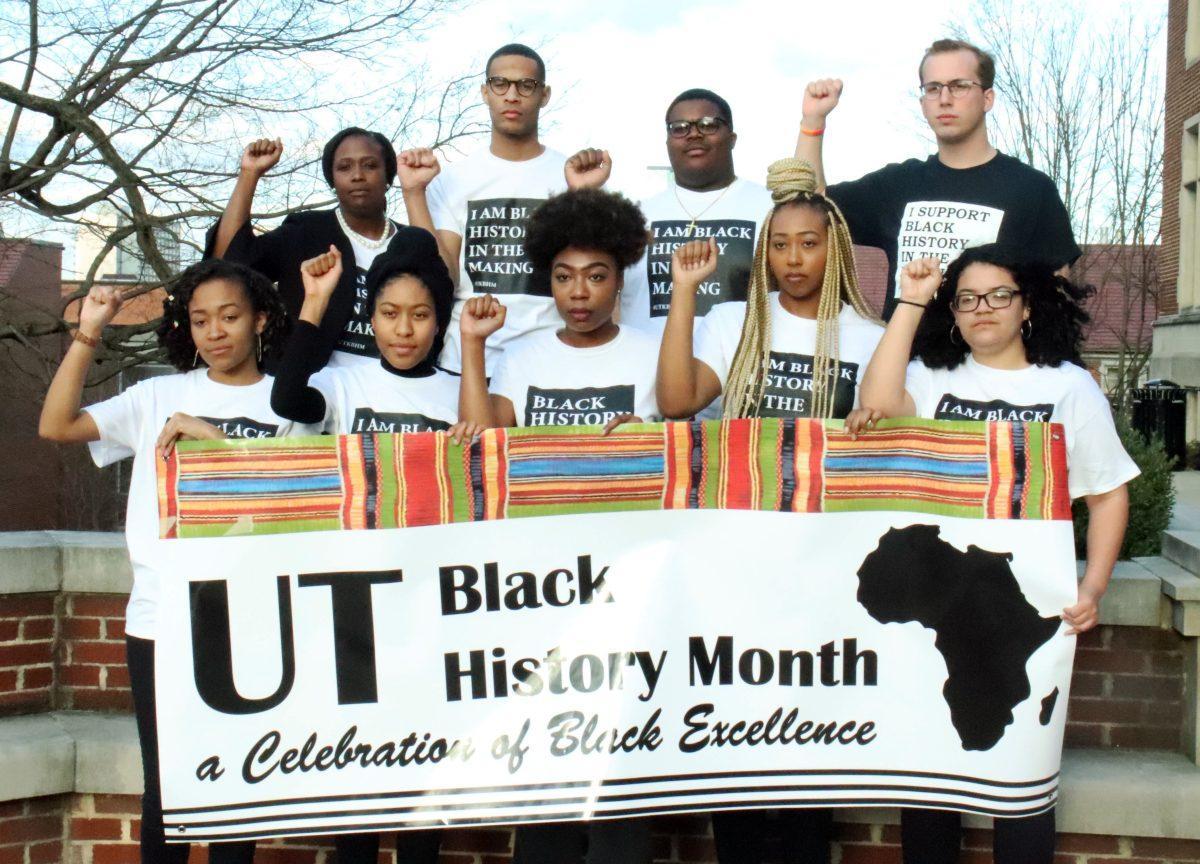
The march was organized by the Black History Programming Committee and is the second march of its kind to take place at UT in as many years.
The BHPC has organized numerous other events throughout February, including “Melanin Monday” discussion groups which allowed students to come and share their lived experience as members of the black community at UT; a screening of Jordan Peele’s “Get Out;” a celebration of black excellence at the Frieson center; and several lectures featuring distinguished speakers of various professional backgrounds.
Madison Woods, a sophomore majoring in chemistry, as well as a member of the BHPC, was encouraged by participation throughout the month from the campus population.
“We’ve seen a diverse group of people coming … it’s great to see … allies of the community want to be educated and support our community,” Woods said.
While many of the month’s programming has been focused on examining the present, the silent march was dedicated to commemorating the past.
The event began at the Frieson Black Cultural Center. Jada Palmer, freshman in the arts and sciences exploratory major and member of the BHPC who spearheaded the organization of the march, noted the history surrounding the silent march.
UT’s own march emulates a New York demonstration organized by the NAACP in 1917, remembered as the Silent Protest Parade.
Following Palmer’s remarks, Knoxville attorney and civil organizer LaKenya Middlebrook addressed students, emphasizing the necessity of remaining dedicated and united in the cause of justice and equality, of engendering honest conversations and critically examining social norms and governmental policies.
Adorned in all black, students marched through the heart of campus, from the Frieson center, down Ped Walkway, past the Student Union and up the steps to Ayers Hall. While demonstrators’ arms were linked in solidarity, the march did not proceed without opposition.
Mack Thomas, an African American and self-described Israelite who frequents campus as a preacher, walked alongside the march and called out to demonstrators, criticizing their motives and shouting remarks that sent murmurs throughout the marchers.
Thomas called marchers “hypocrites” for celebrating one of the main triumphs of the Civil Rights movement: integration.
“It’s a detriment,” Thomas said in an interview. “We’re still a people without a culture, without a name, without a land of our own.” In Thomas’ view, the advances that African Americans have made in the past decades have done little to provide them a unique cultural heritage and identity.
To drown out Thomas’ belting voice, the demonstrators began to sing “We Will Overcome” during the march. The refrain persisted over Thomas’ criticisms.
Lailah Blackwell, a sophomore majoring in finance, explicitly disagreed with Thomas’ views, and was frustrated with the prospect that his strongly-voiced opinions could become associated with the message of the march.
“What he was saying was very conflicting with what some of us within the march would agree with … it paints a picture of all black people which I do not agree with,” Blackwell said.
On the whole, however, Blackwell was grateful that events such as the silent march were being organized.
“These events show that, even though we may be a small percentage (of the campus population), we’re not unknown; we’re recognized, and we have a voice,” Blackwell said.
Blackwell also emphasized the role that other members of the campus community play in creating an atmosphere of equality.
“Sometimes it may be awkward for a black person to speak out against something we find offensive; if we speak it may be seen as playing the race card or something.”
It’s the responsibility of every individual, Blackwell asserted, to fight against inequity.
“When you see an injustice, and you know a black person would be ‘crucified’ for (pointing it out), then speak up against that … it helps to have allies,” Blackwell said.
The march concluded in front of Ayers Hall, where other members of the BHPC spoke, followed by a moment of reflection.
Marchers took a group picture gathered on the steps of Ayers Hall; after the larger picture, many groups of friends split off to take their own photos, laughing together in the setting golden sun.