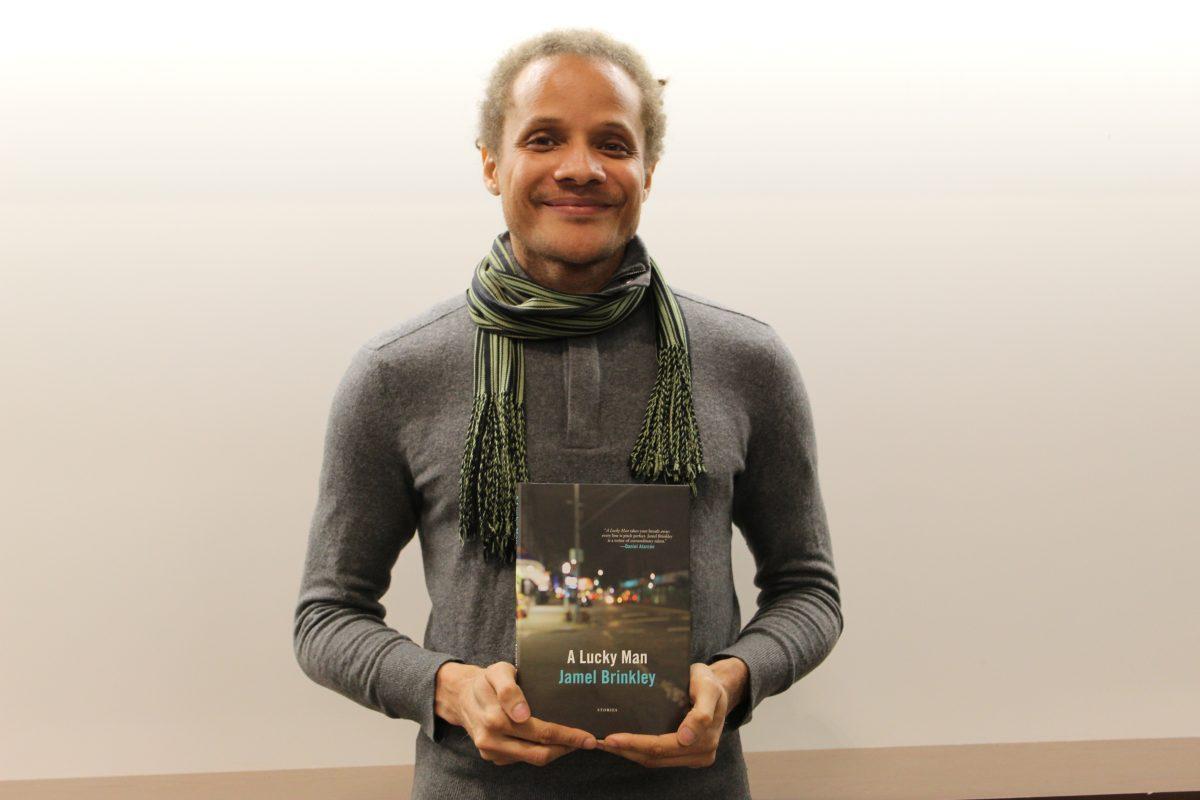
In his short story collection “A Lucky Man,” UT visitor Jamel Brinkley counters short entertainment attention spans and entices the reader to stay a little longer — if only to read the next word.
Published in May 2018 by Graywolf Press, Brinkley’s incisive collection is also his literary debut. Formerly a New York high school teacher, Brinkley has received numerous awards for his individual stories. He also holds a Wallace Stegner Fellowship at Stanford University.
Last month Brinkley came to UT and delivered a reading in Strong Hall, excerpting three of his stories — “J’Ouvert 1996,” “Everything the Mouth Eats” and “A Lucky Man.”
Each story, set in Brooklyn and the Bronx, presents vivid snapshots of African-American life in New York.
The stories unfurl with poignancy, banality, discomfort and joy. Startled by the clarity with which Brinkley regards humanity, one can’t help but imagine that these scenes are, at least in part, derived from the author’s own life.
The stories all comment on some aspect of the African-American experience, but Brinkley doesn’t wax political. The struggles of his characters are portrayed in individual terms, exploring a single person’s experience. The social commentary exists to be read, but it is not the central focus.
As such, Brinkley draws his characters with discretion particular to each story; sometimes, as in “Everything the Mouth Eats,” the central players are depicted in sharp relief, defined by their fraught relationships with one another.
In other moments, the writer lets characters expand in the reader’s mind, offering more suggestions than concrete characterizations.
When appropriate, this tactic works as well as explicit description; occasionally, however, it is disorienting to be engaged in the life of a character that is only minimally hinted at.
A similar divide occurs in the structure of Brinkley’s stories; some are series of carefully delineated events, paced precisely and with clear consideration. Other stories are more streams of consciousness than definite episodes.
Herein lies another, admittedly minor, gripe: The pacing of some stories, while deliberate, is not always balanced. Some action feels disproportionately large, while some climactic moments fall flat. Dealing with these literary about-faces, the reader gets a sense of narrative vertigo.
But then, perhaps this is Brinkley’s point — life is no balanced affair.
No relationship is an equitable, perfectly calibrated series of mutual exchanges. Sometimes affection is met with violence, camaraderie with alienation, love with hate.
Sometimes days, months and years pass with none the wiser, and then, other times, eternity seems to have slipped into the too-tight dress of a single day or instant.
Perhaps it is these contradictions that make Jamel Brinkley’s stories so effective in the first place, for “A Lucky Man” conveys something that is essentially true that possesses what many excellently engineered collections do not, despite its flaws: realness.
Maybe Brinkley’s secret spice is paradox itself; the contradictions that inevitably crop up in any single human life, and the funny circular loops of logic and behavior that come to define us.
“None of us deserves to be loved,” one of Brinkley’s characters reflects, “and so all of us should be.”
For the sake of not ending on such a clichéd note, it should be known that Brinkley’s prose is killer. There are too many turns-of-phrase and passages to quote, too many moments when one can only put the book down and whistle in amazement.
Brinkley chooses his words with utmost care, but only in the service of the truth. His language is precisely what it must be — what it had to be — in order to convey that realness.
For this and for all other reasons — fascinating characters, poignant emotion and powerful imagery — one should explore Brinkley’s work. Good words are rare; real ones even more so.