When one ponders the whereabouts of jazz, Kentucky isn’t the first locale that springs to mind.
Nevertheless, this Tuesday, a faculty quintet hailing from Tennessee’s northern neighbor delivered a lively, varied performance.
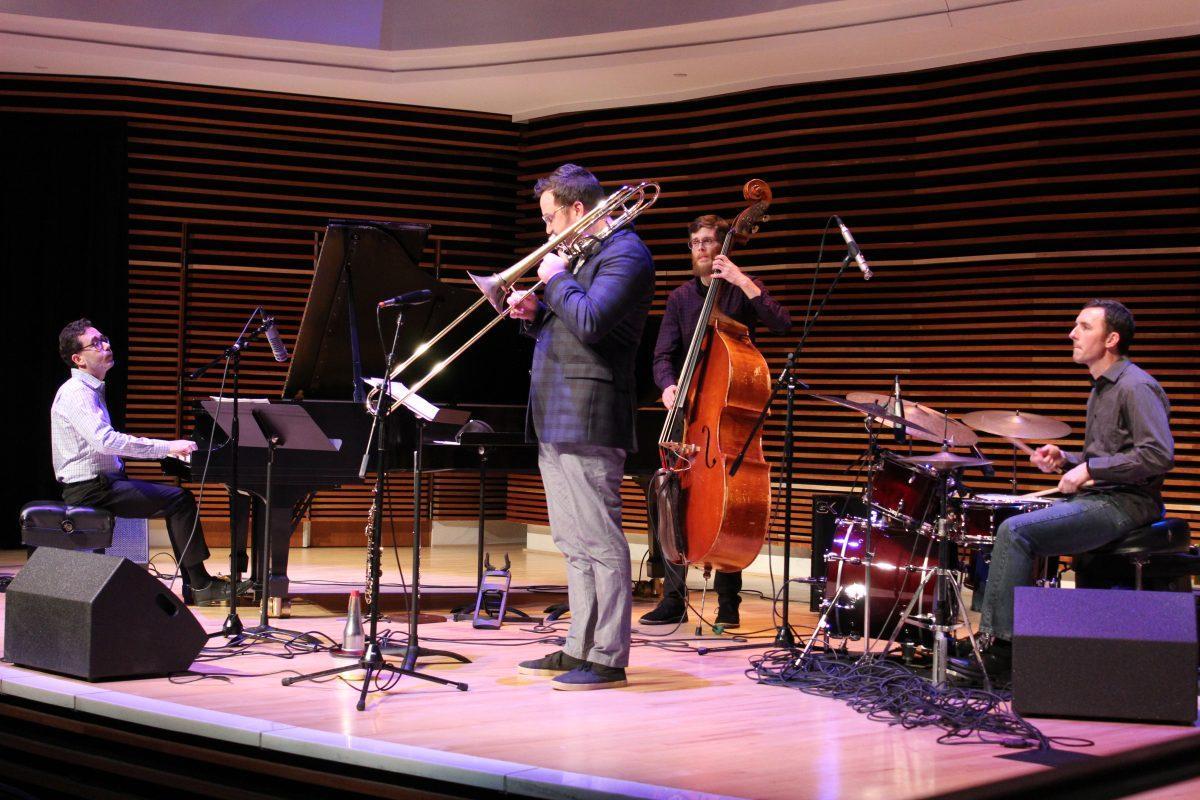
The University of Kentucky Faculty Jazztet consisted of Raleigh Dailey on piano, Paul Deatherage on drums, Danny Cecil on bass, Miles Osland on saxophone and flute, and Bradley Kerns on trombone. Kerns is the most recent addition to the ensemble.
Osland is the director of Jazz studies at the University of Kentucky; each of the other members are instructors in their respective instrument areas within Kentucky’s music school.
The group, which also goes by the moniker of the “Osland-Dailey Jazztet,” released their debut album, “Catch This,” in 2009. Their latest offering, “The Mendoza Line,” was released in 2013.
The Jazztet has been busy touring the Southeast this spring: previously, the group performed at Appalachian State University, Dobyns-Bennett High School in Kingsport, and Farragut High School. They are set to preform at Tennessee Tech on March 13.
Their hour-long recital mainly featured Dailey’s original compositions. The exploratory sound of the Osland-Dailey Quartet is reflected in the playful titles of their pieces—“Dawn Treader,” “Jules Verne” and “Title Goes Here,” to name a few.
Feel and tone ranged wildly from piece to piece—some compositions found Dailey alone at the piano, working out winding, expressive melodies.
Other pieces allowed every performer to jump into the mix, creating a collage of sounds that were simultaneously frenetic but controlled, like a well-choreographed fight scene: sizzling cymbals met head to head with the silken tones of the piano, and veering solos from the wind section backed up against commanding fills by Deatherage.
The Jazztet was greeted by a number of UT music students; for them, the recital was more than an hour of sonic recreation.
Timothy Guinn, a sophomore majoring in music education and a trumpet player, explained that all music students are required to attend a certain number of recitals depending on their instrument area.
While Guinn is training mainly in the classical tradition, he appreciated the change in pace that the Jazztet offered.
“Classical is what I mainly focus my time in, but it’s good to get out of my little zone of classical music,” Guinn said.
As a sophomore music student, his approach to listening to great musicians has shifted.
“Whenever I first started here … I tended to try to analyze the concerts, analyze their performance … but as I kept listening more, I tried to enjoy the music for myself,” Guinn said.
Hope Williams, also a sophomore majoring in music education with a concentration in trumpet, emphasized the analytical aspect of attending the school’s recitals.
“That analytical aspect is good to have … so that you can be like, ‘I like how they did that, I’m going to remember how they did that and incorporate into my playing,’” Williams said.
For this concert, Williams was especially drawn to Osland’s expressive playing.
“I really liked how he was doing his body movements,” Williams said. “Whenever he played really high, he moved his whole body sideways.”
In addition to attending guest recitals, music students observe their own professors in a performance setting.
“I think it’s helpful for us because we get to hear how they sound, and we get to see how they perform, and I think in turn, that can help us in developing our performance and our style,” Guinn said.
The UT Music School has provided numerous opportunities for students to hone their individual styles, both in observation and performance.
Throughout the week leading up to spring break, several more performances are planned: a guest recital from members of the University of Mississippi music faculty, a UT Trombone studio performance, and a senior soprano recital.