A few months ago, the historical drama “Green Book” debuted in theaters. This Oscar award-winning film tackles difficult issues surrounding traveling as a black man in the South in the Civil Rights era.
Perhaps unbeknownst to many, these difficulties surrounding black travel are still very prevalent.
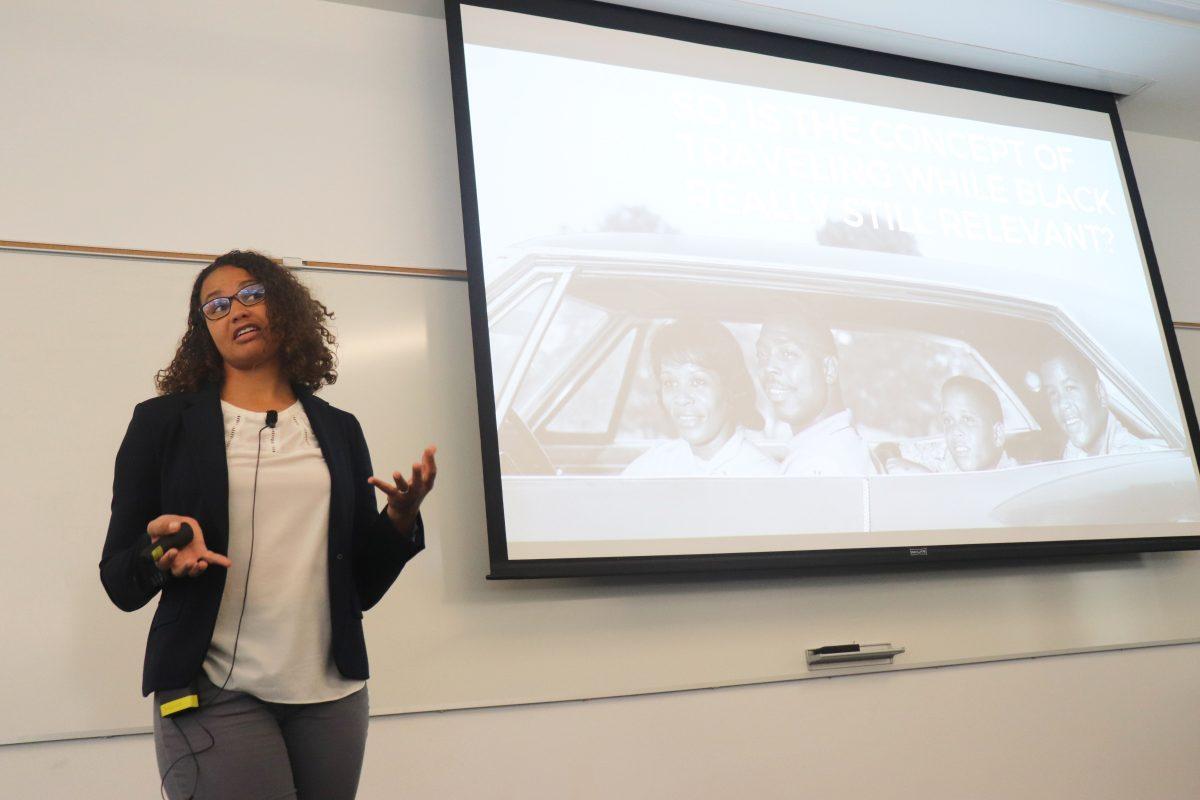
Assistant professor of hospitality and tourism management Alana Dillette of San Diego State University and assistant professor of retail, hospitality and tourism Stefanie Benjamin of UT recently researched the subject, and in collaboration with UT junior in marketing Chelsea Carpenter, led a presentation and discussion at UT this afternoon, bringing awareness to modern black travel.
The film “Green Book” is named for the real “Green Book” created by Victor Hugo Green in the 1930’s, which was a travel guide for African-Americans that listed restaurants and hotels across the country that were safe to visit. With their recent research, Dillette and Benjamin aimed to discover if safety regarding black travel is still an issue.
They opened a discussion surrounding this topic to the crowd and Uriah Richey, a junior studying Africana studies and sociology, shared her thoughts on the topic.
“This concept is definitely still relevant. While the implications of traveling while black may not be as overt as they were 30, 40, 50 years ago, it’s definitely still an issue,” Richey said. “So while it might not look the same as it did in 1965, it is definitely still relevant in 2019—and it shouldn’t be, it really shouldn’t be, but it is.”
The idea of the need for and conception of a Green Book-esque tool for African-American travelers today was also discussed.
“Do we need a green book? Yeah, we do, but we shouldn’t have to, you know, and so if we were to have a green book, who would be responsible for writing that? What would it say? What would it look like?” Richey asked.
One particular modern service has attempted to address the problem: Noir BnB. This company, which operates similarly to AirBnb, was created for safe African-American travel by Stefan Grant after the police were called on him and his friends, simply for being black, while they were staying in an AirBnB.
Grant’s company is one of many travel companies which have been created in recent years to help African Americans enjoy and experience travel.
Dillette and Benjamin interviewed several proprietors of these companies, some of who are also social media influencers, to gain their perspectives on the issue. Benjamin explained that due to the unique social justice aspect of the research, typical anonymity regarding research participants was abandoned.
“Really what typically you’d do within qualitative research is you tend to give it a different name—you tend to give them a different pseudonym. But with this, we had permission from them because they wanted their voices to be heard, their names to be heard, their businesses to be heard,” Benjamin said. “They want to be heard, so we want to honor that, and that’s what we’re doing here with this analysis.”
Benjamin explained the message that Dianelle Rivers-Mitchell, entrepreneur of the company Black Girls Travel Too, aims to send with her work in the field.
“What she’s positing and arguing for is that we need to understand our history in order to move forward. And we’re not telling the true history, we’re not telling the full history –this is something that we’re not doing in our k-12 education,” Benjamin said. “We’re glorifying or romanticizing our past. This is something that we may not be proud of here in the U.S. but it’s something that is real, it’s something that we need to continue to have this open dialogue about in order to move forward and to really understand why “Black Lives Matter,” not ‘All Lives Matter.’”
Throughout the presentation, Dillette and Benjamin opened the discussion several times and conducted different activities. This granted the diverse audience a chance to talk about the topic with those who are different and similar to them.
At one point, crowd members sorted through brochures and counted the number of black, white and colored people they observed in order to demonstrate the way that diversity is represented in the media. The people advertised in the brochures were overwhelmingly white.
Ultimately, Benjmain and Dillette’s research concluded that yes, the difficulties surrounding black travel are still very relevant and still need to be solved.
“This is complex,” Benjamin said. “This is messy, this is uncomfortable. But we have to have these conversations.”