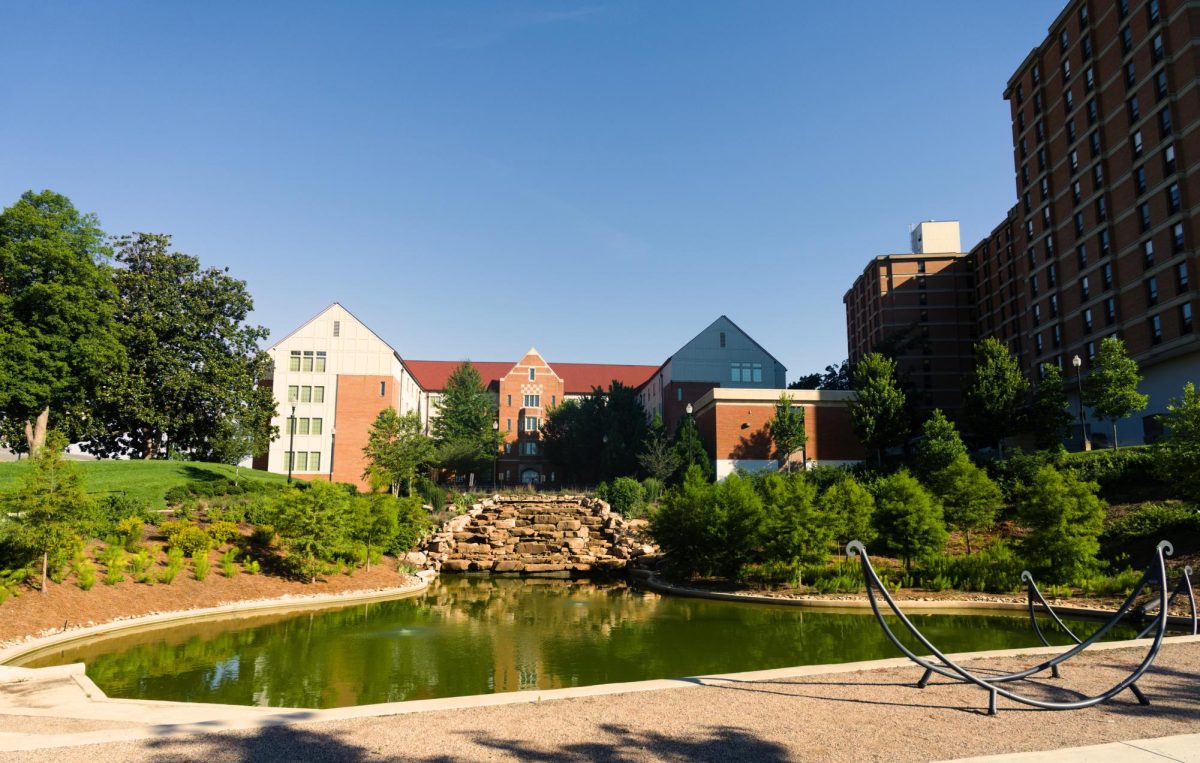
Maxine Burkett, professor of law at the University of Hawai’i at Manoa, addressed faculty and students via Skype in the Baker Center on Thursday. Her presentation, “In Search of Refuge: Climate Justice, Climate Induced Migration and Law” was part of the Interdisciplinary Discussion Forum for Energy and the Environment.
Burkett gave an overview on climate change science, explored the concept of environmental justice, and examined climate change related migration.
“Being a law professor, I think about climate change from angles of liability,” Burkett said. “Access to resources, statehood and statelessness are areas in which the law has inadequate answers.”
Burkett’s view requires immediate action to ameliorate the effects of rising sea levels.
“Residents in many Pacific Island nations are moving across borders or to higher ground to avoid the effects of climate change,” Burkett said. “Appropriate policy, liability and redress, are solutions lawyers explore.”
Climate change is a phenomenon that often marginalizes already disadvantaged populations.
“The poor and the powerless have experienced different environmental impacts,” Burkett said. “Looking at climate change and climate justice, we see pressing issues that climate change introduces. Climate justice explores compensation owed to those who suffer disproportionate effects of climate change.”
Burkett was careful to highlight the sweeping scope of this issue.
“I argue we are approaching a new frontier, not exclusive to our country,” Burkett said. “This becomes a more nuanced conflict between developing countries and developed countries. That’s the face of the global argument. A lot of times the very nations that will be affected have weak disaster response infrastructures.”
Such environmental consequences are not long off.
“Portions of the Maldives capital could be flooded by 2025,” Burkett said. “Their cost of adaptation amounts to a disproportionate percentage of their GDP.”
Certain nations are more prone to devastation, based primarily on varying infrastructures.
“Countries like Haiti and the Dominican Republic share same land mass, but have a different prediction as to how they will be affected,” Burkett said. “People will be migrating from sensitive places to even more sensitive places. Low-lying nations will be compromised, and opportunities for refuge remains a question.”
Global bodies like the United Nations are slow in adapting relevant policy structures.
“We have to consider the implications of how treaty interpretation affects island nations,” Burkett said. “Global climate change is primarily an issue of inequality. Climate justice would require a people-centered definition of what is endangered. Some political lines may have to be redrawn because of the immigration.”
Climate justice advocates fear adding more complications to the already devastating conditions in some locals.
“The poorest of the poor don’t have the resources or ability to leave,” Burkett said. “Communities displaced by climate change have no legal status at all on the international level. The most distressing part of climate migration is the legitimate fear that people won’t have a place to return to. We need refugee law or other protections for those who are migrating due to climate change.”
Legal existence of displaced nations is an uncharted realm of international law.
“Can you maintain an identity if your land no longer exists?” asked Burkett. “Permanent population, territory, government and the ability to establish relationships with other nations are the criterion of statehood under international law. Lack of territory does not necessarily need to be the determinant. There are some precedents of international entities that have citizens that can enjoy political participation in another political community.”
Countries around the world are slow in preparing to receive the victims of climate change.
“There is no international climate refugee status,” Burkett said. “No nation is currently adding to its immigration policy to allow for this type of movement. Many countries are resistant, with a fear of opening up floodgates, so to speak.”
Burkett called for the U.N. to serve as a political trustee to establish ex-situ nationhood, transitioning interim government to a more permanent solution. She believes these efforts must be focused on alleviating harm to individuals.
“I do think there should be an understanding that islands are microcosms for the rest of the world,” Burkett said. “This issue is impacting people today, and has implications for everyone we know and love.”
During a question-and-answer session held after the lecture, Jacob LaRiviere, professor of economics, addressed the speaker.
“You spoke of creating a new legal definition for citizens, and a new legal definition of a nation-state,” LaRiviere said. “When was the last time a new term in a legal situation was adopted?”
Burkett responded with some of her opinions on solutions to this gap in the law.
“I proposed expanding the legal definition of a state to incorporate a new legal entity,” Burkett said. “It would be very much linked to climate change and migration. There wouldn’t be a difference in citizenship; a number of people already have dual-citizenship. For the ex-situ citizen, they would be a citizen of host nation and the nation that was compromised by sea level rise.”
The Interdisciplinary Forum for Energy and the Environment is a Baker Center discussion forum aimed at faculty members and students from every discipline who have taken an active interest in modern environmental, resource and energy topics.