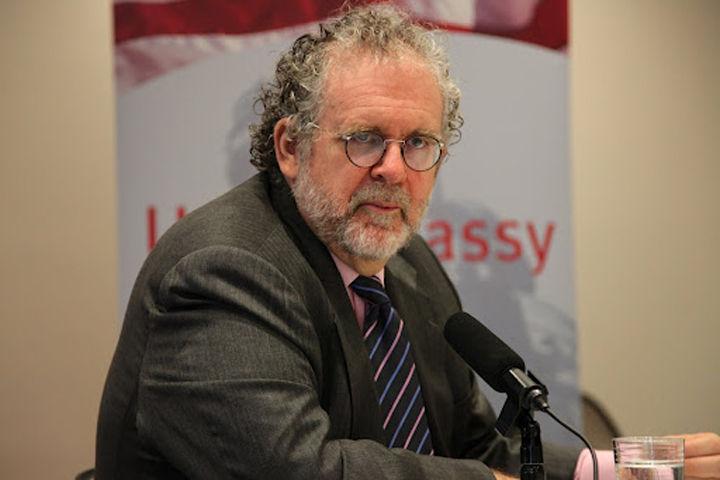
The Department of History announced its new atomic research initiative with a visit from Walter Russell Mead on Monday.
“Professor Mead is one of our most noted experts on American foreign policy,” Vejas Liulevicius, professor of history, said. “This lecture is a cooperative venture, intended as the kick-off to a larger project on the history of the atomic age. This is a partnership between UT, Y-12, and parts of ORNL, to document our area’s role in a new age of history.”
Mead delivered an address, “American Strategy in the Atomic Age,” to a crowd primarily composed of faculty members and graduate students.
He characterized the often grim focus of his research as somewhat of a curse.
“I’m interested in things a lot of people aren’t interested in: American foreign policy in the atomic age,” Mead said. “Historicization of the eschaton sounds very abstract, but is actually quite relevant to where we are today. Eschaton means last, last things. Eschatology is the study of the end of things. This concept we have that someday the world as we know it will end, is an important concept in the history of thought.”
Mead views the creation of an atomic bomb as a major shift in human perception of the world’s end.
“In the past, people couldn’t do anything that would bring about an end to the world,” Mead said. “Humanity was completely passive with regard to how the world would end.”
Human perspective was largely influenced by religious ideology. Specifically, they believed the world was created to exist for a time before divine destruction.
“This begins to change in early modern Europe, at the time of the Enlightenment,” Mead said. “With the Enlightenment people began to notice that we knew more than the Greeks and Romans did. They began to apply scientific techniques and ideas to gadgets that make life better or longer. They started to tame smallpox. People started to see history on an upward trend, with a concept of progress, thinking maybe someday mankind could live forever.”
This realization gave life to new, seemingly radical ideas.
“There begins to be this idea that human beings can escape history on their own,” Mead said. “We begin to see the historicization of the eschaton. Human activity, normal process of ordinary history, could lead us out of history into something new.”
America’s early leaders applied this idea to their vision for the nation’s future.
“In America, this idea is a very important concept. The American colonists were infused with this idea of progress. They came up with a different vision of history: the idea that the Renaissance, the Enlightenment, the rise of human freedom, the rise of the United States, were all part of God’s plan … America was seen as the leading edge of God’s work of redemption, that new freedoms were all part of Gods plan that had been there from the beginning. Americans by and large get uncomfortable if you talk about putting a theological mantle on it, but we believe we are here to make the world a better place. America is on a mission to change the world.”
This stream of thought had a powerful impact on the nation’s collective consciousness.
“America was saying we are going to stop this,” Mead said. “War, tyranny and oppression was no good for anyone. That call to America to end history still lingers today.”
Mead contends that the discovery of the atomic bomb forced perception to shift yet again.
“In 1945 the world changed in ways that still profoundly affect us today,” Mead said. “The vision of life just getting better and better was changed in ways that still affect the way we think about ourselves. The bombing of Hiroshima and Nagasaki and the discovery of the Holocaust illustrate the emptiness of the hopes of the Enlightenment.”
Disenchantment with Enlightenment ideals ushered in a new era of eschatological thought.
“Now we are talking about a very different kind of end to history … human beings as a result of international politics have the power now to wipe out human life, and not in a very nice way,” Mead said. “The Holocaust is even more frightening in light of Hiroshima … you see human evil come to life, here in Germany, the most Enlightened civilized nation in Europe. Absolute evil is now revealed to be in the heart of even enlightened man.”
Mead sees that transition as a dismal foreshadowing to humanity’s future.
“You combine Hiroshima and the Holocaust and you do not get a good post-millennial future,” Mead said. “Technological progress is making the world a more dangerous place. I am more frightened about biology than I am about physics. What humanity is now facing … the onrushing power of technology … is leading us into deeper and darker waters. We see apocalyptic fear entering politics.”
Mead’s lecture highlighted the radical toll atomic advancement has taken on the world’s citizens. His address illuminated the need for UT to explore our region’s role in the development of the atomic bomb.
“I hope my talk will inspire you guys to look at the way this is impacting the world,” Mead said.