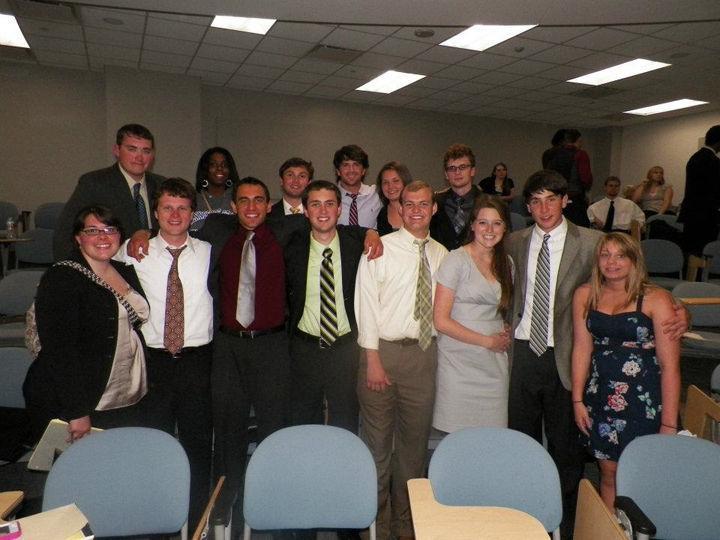
The Tennessee Speech and Debate Society of the University of Tennessee recently returned from competing in the IPDA national tournament in Huntsville, Texas on April 13-15. The team had a very strong showing at the competition, breaking four members into outrounds and claiming a second place national championship finish in the varsity division.
Due to their successes over the past semester, including state championships in debate sweepstakes and a third place overall finish in overall sweepstakes at February’s Tennessee Intercollegiate Forensics Association State tournament, the team was invited to compete in the IPDA national tournament in Texas by host school Sam Houston State University.
“They called us and were like, ‘Listen, you guys are good. Come to our tournament,’” Spencer Hinton, undecided sophomore and vice president, said. “Usually with a national tournament there are a lot of qualification processes, but with this we just got all that waived for us.”
Nevertheless, the organization thrived in their first showing in the IPDA arena.
“I thought the team did wonderfully,” said newly-elected organization president Stephen Burke, senior in Spanish. “It’s the first time we’ve ever done this style of debate, and people were winning around 50 percent at the national tournament in a style they’ve never done before. That says a lot.”
Debating in all three divisions of competition — novice, varsity, and professional — only a couple of the team’s debaters were a win away from breaking into outrounds.
“I’m really proud of everyone,” TSDS judge Kasey Piarrot said. “We still broke five, and then we had one go all the way to varsity finals. That’s really good for our first ever IPDA. I mean the night before there were still people who didn’t know the times and they didn’t know that they needed a partner, so I think going in with that and the fact that the preparation we had being pretty minimal… I think we did fantastic.”
Team members Jacob Clabo and Matthew Smith broke into outrounds in the novice division, while former organization vice president Jordan Smith and former president Nathan Johnston advanced in the varsity division. Johnston ultimately competed in the national championship round where he took home a second place finish.
“I think I did pretty well,” said Smith of his first IPDA experience. “Of course there are always the ones that you lose that you think you should have won, but I think I did really well. I faced the number one seed in the tournament after eight rounds and lost to him two to one, so not bad. I’m not disappointed at all.”
Team member Nichole Indelicato, undecided freshman, who competed in the novice division at the tournament, commented on the switch of debate style.
“I think that IPDA was a good learning experience because it helped me to think on my feet for myself, and it also helped me with speaking,” Indelicato said.
Due to its successes at the tournament, the team plans on competing in five to six IPDA tournaments next year, including another trip to IPDA nationals in the spring, in addition to at least four NPDA nationals.
“I mean I think we all did really well,” Smith said. “I think almost all of us were really close to breaking. So that was really good. We were all really close to being right at that bump, which I mean that bump is gonna come from experience, so the fact that we don’t any experience (in IPDA style) and are still there is pretty awesome in my opinion.”
Completely student-run and student-funded, the Tennessee Speech and Debate Society was also the only team to compete at nationals without a formalized coach. In fact, they are one of the few schools in the nation who do not have a coach and are still very successful in compeition.
Having done so well in a style of debate in which they had never before competed, the organization was able to gain even more national recognition and to add to their list of reasons why they are one of the most successful debate teams in the state of Tennessee.
“We seem to just want to argue with people,” Johnston said. “And we beat them.”