Yesterday evening, the Writers in the Library program kicked off its 17th season by saying farewell to one of its most influential contributors.
This year, Marilyn Kallet will step down as director of the creative writing department, and as a consequence, will no longer run the Writers in the Library program. Although Kallet will continue to teach at the university, several speakers at last night’s program expressed their gratitude for Kallet’s support and guidance.
Amy Elias, a professor in the English department, went on to introduce the night’s featured writer, Margaret Lazarus Dean. Elias first met the writer when Dean applied for the position of assistant professor in creative writing at UT, and the two remained close throughout Dean’s time at the university.
When Dean herself took the stage, she shared how Elias was one of the main sources of encouragement behind her newest book, “Leaving Orbit.”
After the reading, Elias elaborated on her role in guiding Dean to pursue the book.
“She’s a fantastic writer, and she is driven. My impression of her is that she is driven to get to the bottom of something once she starts,” Elias said. “I just encouraged her to pursue what was in her heart rather than what the tenure process was requiring of her at the time.”
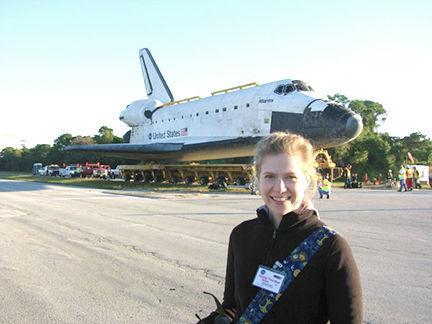
The book is a creative nonfiction piece reflecting on the history and meaning behind NASA’s space program in America. Dean read excerpts from the book Monday night, but in an unusual fashion.
Instead of selecting a single chapter or significant scene, Dean chose a setting: the Vehicle Assembly Building in the Kennedy Space Center.
This building was the largest in the world when it opened in 1966, and more than 40 years later, Dean recalled the intense awe that overcame her when she entered the building. She described how tears welled in her eyes as she looked up at the 525-foot ceiling of what she saw as a type of modern day cathedral.
It is moments like this that comprise the book and distinguish it from other nonfiction accounts. As Dean said, “I want to write about the places where the technical and the emotional intersect.”