The Center for Health Education & Wellness (CHEW) has been giving out T-shirts for years, but this is only the second round for their “Consent Is” sexual assault awareness campaign.
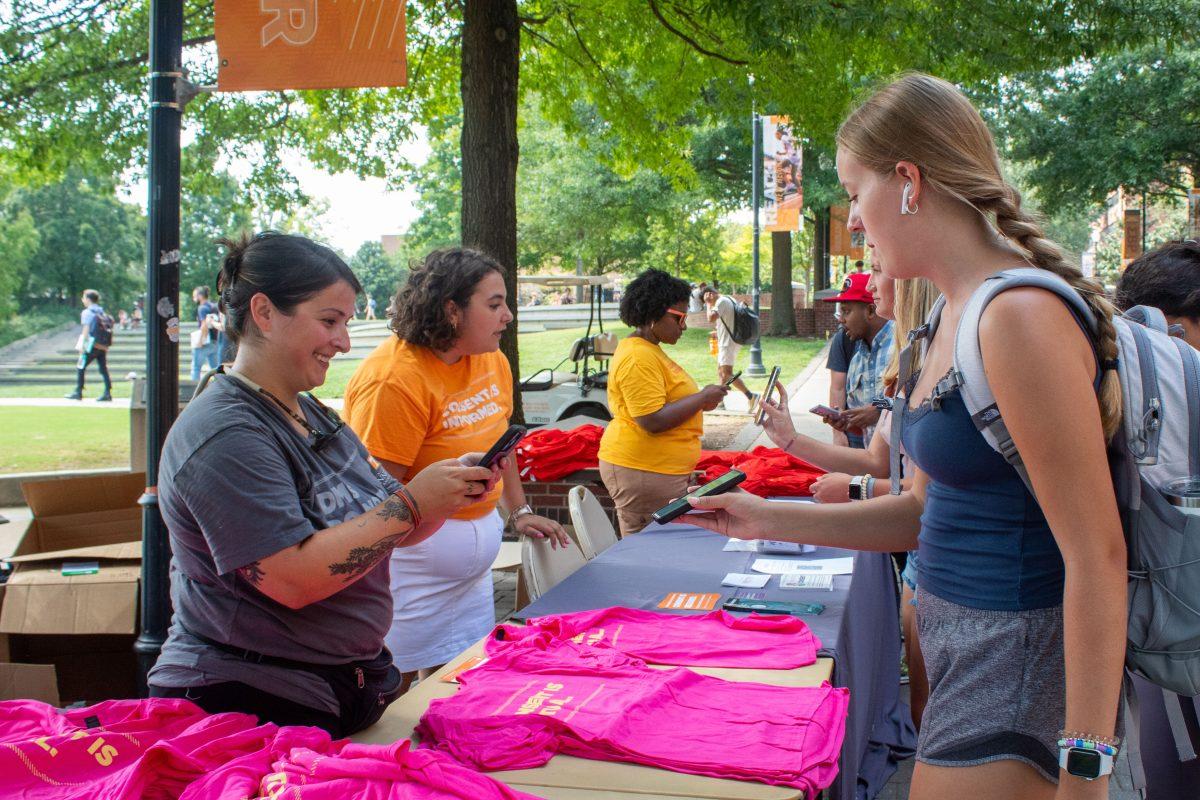
On the first Tuesday of each month, T-shirt Tuesday, staffers set up a table on campus to answer questions about consent and hand out the brightly colored, message-bearing shirts.
UT’s Title IX policy prohibits sexual harassment. This year CHEW added two new phrases: “Consent is specific” and “Consent is ongoing.”
A previous version of the campaign began as part of a 2015 series called Red Zone pop-ups. The Red Zone refers to the span between the beginning of fall semester and Thanksgiving break, when most incidents happen. In those years, the center gave out “Does Not Mean Yes” T-shirts.
“So the phrases were designed to describe what consent is not,” Kayley McMahan, the wellness coordinator for relationship and sexual violence prevention, said. “… Things like ‘DMs do not mean yes’ or ‘Netflix and Chill does not mean yes’ … ‘dating does not mean yes,’ ‘alone with you does not mean yes,’ all kinds of different phrases like that.”
The center revised the shirts in the spring of last year to shift to talking about what consent is, surveying students to come up with the phrases. They began giving them out last August.
“There are seven different shirts that a person could get,” McMahan said.
The other five shirts say that consent is required, revocable, mutual, clear and informed.
McMahan loves it when people wear their shirts any day of the week. But she especially encourages everyone to wear them on Tuesdays, sticking with the theme.
“I think it kind of makes a big statement … ‘Look at all of these hundreds of people,’” she said. “Just like we all wear orange on Fridays because we support UT, I think wearing our consent shirts on Tuesdays says, ‘Okay, we support consent, and we support consent education, and we support sexual assault prevention.'”

A pile of "CONSENT IS SPECIFIC" t-shirts sit ready to be given to students as a part of CHEW's T-shirt Tuesdays.
McMahan said many students who show up for the shirts thank them and say they appreciate the work the center is doing.
“A poster can be put up by anybody,” McMahan said, adding that those were important. “But when you see a live person representing the message, I think it shows folks that this is an important message for our community.”
Kristen Ravi, an assistant professor in the College of Social Work, said awareness of relationship red flags and green flags and where to seek help are important.
“College involves a unique transition that often includes pursuing dating relationships,” Ravi said. “However, it is also a time when young adults experience high levels of educational and adjustment stress.”
Her examples of red flags were limiting or controlling your time with family and friends, not respecting boundaries and communicating in a hurtful or threatening way, while green flags would be giving emotional support, communicating openly, respecting your boundaries and being a person you feel like you can be yourself around.
Since the beginning of August, 14 reports of unwanted sexual contact have been reported to either the UT Police Department or another campus security authority. A 2019 University of Virginia report that surveyed over 180,000 students found that one in four female undergraduates, and almost one in 14 male undergraduates experienced sexual violence.
According to the National Sexual Violence Resource Center, the vast majority of sexual assaults are committed by someone that the survivor knows. Studies show 62% of all college students have dealt with intimate partner violence, or IPV, in comparison to 41% of women and 26% of men in general.
Ravi said IPV tends to be associated with higher levels of stress, so it is important to address student stress and emotional regulation strategies. She also noted the documented association between higher alcohol consumption and IPV among college students.
A lesser known related scenario is “school sabotage,” when an abusive partner prevents a survivor’s education – holding up financial aid, attacking or stalking them at school, disrupting child care so the survivor cannot attend classes and keeping the survivor from campus or campus resources.
IPV is associated with a higher risk for depression, anxiety, PTSD and poor physical health. Studies have also shown IPV in college is related to a lower GPA and a higher risk of dropping out.
“This is important because adverse academic outcomes may have economic consequences such as economic instability, unemployment or underemployment, and lower lifetime earnings,” Ravi said.
So, every first Tuesday, CHEW staffers give out two of the seven different shirts, rotating them each month.
For September, they gave away the pink “Consent is mutual” shirts and the orange “Consent is specific” shirts. In October, one shirt will be “Consent is revocable” in the color purple for Domestic Violence Awareness Month, McMahan said.
That giveaway will be a special T-shirt Tuesday with campus and community partner tables and education about dating and domestic violence. The event is Oct. 3 from 12-2 p.m. at the Student Union Plaza.
McMahan expressed that there were many ways to measure success.
“Have they learned something, are they understanding consent? Are they practicing it in their daily lives?” McMahan said.
McMahan added that the center keeps track of how many people seek out resources, request training or schedule presentations.
“I think part of it though, at the basic, at the very minimum, is that the work is being done, that we’re out, we’re doing the work. We are showing up for students and showing them that this is important to us,” McMahan said. “That consent education and sexual assault prevention is important to us. And if students know that and see that and are aware of that, then I think that that is a success.”
T-shirt Tuesdays will also take place on Nov. 7 and Dec. 5. Future times and locations will be listed on the events page for the center as well as the university calendar.
Although McMahan said handing off the shirts is a fast-paced activity, when it slows down, they do have a good opportunity to talk with students.
“We like to say both the ask for sexual activity and the answer should be clear,” McMahan said. “Clear consent is everyone’s responsibility.”