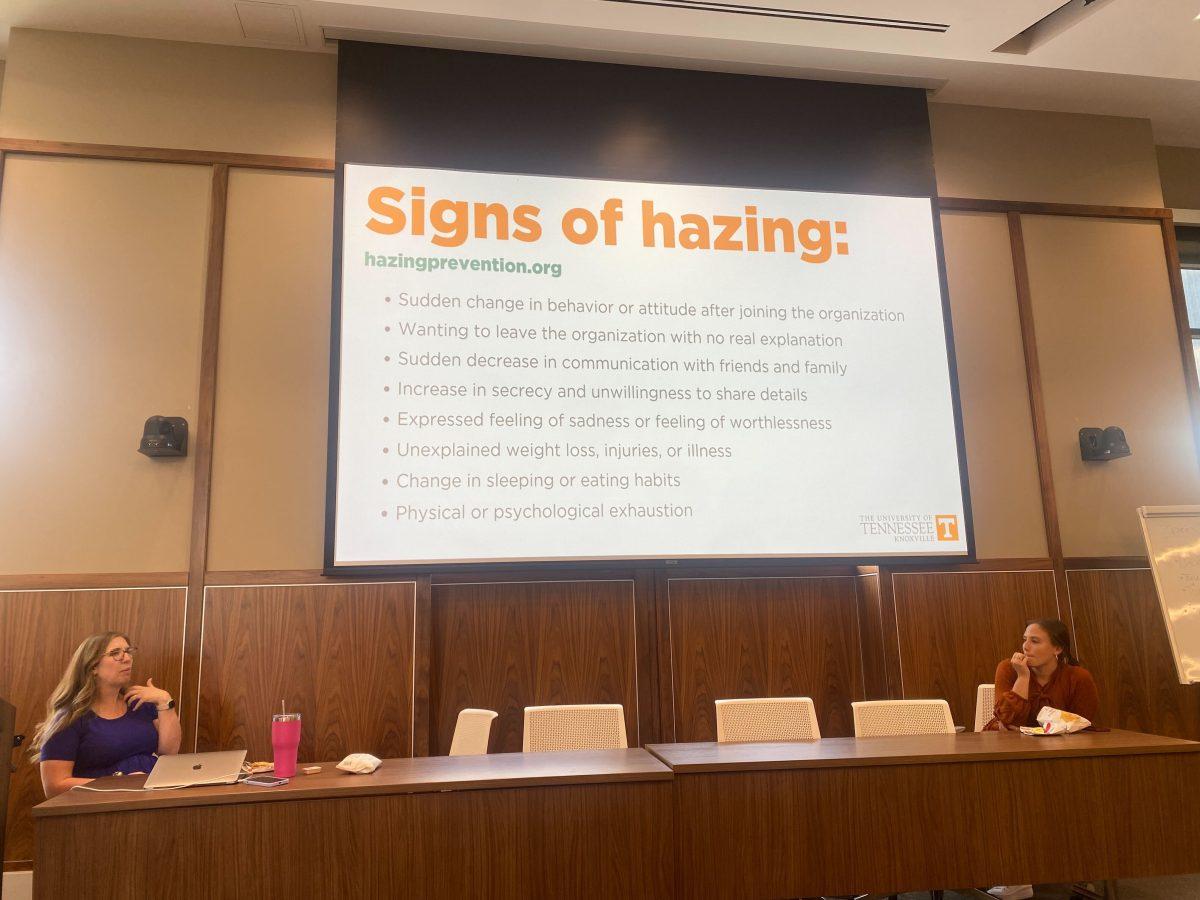
The UT Division of Student Life hosted a hazing prevention roundtable on Thursday, Sept. 28. The discussion was a deep dive into recognizing what qualifies as hazing, how to recognize it and how to prevent it.
The roundtable was led by Hazing Prevention team members Harriet Collins, assistant director of student conduct and community standards, and Hailey Flavin, assistant director for harm and risk reduction from the Office of Sorority and Fraternity Life.
According to UT’s conduct and community standards website, hazing is any intentional or reckless act that is directed against another student that might endanger their mental or physical health or induce a student to endanger their own mental or physical health, regardless of one’s willingness to participate. That last part is an important distinction according to Collins.
“We talk a lot about ‘regardless of one’s willingness to participate,’” Collins said. “We talk a lot about brain development. A traditional age college student, between the ages of 18 and 22, does not have a fully developed frontal cortex. That doesn’t mean that they’re not smart. They’re very, very smart. However, it just means that sometimes they’re still not in a place where decision-making abilities are really at the forefront.”
There are many different kinds of hazing activities. Some are very obvious, but some fly under the radar more easily. Outside of the obvious alcohol-related hazing, other examples are verbal abuse, personal servitude, social isolation, embarrassing activities and sleep deprivation. No matter what manner it is done in, the heart of it all is power.
“The core crux of hazing is a power balance,” Collins said. “You cannot haze somebody unless there’s some kind of power balance going on. You yourself can personally not haze yourself. There’s got to be something that one of the people wants.”
Any student can play a role in helping prevent hazing. Flavin stressed that it is important to support your peers if you notice something about them has changed after joining a certain group.
“It’s not your role to really have to investigate what’s going on, but if you notice that something’s off, you see that they’re unwell, then maybe you should report them to the counseling center,” Flavin said. “If you’re seeing some of those trends, they’re not coming home at night, stuff like that, maybe it’s time for you to support them and anonymously report that behavior so that it can be looked into.”
Being an active bystander is a big part of what being a Vol is all about. Hazing prevention can only be successful if everyone on campus acts when they see something. Collins and Flavin also stressed that it is important to check up on your friends from time to time and have real conversations with them to make sure that they’re doing okay. You can’t know if there’s a problem if you never ask.
“Trust your gut,” Collins said. “If something feels off, then it’s probably off even if it’s not what you initially thought it was. So trust your gut, and if anything comes out of it, report it, and we can look into things from there.”
You can report hazing directly through the Office of Student Conduct. A form can be filled out on the office’s website, or you can call or email the office directly. When making a report, it is important to provide as much detail as possible, and it can be done anonymously.