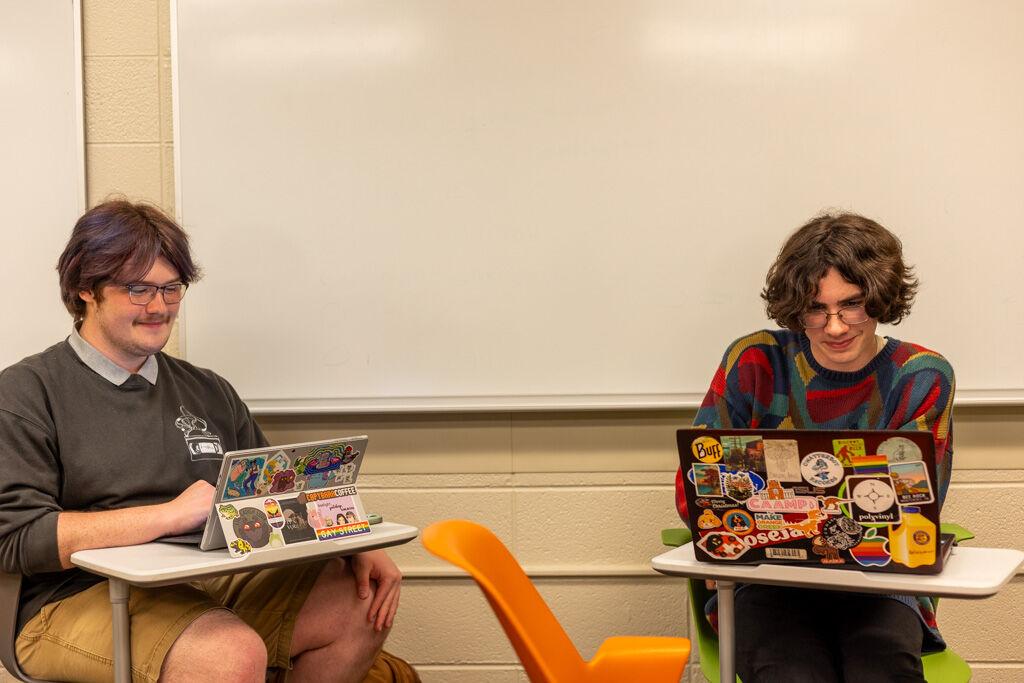
As a double major in biochemistry and creative writing, senior Luke Leftwich sees lots of differences in his classes from day to day — differences that do not stop at flipping from organic chemistry to fiction writing as Leftwich witnesses a contrast between the two when it comes to being an open space for LGBTQ students.
Professors and students in his STEM classes are often still affirming of the LGBTQ community, but Leftwich says there’s a difference in the demographics. While he knows many LGBTQ students in his liberal arts classes, the STEM ones tend to yield fewer LGBTQ students.
“There really isn’t a lot of support for queer people in the STEM field,” Leftwich said. “I know that maybe it seems silly like, yeah, there’s queer people everywhere, but it feels pretty alienating.”
oSTEM, an organization for students who are out and in STEM, works to fill that gap and provides Leftwich and others with a space to be authentically themselves while meeting students who are in similar classes.
Leftwich, a junior and the president of oSTEM, and Chloe Mitchell, a senior neuroscience and psychology major and vice president of the club, see oSTEM as an organization that draws out the people who may feel isolated in their classes and gives them a space to connect with other students.
Mitchell noted that there are seemingly few students who identify as LGBTQ and are majoring in a STEM-related field. Not only does the space support and affirm the identities of students, but just like other clubs, it unites people through a common interest.
“I think part of the mission of oSTEM is just building that support because being a STEM major, other people sometimes don’t know what your classes are like and what you’re going through,” Mitchell said. “And so somebody who shares your experience of, like, this is my identity as well as this is what I’m studying, it makes for a really good way to form connections with other people and to have people that share your same ideas and experiences.”
oSTEM works to provide that community for students, a community that to LGBTQ students is important not only in STEM but also at UT. Chilson Whittum, a first-year graduate student in nuclear engineering, is a member of oSTEM and said that in a state like Tennessee with legislation targeting the community, having something like oSTEM is vital to wellbeing.
“Having groups like that that you know will have your back and be a group you can fall back on and will understand you as a person not question you as a person is huge,” Whittum said.
The club fosters this community through arts and crafts-themed meetings as well as holiday celebrations. Outside of just the community aspect though, a large purpose of the club is to prepare students for careers in STEM. They aim for their meetings to have professional development opportunities. Sometimes it’s in the form of guest speakers from STEM professions, sometimes it’s help with resumes and other times it’s simply a study night.
Because the STEM field can feel alienating for LGBTQ students, Leftwich and Mitchell said there are ways that professors make the environment feel more open or ways in which they could improve the environment. Something as simple as telling students that the room is a safe space on the first day of class can make a difference.
“I think something to emphasize is like it can be hard to speak up when you’re the odd one out in an environment,” Leftwich said. “So yeah, I definitely think including those kind of value statements when you’re teaching your class and mentioning resources, stuff like that, it really does make a difference because you feel like you want to be heard.”