The Ewing Gallery in the Art and Architecture Building is currently hosting the “AI T.B.D.” exhibit, which examines how AI tools are being used in creative spaces.
The exhibit was curated by Mark Stanley, an assistant professor in architecture, and Julie Kress, an adjunct assistant professor in architecture and part of the Tennessee Fellows program, and explores how people use generative AI, some of its limitations and how it may be used in the future.
This exhibit is part of a longer tradition of inviting prominent architects and artists to showcase their work in the Ewing Gallery. This allows students to get a closer look at the works of the artists that have been invited, allowing for better engagement with and a more personal connection to the art.
Usually, the exhibits feature only one artist, but Stanley and Kress decided to change that for “AI T.B.D.”
“This year, instead of just inviting a single artist, we decided to invite a collection of artists,” Kress said. “I don’t know if artists is the correct word to use — image-makers who we’ve noticed working a lot with AI.”
The three artists were Shelby Doyle, Curry Hackett and Andrew Kudless. All three explored different aspects of AI in their work.
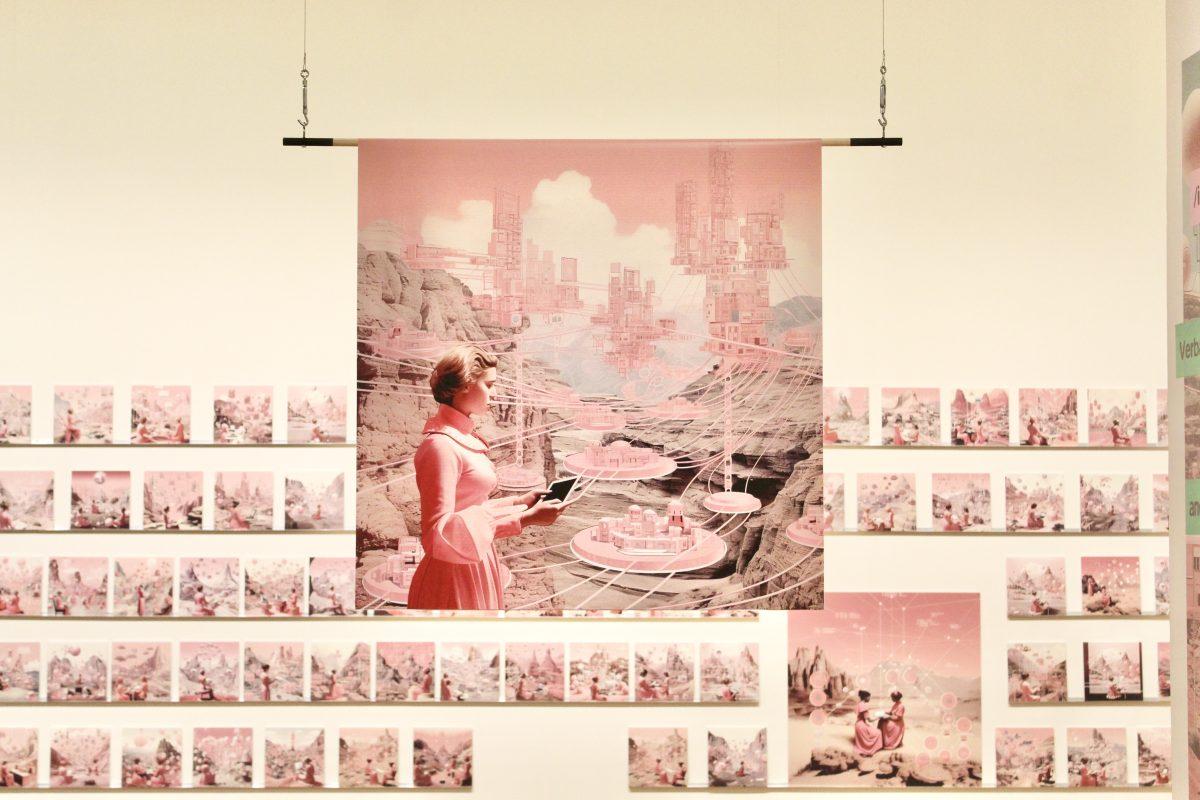
Doyle’s work, a collection of very similar images all generated with the prompt “digital feminist architecture history computation,” questioned what we are able to generate if the database does not include anything similar.
While other prompts may generate a wide variety of people and scenery, Doyle’s all generated women dressed completely in pink, facing tablets or computers pink. Barely connected buildings were scattered around the mountainous landscape in front of them. Because the database did not include anything similar to what Doyle wanted, it left her questioning how these archives and the AI that pulls from them reflect what people deemed important enough to write down.
Hackett’s work explores what the world could have looked like if Black cultures were given more space to express themselves. Hackett has been exploring this throughout much of his work before his AI projects, but being able to use AI has changed the way he works and what it looks like. Similar works by Hackett were made with collages, which lack some of the realism that AI artwork has been able to achieve.
“Collage creates distance from reality because it lacks realism, you can see that it was montaged together,” Kress said. “These are a lot more visceral in a way, and in order to create a rendering of that sort, it would be a lot of effort just to create a single image that had realistic qualities of light and shadow, have three dimensionality and to have characters in the scene.”
Even then, the works aren’t perfect. The characters in the scenes often have distorted faces or odd features because the databases still struggle to find examples of Black people or to mesh them in a realistic way, further showcasing that Black people often go unseen in tech and AI systems.
Kudless’ work also looks at some of the limitations of AI and attempts to push it to its limits. He generates houses made entirely of fabric, something notoriously difficult for artists to render that AI handles easily. He makes aerial maps of imaginary cities to see what AI can understand. He also has AI generate a stereotypical street in a country that became a collection of cliches.
All three of these artists use AI in a creative way that pushes what it can do, but they are not the only thing in the exhibit. The exhibit also included work from students and faculty members in the College of Architecture and Design that fell into one of three categories: Best Work, Altered Workflows and Nature of AI.
The Best Work section asked students and faculty to submit what they believe is the best image they have generated with AI.
The Nature of AI had people make critical statements about what AI means to them, whether it be what they fear or what they’re excited for, and trying to figure out the nature of generative AI as a tool.
Finally, Altered Workflows showcased how AI can be a step in imagining or designing something, for instance having it build on a 3D model someone has created or design a background for an animation. This part of the exhibit also helped give a peek into the future of how people may use generative AI in art, architecture and design.
“One theme that kept coming up was just how technologies have consistently altered design processes,” Stanley said. “Everyone that we encounter, every new tool and technology that we encounter starts to change our approaches and capacities relative to design, and this is no different.”
With some of the current debates about the ethics and nature of generative AI in the art world, having an exhibit that solely consists of AI-generated art opens up discussions on how we use it and the fears surrounding it.
“We wanted to be somewhat provocative with the content of the show being all AI-generated,” Stanley said. “We sort of wanted to riff on the current cultural anxiety about what it means to make images with AI, if they’re authored or not, if they count or not, what kind of status they serve in terms of how much we appreciate them and what their value is.”
There are many reasons that artists against AI art will say that AI art shouldn’t be valued as highly as art made by people. Generative AIs are trained on databases of images and art and blend them together to create something new. Some do not want their art to be part of those databases because they feel training an AI on their art is in some way stealing their work. Others simply believe that because a computer doesn’t put as much effort into something that a human has to, it should not be valued the same.
The AI images being trained on databases also brings up the question of authorship: Who owns the image if it is created by meshing thousands of images together? Many artists are very possessive of that ownership because of the effort they put into the art. Collaborating on art and pulling inspiration from others can help generate new ideas, but some worry about generative AI being the method for it.
This exhibit may not be able to answer those questions, but it provides a place for people to discover their own.
“To just kind of think deeply and critically about that question,” Stanley said. “I’m not sure that we as curators produce an answer to that question, nor do we seek to. It was more like producing a conversation around it.”
For many, generative AI will be a tool that helps them come up with ideas or expedite the process of creation, and this exhibit showcases that alongside opening discussions on how exactly it is used and the limitations.