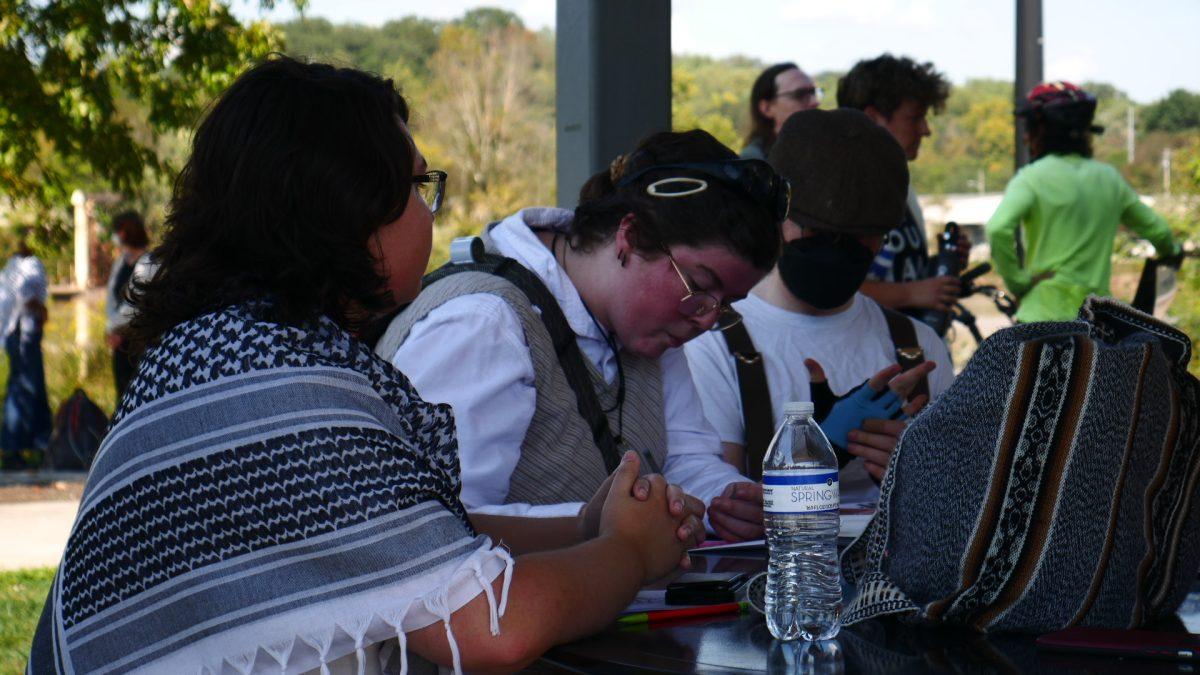
On Sunday, Oct. 6, activists gathered by the Tennessee River to participate in a Jewish tradition: Tashlich, a Jewish ritual where one symbolically casts away their sins by tossing bread into a moving body of water. It often happens during the Jewish New Year — a week-long period of celebration and reflection — starting on Rosh Hashanah and ending on Yom Kippur.
One of the attendees, Hannah Alpert-Abrams, explained the importance of the gathering.
“You’re symbolically casting off the things of the past year that you don’t want to bring into the new year,” Alpert-Abrams said. “And that’s why it’s such a good representation of where we’re at now. It’s an opportunity to cast off our complicity with genocide.”
The event was organized by the the Knoxville chapter of Jewish Voice for Peace, which has been vocal in its opposition against the occupation of Palestinian lands and the oppression of Palestinian people.
“I joined JVP about a year ago when I saw Israel take the first steps into Gaza,” Alpert-Abrams said. “I was really scared about what was happening. I was afraid it would become a genocide. I felt that as a Jewish person, it was just really important that I make it clear that the people talking those violent actions don’t represent me. Unfortunately, that fear turned out to be true.”
Rabbi Adam Rosenbaum, the rabbi of the local Heska Amuna synagogue, shares a similar perspective.
“I’d like to say that Israel is not defined by Benjamin Netanyahu (the current leader of Israel), he is not all of Israel,” said Rosenbaum. “Just like how America is not all Joe Biden. So it’s important to note that the violence since Oct. 7, the intention at least, was not to declare war on all Palestinians but to resist terrorists.”
A year ago, Rosenbaum was just a visiting rabbi, and he happened to be at Heska Amuna on Oct. 7.
“Part of the challenge was the fact it was a Jewish holiday — Simchat Torah,” Rosenbaum said. “That holiday is supposed to be joyous, even ruckus. We weren’t going to forget the observance (of the holiday), but we couldn’t ignore what happened. It was one of the worst days not just in Israeli history, but for Jewish history.”
In response to the events of Oct. 7, the Knoxville Jewish Alliance immediately sprung into action. Tara Bain, the KJA director of community engagement, recounts the groups reaction.
“A few days after, KJA held a community vigil to honor the lives lost in the attacks,” Bain said. “We collected donations for Israeli families through the Jewish Federations of North America. Hillel at UT held a candlelight vigil for more than 200 students on Oct. 12 at The Rock.”
The KJA is currently raising money for SafeHeart — an organization focused on helping the survivors of the Oct. 7 attacks on the music festivals in southern Israel.
But they weren’t the only ones in action. Over the past year, the JVP has also been active in helping those affected in the aftermath of Oct. 7.
“Just this past year, we raised $5,000 for direct aid to Gaza and the West Bank. We’ve also raised money to help the families of people in town that are in Gaza or trying to leave Gaza. We’ve also supported medical workers in Gaza and the West Bank who are supporting refugees.”
Currently, the JVP is focused on ending the U.S. enablement of Israel’s violent actions against Palestinians. They plan to achieve this through encouraging divestment and a weapons embargo that will directly lead to a ceasefire.
“I think that what we’re seeing now is an escalation that’s really scary for those of us who love peace and human life,” said Alpert-Abrams. “I think there was maybe a moment when there was a discussion we could’ve had about the choices that were being made by a nation in an occupied land, but I think that moment has passed. I don’t think there’s any justification for genocide.”
Rosenbaum also shared his thoughts on the current conflict.
“I believe that most Palestinians and most Israelis would want to live their lives in peace,” Rosenbaum said. “I know a lot of Israelis and Palestinians who are friends and understand each other. The problem is when you have a group in power that dominates the agendas of any nation, regardless of any nation, sometimes the good people are suppressed.”
Rosenbaum explained that both America and Israel have flaws, but people only look at Israel and question their right to exist.
“I’m not denying that Palestinians should have a place in the region, but there is a place for Israel,” Rosenbaum said.
While the two share different perspectives, they both came to similar conclusions. Both see the value of human life and the importance of preserving human life by hoping for peace — despite seeing the conflict from opposing views.
“I believe that none of us are free until all of us are free,” Alpert-Abrams said. “What that means is that my loved ones in Israel are also not free as long as Palestinians are living under oppression, and same with us in the U.S. … I hope for a move towards peace and liberation.”
Rosenbaum shared a similar sentiment on a call for peace.
“I hope for peace,” Rosenbaum said. “I hope for a day when the threat of terrorism is vanquished. I truly hope for a day where Israelis and Palestinians can live in peace. And I still believe it’s possible in spite of everything.”