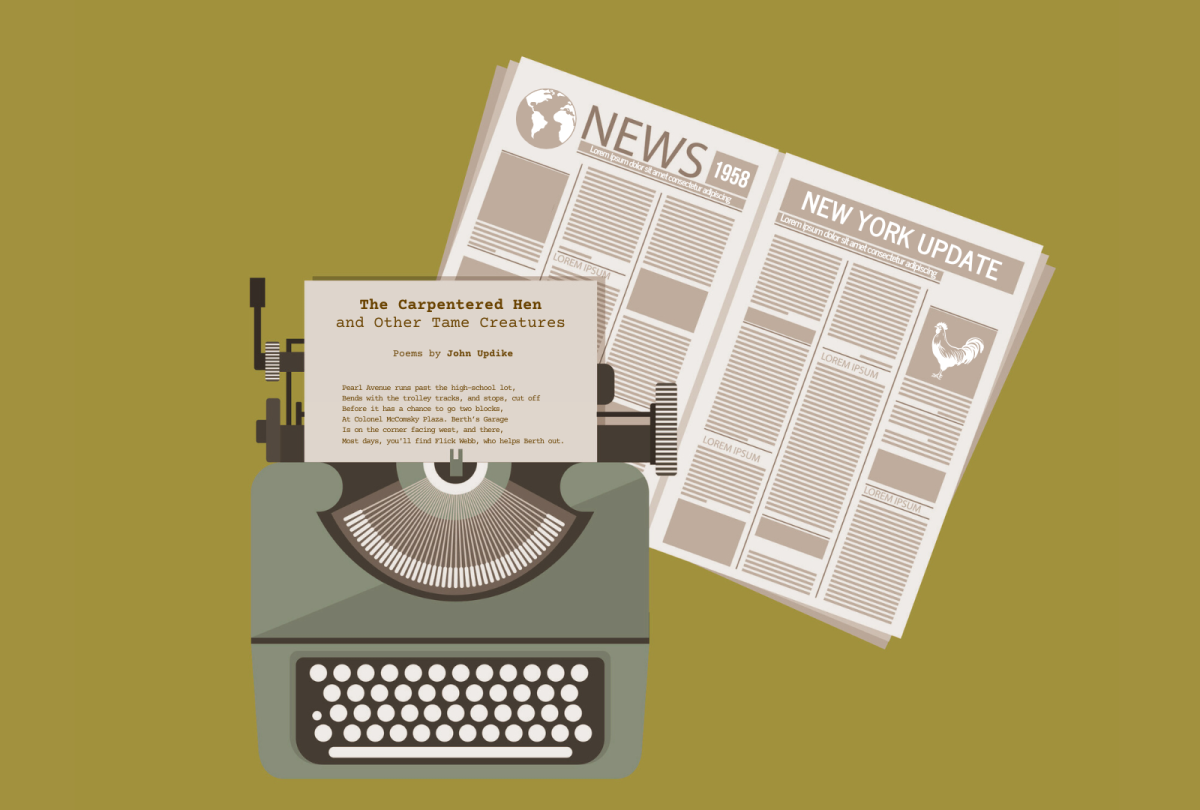

A few years before John Updike decided to try his hand at publishing longer works of fiction, he published his first set of work in 1958: a small collection of poems entitled “The Carpentered Hen and Other Tame Creatures.” Updike, still a young 26-year-old graduate of Harvard University, was recovering from quitting his staff writer job at The New Yorker and getting used to his wife and new family as they made the move to a small harbor town in northern Massachusetts.
Much like the year before its publication, this poem collection expresses the frequent, constant, radical changes over the course of time, similar to Updike’s real life. His family shifted from a bustling, propelling city of opportunity to a constant aroma of king crabs and salty ocean air in Ipswich, Massachusetts.
Poems like “Ex-Basketball Player” harness his ideals of watching people work and becoming inspired by little things in his life. Updike’s previous ambitions before professionally writing were that of a professional cartoonist. His words are playful and animated, electrifying the pages enough to grapple a reader on a personal level.
Other poems like “Recitative For Sorely Tested Products” speak fluently in juxtaposition with Updike’s personal idea of becoming something while taking the time to learn that what he has become is not meant to be. Time is all someone really needs to figure things out, just in case your destiny isn’t visible early on.
“Capacity” and “March: a Birthday Poem” are where Updike shows his true personality. He cares so much for his family and uses writing to provide for them. His life revolves so heavily around writing, so he makes his writing revolve heavily around his life. Some of his works could be considered autobiographical.
Updike, acknowledging his previous attempts, begins to take his craft seriously, putting effort into improving and honing his writing. Most of his poems were in The New Yorker and various other magazines before becoming the published collection we know today.
With Updike’s story, it makes you think about what destiny is all about. The idea that maybe you are pursuing the wrong profession, doing the wrong thing, acknowledging the wrong achievements, when you should be doing something different. A cartoonist turned writer, a carpenter turned actor, a news anchor turned hostess of her own television show and known primarily by his first name.
Years later, after Updike’s prolific vein had popped out because of his ever-so-rising age, he presented a collection of information on his life. There he was, a wrinkly man of 68, telling the truths and lies he spouted for years and eventually came clean. He cared so deeply for his family but regretted not showing it in the years prior. His whole career was based around them, whether they figured it out or not.
Updike’s palette for creating fictitious realism is insanely serene. He takes a brick of blank-like pallor and fructifies it with imagination, ambition and all the beautiful things that make life worth living. Then comes vivid, passionate descriptions of how wonderful life is and what exactly you are to expect. His impulsive scriptures of life-changing grandeur kiss you on the cheek after the smack wound is still healing. And once the people would read them, they became, unlike the clouds without rain, sharing the scriptures in a biblical notation.
Quite possibly one of the greatest writers of the 20th century, John Updike carried his weight through an uncertain time in his life and created a selection of words that meant more than meets the eye. After “The Carpentered Hen and Other Tame Creatures,” he set off sailing. By 1960, he had four books out and was hailed as one of the greatest young writers of the age, but poetry is increasingly looked upon with negative scrutiny regardless of what people claim they think.
Since it is typically informally written, poetry isn’t a concrete way of communicating information. It requires a lot of context clues and small tidbits of information at random increments. As non-uniformly as possible, Updike uses written language as self-expression, just like many other poets and creative writers. How to get rid of your problems and make them better. How to exercise your brain from the chaotic amount of pain and suffering it’s going through.
There is a lot of sadness written in Updike’s collection of poems. There is a lot of sadness in a lot of his writing but also a lot of beautifully jovial things. Things are written that roll off your tongue and make you want to make a funny face and jump out of your chair, waving your hands frantically in the air. There is a degree of unpredictability that not even a writer can imagine, but Updike can come pretty close.
Not always my favorite writing technique, poetry is still demonstrated as being one of the most popular forms of writing, both creative and informal. I have tried my hand at poetry and can rhyme words to create a mediocre-sounding story, but a poem isn’t necessarily supposed to rhyme.
Almost like life, a selection of random words that form bits of a story is still art in its truest form.
Drake Dyer is a freshman at UT this year studying finance. He can be reached at [email protected].
Columns and letters of The Daily Beacon are the views of the individual and do not necessarily reflect the views of the Beacon or the Beacon’s editorial staff.