Kerry Wallach has spent years working to resurrect the life story and works of Jewish artist Rahel Szalit, shedding light on the profound impact of Szalit’s previously unknown art.
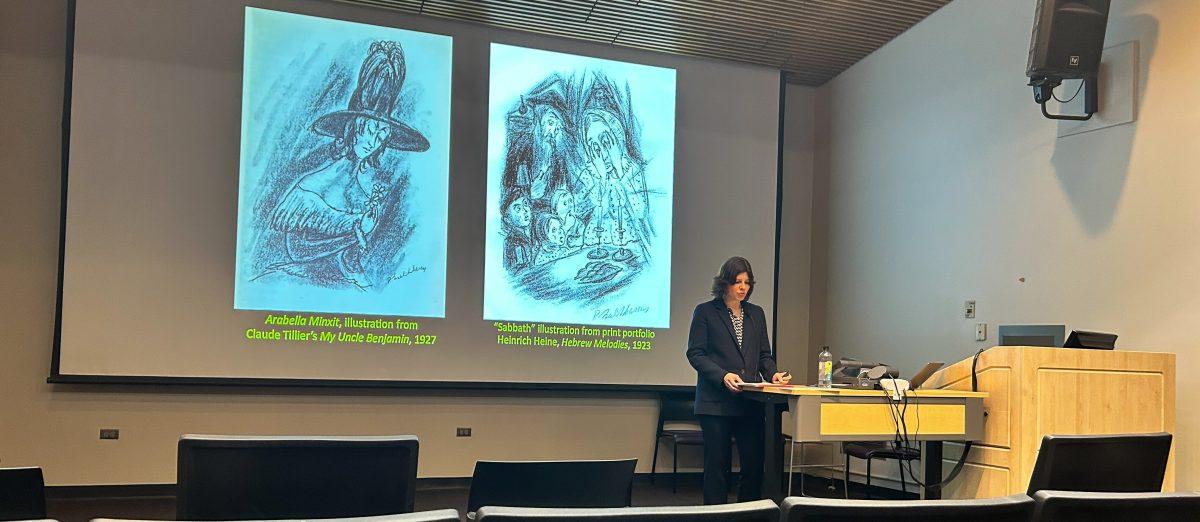
On Jan. 27, Hodges hosted Wallach to give a distinguished lecture on Jewish artist Szalit, titled “Recovering the Lost Worlds of Jewish Artist Rahel Szalit.” This lecture covered the works and life of Szalit, who lived from 1888 to 1942.
Wallach is a professor and chair of German studies at Gettysburg College. She has written two books and several articles that are well-accredited.
One of the goals of the lecture, which covered Wallach’s recently written book about Szalit, “Traces of a Jewish Artist,” was to learn and appreciate the lives of the victims of the Holocaust, not just their deaths. In his introduction to Wallach, Dan H. Magilow, professor of German and affiliate in Jewish studies, expanded on this.
“For decades, Holocaust studies relied mainly on bureaucratic documents and other sources that the perpetrators created,” Magilow said. “But particularly since the 1990s and early 2000s, scholars have taken much more interest in victims’ lives rather than just their deaths.”
Wallach took this principle and applied it to her work when researching Szalit. Many parts of Szalit’s life are not recorded in official documents, including significant details like records of registration in art school, or even the exact time or location of her death. As a result, she spent many years finding every illustration, drawing, painting or work of Szalit available.
This process resulted in a unique novel, “Traces of a Jewish Artist,” covering the life of Szalit. Instead of being strictly historical nonfiction, Wallach found it would be much more valuable to the reader, and for the sake of remembrance of Szalit’s life, to use all the historical knowledge she did have and create a hybrid fiction-nonfiction biography by filling in the gaps of her life.
Wallach was careful in the creation of the fictional parts of the story, making inferences about her life from Szalit’s art style and sketches from each period of her life. In the lecture, she divided Szalit’s life into four time periods.
This followed Szalit’s birth in Eastern Europe and her many moves throughout Germany and eventually Poland. It was Germany where Szalit spent the biggest part of her life, until she was forced to flee from the Nazi regime in 1933. She then moved to Paris, France, where she also resided during Nazi occupation for two years, until her arrest in 1942. We know Szalit was sent to an internment camp north of Paris for several weeks before being put on a train to Auschwitz. Szalit either died en route or in the gas chambers at Auschwitz.
Wallach emphasized throughout her lecture several times that Szalit should be remembered for her exceptional life and art, not her death.
“Szalit’s story teaches us that exceptional women artists gained simultaneous access to both the Jewish Renaissance and mainstream avant-garde art movements, such as Expressionism and New Objectivity, by engaging with different media and genres,” Wallach said. “Her work intersected with literature and journalism in exciting ways.”
Throughout her life, Szalit experimented with several different forms and styles of art, ranging from paintings to illustrations, to writings for newspapers.
“She often went against the grain by featuring female subjects and perspectives, and sometimes in Jewish contexts, but not always,” Wallach said. “Szalit was erased from history and forgotten in part because of her gender and complex relationship to national identity and language.”
Wallach concluded the lecture by stating that she hopes Szalit continues to become more known and appreciated in the art world, and that Wallach hopes to spread Szalit’s story through her work.