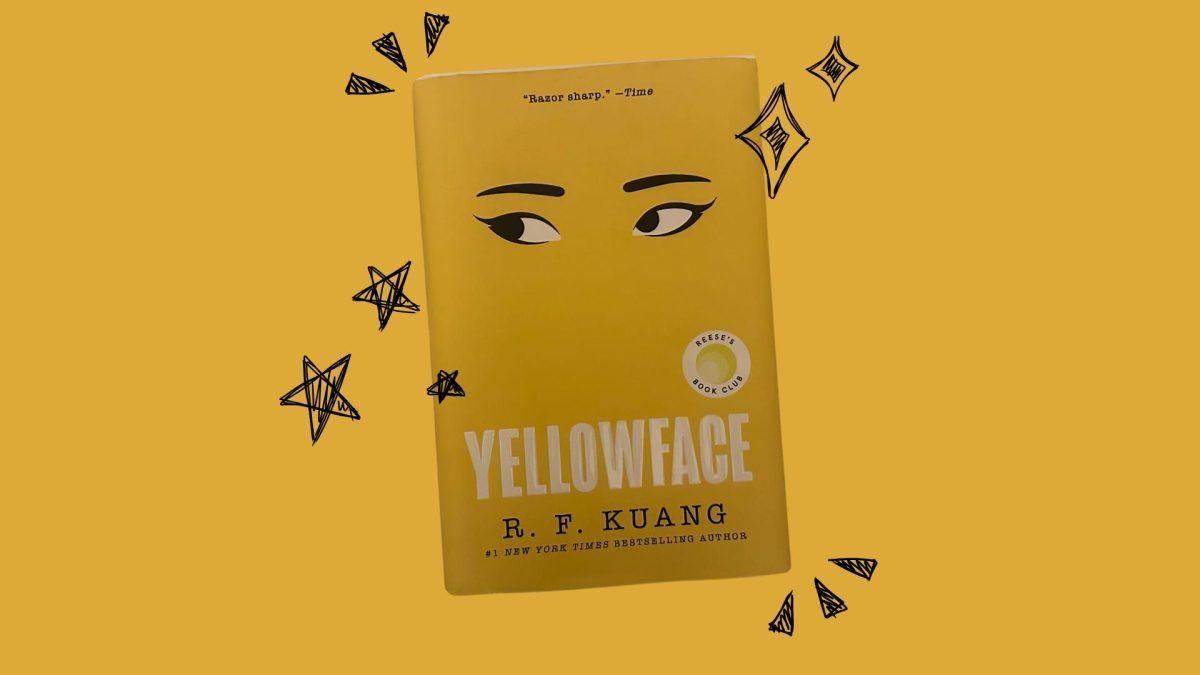
A young woman is desperate to have her big break in the publishing industry and finds herself willing to go to any length to reach literary stardom, even if it means stealing the work of her late friend/enemy.
R.F. Kuang’s novel “Yellowface” follows June Hayward, a young white author in her late 20s, as she manages her jealousy of her friend and literary rival, Athena Liu.
Liu is beloved within the literary community, with a multitude of best sellers and film deals under her belt. However Hayward, despite graduating from the same college and having a similar educational background, seems to have slipped through the cracks in comparison. Her internal jealousy, need for success and self-preservation catalyze her actions throughout the novel.
When Liu passes in a tragic and untimely fashion, Hayward sees an opportunity to “honor” her late friend by editing and completing her unfinished manuscript for her latest novel. The majority of Liu’s career and work is based on her Asian-American heritage. This remains true in the story Hayward takes under her wing, “The Last Front,” a novel that follows the lives of Chinese workers within the British military during World War I.
When Hayward releases the novel as her own and receives more recognition and accolades than ever before, she is forced to determine which sensation is stronger — her internal guilt or her need for success.
It is important to note that as the narrator and sole perspective of the novel, Hayward is notably unreliable, from her description of her rivalry with Liu down to her portrayal of how she stole — or, in her words, “fixed” — Liu’s work. Hayward’s words should not be taken at face value, although she is an expert at blurring the lines between reality and the false existence she has created.
A surface-level survey of the novel may appear as a classic tale of rivalry between two colleagues and the consequences that can result from it. Kuang also takes on the challenge of creating a story that not only explores the inner workings of the publishing industry, but also the impact of internal racism and cultural appropriation and how it manifests itself.
Throughout the novel, Hayward consistently — and sometimes desperately — insists that she is not racist and “doesn’t see color.” However, she often finds herself in situations where race, along with her knowledge and opinions, are called into question. Interviewers challenge her ability to have written a book surrounding Chinese culture in stark detail as a white woman, and internet speculators call her true character, morals and writing ability into question as well. Hayward is forced to make her way through the web of controversy she has sparked, all while keeping her dark secret.
“Yellowface” is as satirical as it is truthful. Kuang writes Hayward in a way that feels authentic to the everyday “ally.” Hayward believes that everyone should be treated equally but fails to acknowledge the impact that race can have within society. She can’t comprehend why it is so difficult for readers and critics to view her as the authentic author of “The Last Front” as a white woman. She finds it even more difficult to understand why it may be an issue in the first place, especially for the Asian-American community.
Kuang’s writing is modern and feels like more than just words on a page. Her writing is immersive and can make a reader call their morals into question because Hayward’s character, while unreliable, has such a persistence and willingness to defend herself that she comes across as truthful and authentic. However, this makes the book a tough read for those same reasons. Hayward’s internal battle resonates just as strongly in the head of the reader as it does on the page.
With a Goodreads score of 3.8 out of 5 and positive reviews from sources like The New York Times and NPR, “Yellowface” was well received by audiences. This is to be expected from Kuang, a repeated number-one New York Times bestseller.
“It’s a breezy and propulsive read, a satirical literary thriller that’s enjoyable and uncomfortable in equal measure; occasionally, it skirts the edges of a ghost story. It’s also the most granular critique of commercial publishing I’ve encountered in fiction, and seeing the cruel, indifferent vagaries of one’s industry so ably skewered is viciously satisfying,” said Amal El-Mohtar in a New York Times article.
Sitting at 336 pages on hardback and 352 pages on paperback, “Yellowface” is a quick and engaging read. Readers can expect to explore the mind of Hayward as she navigates through her self-made controversy, while also checking their own biases and morals when it comes to internal racism and cultural appropriation. The novel is entertaining and serves as an example of just how far someone may be willing to go to achieve success.