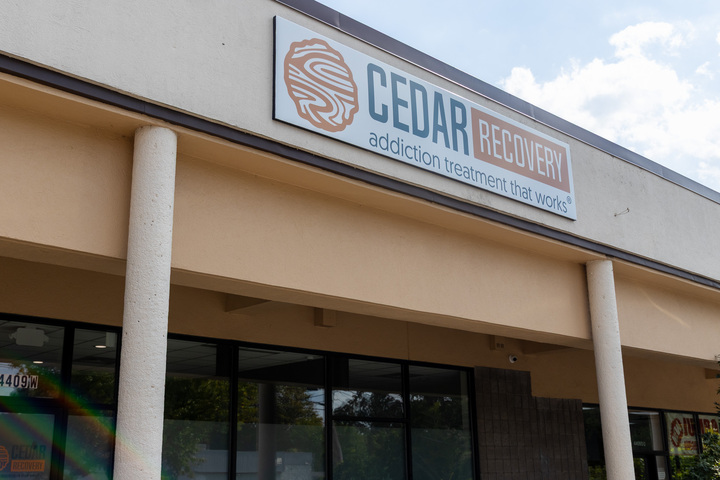
When Cedar Recovery launched its first opioid methadone treatment program, its team did not anticipate an expansion in the number of new patients or the staff needed to treat them.
Cedar Recovery treats several different types of addictions while touching on all aspects of recovery, including the emotional and physical impacts. The facility offers a personable approach, meeting patients where they are in a non-judgmental manner.
Although the abundance of patient turnout created new obstacles, Lisa Case, the opioid treatment program director for Cedar Recovery, views this as a positive development.
“I think the biggest challenge has also been the biggest blessing that we’ve had rapid growth,” Case said. “Trying to come up with creative ways to staff and share office spaces and things like that … that means that we’re able to help a lot of folks in the community.”
Part of the patient increase is due to the accessible KAT bus located in front of the building, its flexible operating hours and the widespread network with several insurance companies.
“We’re able to accommodate folks before they go to class or work … then there’s another group that we’ve been able to give access after class and after work, just by having those expanded hours,” Case said
Case and Dr. Jennifer Anderson, a medical provider within Cedar Recovery, recognize that several UT students currently study in the medical field, possibly entertaining the idea of working in recovery. Cedar Recovery includes a place for everyone in this field as the facility holds positions such as a pure recovery specialist — where people have a lived experience of the recovery process — lab assistants, counseling, front desk and others.
The new location on Chapman Highway is also less than 10 minutes away from campus, making these possible careers more accessible.
“I think it’s an amazing field to go into,” Anderson said. “It’s highly rewarding, you get to be involved with your patients, you get to go through the victories with them, you get to walk with them through the challenging times.”
Some state regulations, effective Sept. 4, may allow for a more leisurely pace in Cedar Recovery. The regulations permit “more freedom” in the medical practice, according to Case. Medical providers like Anderson are now able to administer higher doses to patients, resulting in less time spent in the center and more time for them to engage in their daily routines.
The alterations in fentanyl over the past decade are one reason for the increased dosage in medical settings, according to Case. Fentanyl began as a prescribed drug but is now accessible through an illicit supply.
“Typically, when we start methadone, we’ll start around 30 milligrams or 40 milligrams with initiation, and then we can go up on the dose every two to three days, depending upon the patient and other issues … we can get that patient more rapidly up to a 70 milligram dose, they have a higher likelihood of being retained in treatment because again, they’re more likely to get therapeutic quicker,” Anderson said.
As Anderson actively works with patients firsthand and manages their correct dosage, research guides these implementations with some patients at Cedar Recovery.
“There was a study that came out this past year, and instead for individuals who were able to get up to 70 milligrams of methadone in the first week of treatment, there was a 90% retention in treatment at 30 days,” Anderson said. “That’s huge because when patients stay in treatment, they tend to do better, and they tend to have better outcomes, and so we want to keep our patients retained in treatment.”
Case said that the increased dosage gave way to success for several patients in their recovery journey.
“I’ve had a couple of patients tell me that they are now going to college and they got a job now and one got her child back … one of them told me, ‘this is the first time I’ve been clean in seven years,’” Case said. “And we try not to use ‘clean’ and ‘dirty.’ It feels self-deprecating. We say favorable and unfavorable, but when you hear a single mom with three kids making that statement, it’s heartwarming, just to know that we’ve had that kind of impact on her life. We’re seeing so much of that, especially since Dr. Anderson’s been here. I hear those stories a lot. They’re very proud of themselves, and we’re super proud of it,” Case said.
There are a plethora of different patients who walk through those doors since “addiction is not a respecter of the person,” according to Anderson.
“I think that that’s one of the unique things about substance use disorders is that there really isn’t a prototypical patient. Like we have patients that maybe are struggling with lack of stable housing right now, and then we have patients that have very good employment and you would not know that there’s a struggle with substance use, and we see everything in between,” Anderson said.
According to Case, Cedar Recovery treats slightly more females than males and a vast age range — ages range from patients who are barely 20 and people who are in their 70s.
Although each individual is different, younger patients often face peer pressure due to their surrounding environment and fear that their parents will find out through insurance, according to Anderson.
“Knoxville is one of the biggest party campuses that there is,” Case said. “It’s very well known for that.”
Case proposed the idea of potentially collaborating with Rocky Top Recovery to increase their outreach with students at UT. This collaboration could help Cedar Recovery gain a closer insight with this age range of patients, since she acknowledges changes have occurred through generations.
“It’s up to us in the industry to normalize this, things that have chronic illness, right? And sometimes, when you’re not on campus … you lose touch with what’s available,” Case said. “(Older generations) remember the students’ center from the early 80s and (they) don’t know how things have changed.”