UT students are now gaining hands-on experience with crisis intervention through a psychology course.
Sarah Stambaugh, a fourth-year doctoral student in counseling psychology, instructs PSYC 399 through a partnership with Knoxville’s Contact Care Line. She reached a full-circle moment as she took the same course at UT in 2019. According to Stambaugh, the Contact Care Line was then entirely volunteer-run, with just one paid intern serving the entire organization.
Congress approved substantial funding for a 3-digit number in 2020, expanding 988 centers nationwide. The Contact Care Line now employs over 100 staff members, according to Stambaugh.
Emily Luna, a senior in the course, believes it is vital for students to know how to intervene in a crisis.
“I think it’s incredibly important,” Luna said. “Unfortunately, in today’s world, it’s more common for, especially young adults, to feel depressed and have this suicidal ideation and it’s expressed greatly in media, so it’s just right in front of our faces all the time.”
Suicides including on and off the UT campus remain a persistent concern — in 2023, suicides were the second leading cause of death for individuals aged 10 to 34.

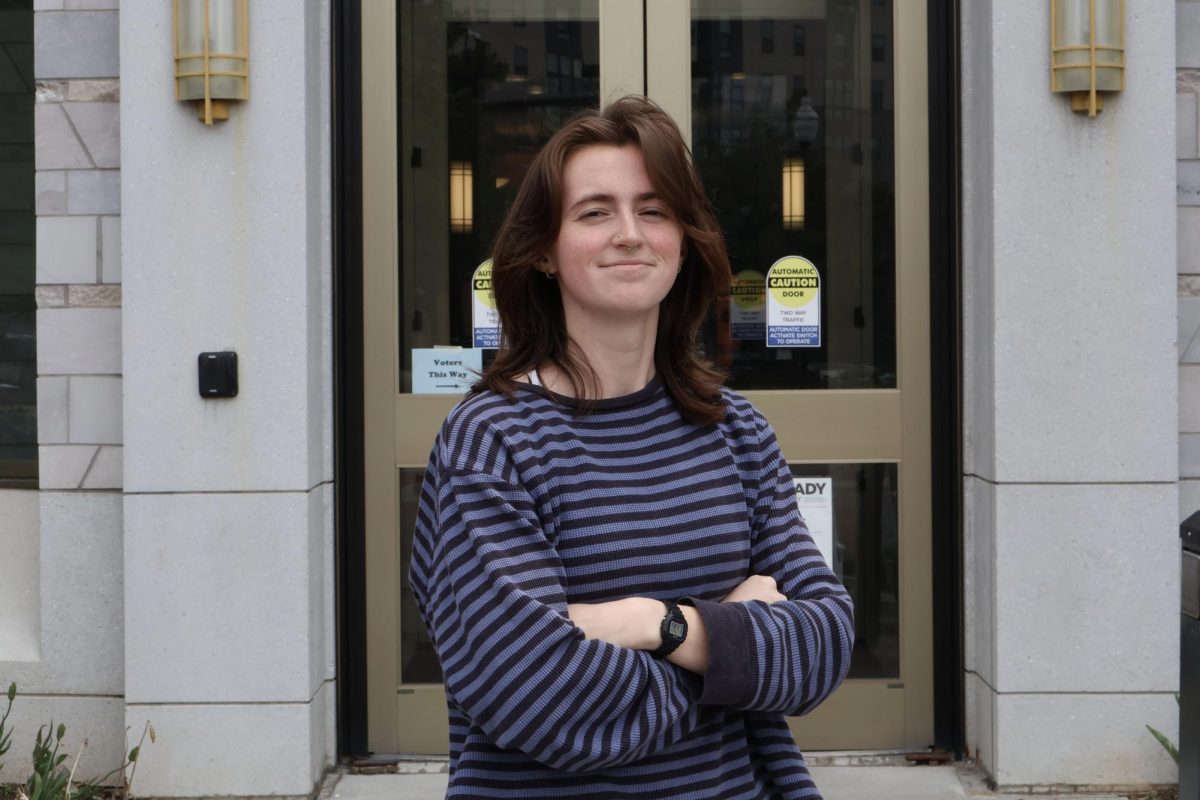
Emily Luna, a student in PSYC 399. Sept. 30, 2025.
“As a campus, I do think it’s really important to be very transparent about this stuff because it (suicide) is something that happens, especially with college-age kids, and it’s heartbreaking,” Luna said. “It’s never anyone’s fault for what happens to someone, but there are usually signs leading up to this that could have helped this person before it got to where it was.”
Students like Luna are currently training to prepare for their first authentic Contact Care Line call using the Assist Program, where participants engage in mock scenarios and role-play to guide them for real-life situations.
“I think it (Assist) was very eye-opening because we got to meet with counselors and school psychologists that also lent their experience,” Luna said. “The coordinators were so incredibly helpful and understanding what it’s going to be like.”
Individuals call the line for numerous different reasons and situations, but Luna and other students are taught to approach the callers in a non-judgmental manner.
“Sometimes people are going to call and say, ‘I’m not really sure what’s wrong, but I’ve just had a really bad day,’ and we are being trained to listen to that and respond without accusatory or making the person feel badly about themselves in that situation — metaphorically, walk them off the ledge they’re standing on,” Luna said.
Within this course, students who put themselves on the line can encounter several challenges, especially if they are new to this environment.
“I think, ironically, one of their hurdles … is just getting over the embarrassment of what it’s like to role-play vulnerably around other people and be willing to make mistakes in front of other people. And also, I think in that process, they learned that their mistakes aren’t always at the end of the world and they build some confidence,” Stambaugh said.
Another obstacle students can face in this class is the initial anxiety of that first call. Luna feels that the training equipped her with the knowledge to make herself at ease, helping the individual understand their feelings.
The Contact Care Line offers a new perspective on life for individuals who reach out, as well as those who provide that needed support — the impact the callers have on the staff does not go unnoticed.
Scott Payne, the outreach and support manager at Contact Care Line, shared a personal experience that highlighted the value of listening to people.
“I spoke with a young woman who had just graduated college and said she wanted to walk in front of a train when I answered the crisis line,” Payne said. “I listened to her and engaged in helping her tell her story. She was concerned that her parents would not let her move home after a relationship with her significant other had ended … She told me she would call her parents, and I asked her if I could follow up in 3 hours. She agreed, and when I called her to follow-up it was like I was speaking to a different person. She thanked me for taking the time (20 or so minutes) to listen to her and help her see she had more than the one option she had been considering. Listening matters, and it can help someone reconnect to hope.”
A past professor of Payne’s told him that in order to determine what ministry a community needs, one must learn about that community’s suffering. Ever since he heard this message, he has volunteered for a crisis center and other services, inspired by the authenticity of the work.
Similarly, Stambaugh views her time at the Contact Care Line as a catalyst for her involvement in her current work and her future career.
“It’s changed my life,” Stambaugh said. “I think people say that a lot about a lot of different things, but I really mean it. It was the foundation for me getting into my program. It was the foundation for my work with therapy clients. It’s the foundation of my research. I mean, it’s everything. And I think they truly care about the students that they interact with, and they’re always working to make improvements.”
A report for July 2025 revealed that Tennessee’s in-state answer rate for 988 calls is 89%, coming up just short of the highest level of answer rate across states.
“This rate is variable, and our goal is to be 90% or better,” Payne said. “The reasons for the variation are numerous, and we work closely with the state to adjust staffing to maintain this goal.”
On Sept. 10, in honor of Suicide Prevention Awareness Month, Stambaugh’s course viewed a livestream of posts from 988 about how they plan to spread awareness. Stambaugh also empowered her students to participate in campus activities in observance of World Suicide Prevention Day.
Outside the classroom, Luna encourages everyone to pay close attention to their friends.
“I think definitely, while it’s not one person’s job to make sure everyone’s okay, but check on your friends. If you notice someone is isolating or you’re not seeing them as much, just check in on them. You don’t have to accuse them. Just say, ‘Hey, do you want to go to a movie tonight or something?’ Or, ‘Hey, I was thinking of you,’ and just kind of make them feel seen,” Luna said.
“Understanding what occurs when someone is experiencing suicide ideation encourages people to seek help for themselves or others they may be concerned about. Participating in suicide prevention training empowers them to make a difference through active listening and referral to mental health resources,” Payne said. “Awareness allows us to have conversations which normalize behaviors and validate emotions around ideation, so we can calmly address the need for help in the knowledge that hope is available.”
If you need immediate help, do not hesitate to call 911 for an emergency, 988 or the Student Counseling Center at 865-974-2196.
“Anyone who calls the 988 lifeline will receive unconditional positive regard, active engagement in exploring their story and finding their connection to hope,” Payne said.