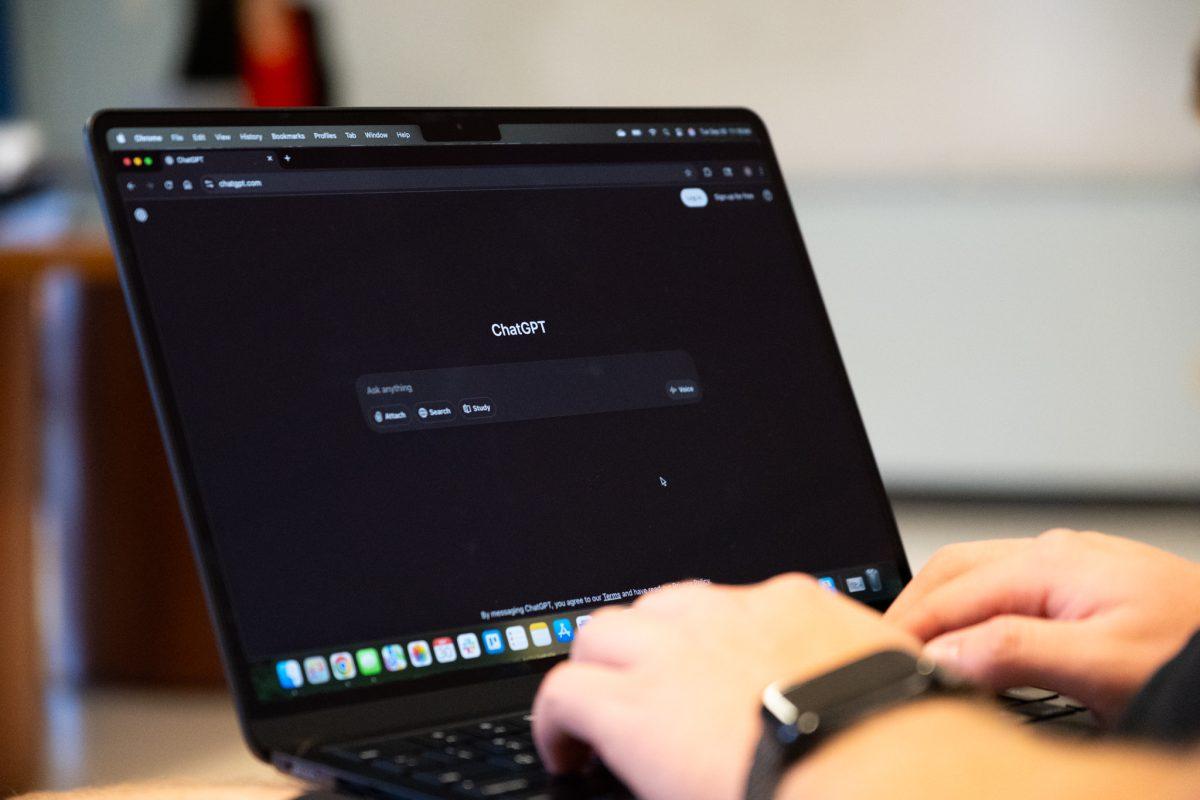
Artificial intelligence has quickly made its way into nearly every corner of higher education, sparking debate over whether it is a valuable tool or a harmful shortcut.
At UT, professors are wrestling with the role of AI in the classroom, with some embracing it as an innovative teaching partner and others rejecting it as a barrier to authentic learning.
UT leaves AI policy decisions up to individual faculty members, resulting in a patchwork of approaches that reflect both optimism and skepticism about its role in academia.
For some professors, AI platforms such as ChatGPT open new opportunities for creativity and accessibility in education.
Jonathan Ring, lecturer and director of undergraduate studies at the Baker School of Public Policy and Public Affairs, has embraced AI in his classroom as both a teaching tool and a skill for students to develop. He personally utilizes AI to help find quality information for his students to engage with.
“In my class, I had students engage with some Aristotle and Francis Bacon to talk about the philosophy of science, and there were some original texts that I wanted them to go look at. They are open source, so I know they exist freely on the internet,” Ring said. “I actually had a hard time Googling my way to find them. But when I asked ChatGPT to identify a location where I could give students full text access to those resources, it happened just as quickly as I was expecting something like that to be able to.”
Ring believes that while the internet has greatly changed in the past ten years, making information harder to find, AI can make it easier for students to navigate.
In Ring’s class, AI might help students with tasks that used to be tedious, such as organizing research, creating graphs or generating outlines, but they are required to reflect on the process and disclose their usage of AI. He encourages students to experiment with platforms like ChatGPT, while emphasizing the importance of transparency.
”If you’re told not to, don’t. But if you aren’t told not to, or if you’re encouraged to, just share — and over share for now — and then we’ll establish some norms and rules and procedures over time about what a good citation looks like,” Ring said.
For Ring, AI additionally represents a shift in the way higher education itself will function. He predicts that as these tools become more deeply integrated into academia, classes will become less about producing polished outcomes and more about honing the process of learning.
”It’s going to change the way that we evaluate students’ work more toward focusing on the process-based evaluation, rather than the outcome-based,” Ring said. “And then it’s going to transform the in-class experience too, I think in the opposite direction, where there will be a return to pen and paper and books.”
Ring admits to some unease about the possibility of classrooms becoming overly dependent on automation.
“But what I hope doesn’t happen is we just have students turning in AI-generated stuff and professors giving AI feedback, and basically no one is doing the work,” Ring said. “And they’re not talking to each other right? AI is talking to itself.”
He recognizes that not every professor shares his optimism. Some hesitate to bring AI into their classrooms out of concern for academic integrity or loss of critical skills.
That caution is evident in Shannon Scovel, an assistant professor of journalism who forbids AI in her classroom altogether. For Scovel, the use of AI creates a barrier to authentic learning. She worries that students who rely on it miss out on the hard but essential work of developing their own voice and critical thinking skills.
“As a journalism professor, it’s super important to me that my students understand ethics and the value of reporting a holistic, authentic, accurate story, so, in an effort to teach those skills at the most fundamental level, I do not allow AI in my classes,” Scovel said. “I always bring this discussion back to UT’s student conduct code for academic integrity and discuss how the use of AI without disclosure is equivalent, in journalism, to plagiarism because it involves putting a student’s name on work that they did not independently create.”
Though Scovel forbids its use in her classes, she has not ignored the technology. She keeps up with developments and acknowledges that in other fields, AI can be useful. But for Scovel, protecting the integrity of the unbiased writing process outweighs the potential conveniences. She worries that reliance on the technology strips away the very heart of learning, particularly in a discipline built on human storytelling.
“I respect that AI has value in some situations in some classes, but, in the case of my journalism classes, I want my students to practice the craft of writing, revising and rewriting themselves,” Scovel said. “I want them to experience the joy of having a breakthrough learning moment on their own and challenge themselves to think critically every day.”
For Scovel, returning to traditional methods has been rewarding for both her students and her as an educator.
“This semester, I’ve gone back to paper-pencil assessments in my ‘Intro to Journalism’ class, and I’ve loved reading the student responses and seeing their thoughts come alive on the paper. They’re learning and processing information in such an earnest way, and it’s a true joy to see,” Scovel said.
The debate over AI at UT highlights the broader challenge facing universities across the country: how to prepare students for a future where AI is likely unavoidable, while still protecting the value of human creativity, analysis and connection. As professors navigate this uncharted territory, students are left balancing two very different sets of expectations — sometimes within the same college.
Like most professors, students are also conflicted on the topic of AI. Some believe that it can be a very useful tool, especially in the classroom, but there’s still uncertainty surrounding whether it can fully be trusted in everyday life.
Many current students at the university were in school when generative AI platforms very first gained popularity. Their level of exposure has been high, especially in regard to school work, once they figured out the assistance it can provide with assignments in most subjects.
While some students still find this to be very valuable within classes, many still feel skeptical about the potential drawbacks of using it for school work.
Likeia Boone, a freshman whose public health and english classes both allow the use of AI, believes that the effects of using AI may not be as positive as some at the university hope.
“I think it will have a negative impact, just because of the ways students will use it,” Boone said. “No matter what, a majority of students will use this as a way to get through assignments quickly.”
She does, however, still hold out hope that AI can be used as a helpful tool in some scenarios, even if it can easily be misused by students.
“I’m sure if integrated in a way that students are still able to use and build on natural ideas rather than relying on AI, it can be super helpful,” Boone said.
Freshman Mary Johnston is in David Frank’s University Honors 207 class. Frank allows and even highly encourages the use of AI in his classroom. Johnston expressed a generally mixed view on the potential impact of AI being used in the classroom.
“There are definitely both positive and negative impacts of AI on students. When used correctly, AI can be a very beneficial tool for students that helps them learn, but more often than not it is used simply to get answers, which often leads to lower retention of information,” Johnston said.
Johnston also talked about her beliefs when it comes to her personal use of AI and whether she thinks it’s generally beneficial in the classroom.
“If it’s a class where understanding AI and its responses is important then obviously it’s helpful,” Johnston said. “Outside of that context I personally don’t like to use AI on my school work because it makes school less about learning and more about grades.”
UT has begun to offer some classes that are solely focused on learning about AI and how to use it. The university is even offering a major in applied AI within the college of emerging and collaborative studies, providing the potential for great improvement in knowledge surrounding AI.