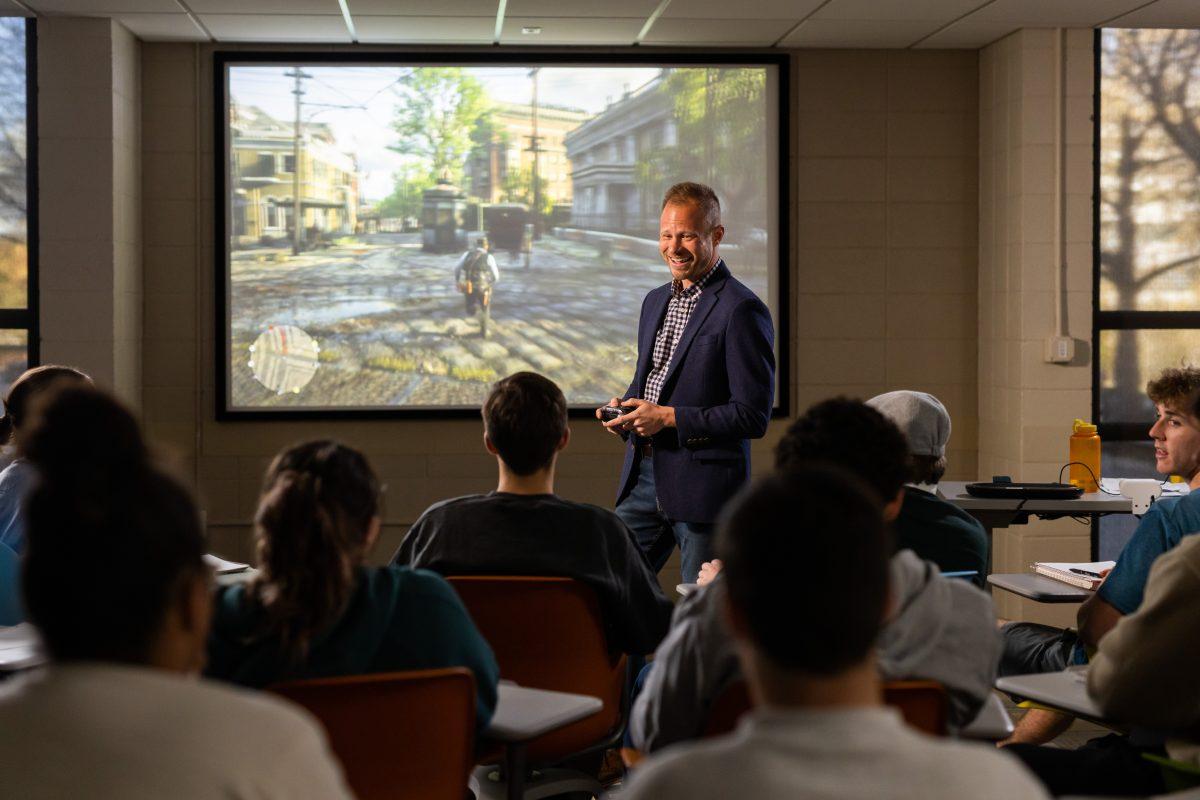
Tore Olsson, Associate Professor of History and Director of Graduate Studies, uses the video game Red Dead Redemption to teach his class “Red Dead History: Exploring America’s Violent Past Through the Hit Video Games” inside a Humanities and Social Sciences building classroom on March 29, 2023. Photo by Steven Bridges/Steven Bridges/University of Tennessee.
This spring, a new class will be turning Grand Theft Auto into a guide for understanding recent American history.
Titled “Grand Theft America: U.S. History since 1980 through the GTA Video Games,” this course will be taught by associate professor of history Tore Olsson.
“Historians have always used pop culture to make the past meaningful to students, whether via literature, film, television shows and more, so it’s wise that we begin taking games more seriously,” Olsson said.
He added that the class has already received strong support within the university.
“I’ve been discussing plans for this class for many months with my leadership in the History Department and the College of Arts and Sciences, and they have been supportive and enthusiastic – they know that I’ll be teaching a serious, demanding and thoughtful class,” Olsson said.
That support stems from Olsson’s track record with similar classes.
Scout Herber, a senior history major, took another one of Olsson’s classes that reflected this emphasis on the intersection of video games and history. She took his class, titled “HIUS 383: Red Dead America,” in the spring semester of 2024.
“I learned a lot in that class,” Herber said. “It taught a lot about racial identity, American expansion, manifest destiny and the attitudes at the time.”
This class was based around the Red Dead Redemption games, a franchise that takes place on the American frontier in the early 20th century. Despite the games being an enticing entry point, the course was still just like any other history course in terms of depth and content.
“The gameplay was helpful in guiding us with a timeline for what we learned in the class,” Herber said.
The structure of Olsson’s upcoming class will be similar, using GTA as a framework and not focusing strictly on the game’s portrayal.
“Most often, I’ll use screenshots and video clips from the games to open each lecture. If YouTube videos can’t do the trick, I’ll bring my controller and briefly play the games in class, perhaps driving around to showcase some features of the games’ cities,” Olsson said. “But most of our time in class will be spent in fairly traditional pursuits: lectures, discussions, analysis of primary sources, preparing for exams, et cetera.”
The GTA franchise is now 30 years old, and with the games set a few years before their release dates, they reflect shifts in time with American cultural changes.
“I very much believe that the years between 1980 and today mark a distinct and cohesive era in American history,” Olsson said. “If we want to understand the divided and unequal U.S. of today, we have to grapple with what’s happened in that time.”
Olsson’s main goal with this class is to use these games to take students through the progression of history that has led us to where we are today when it comes to broader issues.
Olsson described the many themes that will be expanded upon throughout the class while using the GTA games as a background.
“The growing wealth gap and hollowing out of the middle class, the decline of American manufacturing, the explosion in the U.S. prison population, the increasing polarization of party politics, and the ballooning of America’s immigrant population, among others,” Olsson said.
To make these ideas tangible, Olsson plans to link these historical trends to the familiar landmarks and settings students see in the games.
“For example, we’ll look at urban ghettos to understand how cities deliberately insulated poverty. We’ll look at container ports to understand how American companies offshored production. We’ll look at ‘Ammu-Nation’ gun shops to understand the contours of gun capitalism,” Olsson said.
In the end, Olsson’s course sees Grand Theft Auto not just as a game, but as a cultural artifact that can help students think critically about the forces that shaped the modern United States.
“I plan to continue teaching courses that meet students ‘where they are’ – engaging the subjects that are meaningful to them but then taking them to intellectual vistas unimagined at the beginning of the semester,” Olsson said.