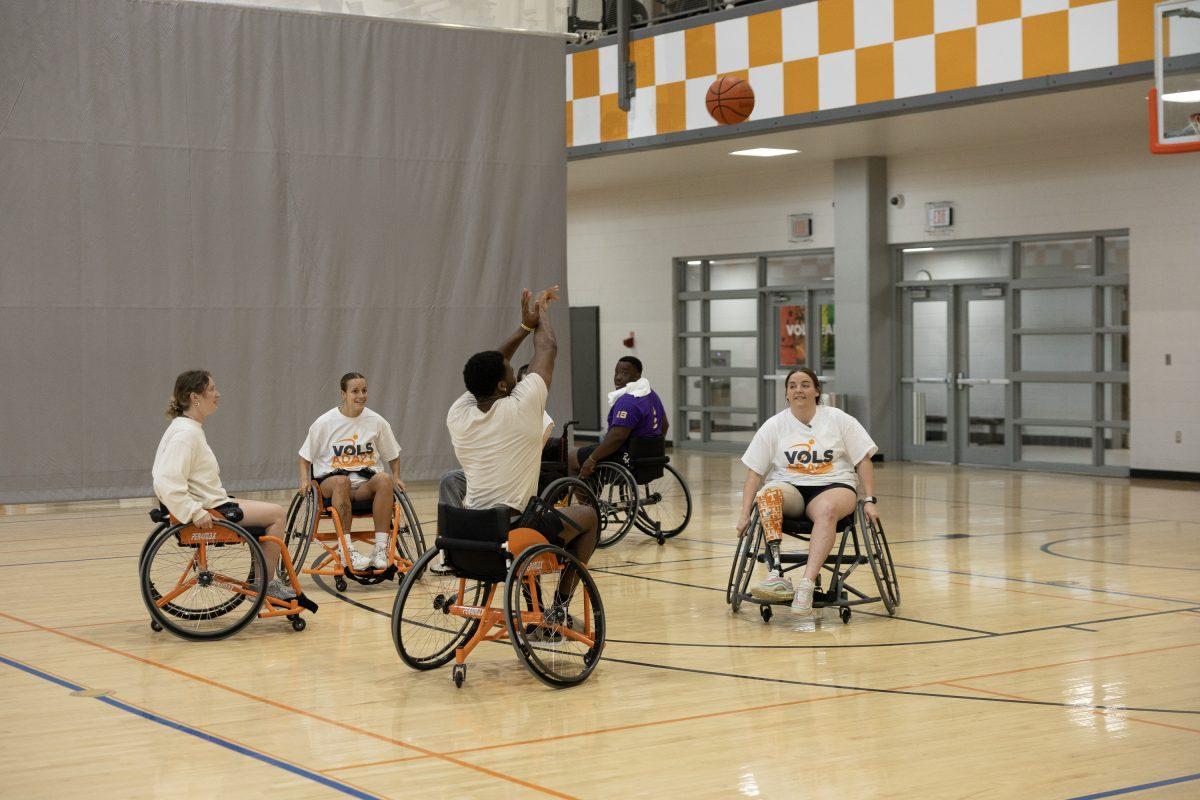
Several University of Tennessee departments collaborated and hosted the Vols Adapt adaptive sports fair to promote inclusion and a greater understanding of adaptive sports.
Hosted at the TRECS, the Department of Kinesiology, Recreation and Sports Studies, RecSports, the Center for Sport, Peace and Society and the Student Disability Services departments came together on Thursday, May 1.
The event was open to all students, regardless of their experience with adaptive sports. The sports offered included goalball, sitting volleyball, blind soccer, wheelchair tennis and wheelchair basketball.
The event allowed students to try a new, adaptive form of their favorite sport. Matthew Onorati, a freshman studying computer engineering, appreciated the unique opportunity to try out wheelchair tennis.
“It was pretty fun,” Onorati said. “But it was hard to try to maneuver the wheelchair around and try to get to the ball. It was difficult, but I had a really fun time hitting the ball back and forth and seeing what it would be like to try to play sports with a wheelchair.”
Jason Scott, an associate professor with the Department of Kinesiology and Recreation and Sports Studies, coordinated the Vols Adapt event. He was impressed with the levels of student engagement with the program.
“This is our second annual adapt to sports showcase called Vols Adapt, because Vols do adapt,” Scott said. “This is all about promoting inclusion and access to sport. So we have students with and without disabilities learning about sitting volleyball, wheelchair tennis, goalball, para-cycling and blind soccer.”
To help support the adaptive sports showcase, the nonprofit Special Olympics Tennessee was present and promoted inclusive sports at all levels. The organization allows students with and without disabilities to play together at all levels in the state, as well as in elementary school and college.
“The goal is unified sports, students with and without disabilities coming together and playing on the same team,” Brooke Montjoy, a coordinator with the nonprofit’s Unified Champion Schools program, said. “It goes beyond sports with social inclusion opportunities. We do youth leadership events, fundraising and whole school engagement.”
Special Olympics Tennessee worked directly with UT’s Unified Special Olympics Club. The club started last year to bring more unified sports to campus.
Hadley Blankenship, the club’s president, found the adaptive sports showcase an excellent opportunity to introduce students to adaptive sports.
“It’s been fantastic,” Blankenship said. “I think just having something that’s so interactive makes people more aware of the different accessible sports there are, because it can be difficult for people with disabilities to find something recreational that helps them stay fit. This event is very important for that.”
While the event was just a few hours, the organizers believe its impact on participating students will last a lifetime. They all echoed a desire to increase awareness of inclusive sports and to help bring together people with and without disabilities through recreation.