Being a woman in any field comes with its challenges. According to an article from the Society for Human Resource Management, women earn 83 cents for every dollar earned by men. Also, compared to white, non-Hispanic men, the wage gap is 43% for Hispanic women, according to the United States Department of Labor.
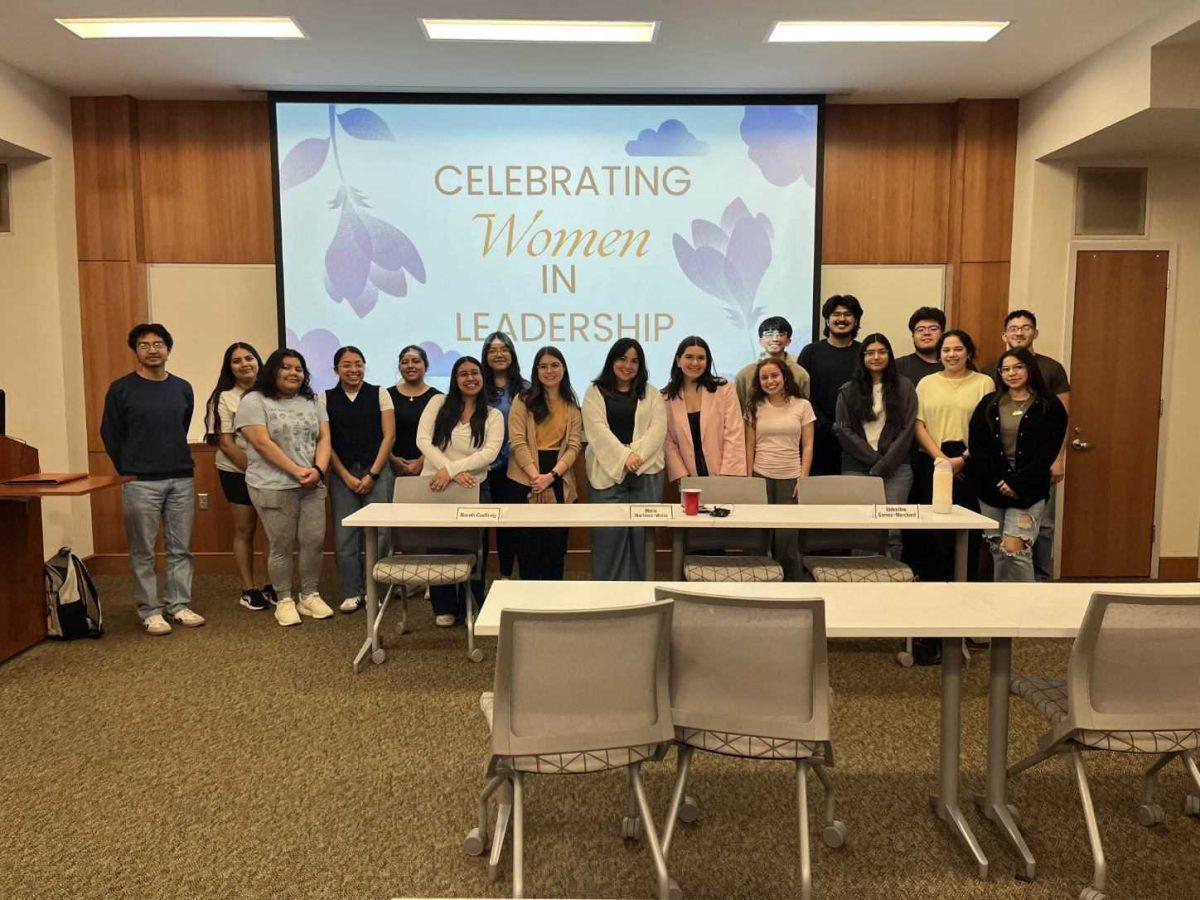
On March 12, three Latina women in professional fields shared their experiences in the workforce with the Latino Business Student Association — a student organization dedicated to creating a community for Latino students interested in business.
The three panelists who spoke were Karah Godfrey, María Martínez Weiss and Valentina Gómez — all three women are University of Tennessee alumni.
Godfrey graduated from UT in the fall of 2024 with her bachelor’s in civil and environmental engineering. She currently works in roadway and traffic design and is aiming for her professional engineering license.
Godfrey got her start at UT through a week-long summer camp that allowed underrepresented students to take engineering classes, live on campus and interact with faculty. Godfrey loved the experience so much that she went back repeatedly through high school.
In her undergraduate years, she faced many challenges as a woman in STEM.
“Going through engineering was scenario after scenario of conflict with others because I was constantly underestimated,” Godfrey said. “Over and over again, I felt like I had to prove myself to be taken seriously. I’ve had to learn to stand up for myself and be sure of who I am.”
Godfrey emphasized the importance of building a community wherever you go, especially regarding networking.
“When you have a good sense of community, networking becomes so much easier,” Godfrey said. “Being the only one in a space can be hard and lonely but it’s not the end of the world because it won’t always be like that.”
Godfrey’s mother inspired her throughout her career journey. From being underestimated in her field to a professor who told her she wasn’t cut out for it, her undergraduate experience did not hold back on challenging her.
“My four years at UT were very messy, but I had people cheering me on,” Godfrey said. “If you don’t have family who will cheer you on, find people who will.”
Having the opportunity to be in a diverse space also motivated her.
”I am a product of increased exposure to underrepresented groups,” Godfrey said. “Without that exposure, I may have never been motivated to pursue engineering. Diversity is integral, and it’s the only way we can gain differing perspectives. There is a simple solution to a shortage of workers and it’s to open doors to underrepresented students.”
Confidence and boundaries are significant factors in navigating the workforce as a woman, according to Godfrey.
“Don’t think you have to walk a tightrope all the time,” Godfrey said. “Also, notice when a workplace is toxic. If you don’t want to work there, then don’t.”
Godfrey’s career goal is to encourage more Hispanic women to pursue engineering. She also encourages men to challenge their assumptions that women can’t or don’t want to do specific tasks.
Weiss graduated in 2016 with a bachelor’s in modern foreign languages and literature and is pursuing a Ph.D. in higher education administration. She works at UT as assistant director in education development for the Division of Access and Engagement.
In 2024, she was awarded a grant as part of the graduate student research awards for her project that fostered inclusive environments for Latinx students in higher education.
She began to like the idea of working in administration after working as an orientation leader and resident assistant.
“I loved that there were a lot of professionals that wanted to see me be great and grow and I wanted to be that for others,” Weiss said.
She struggled with imposter syndrome a lot, discussing the difficulty of being the only one in a group in a space. Like Godfrey, she said the key is self-confidence and having people who will support you.
“If you don’t see yourself reflected in certain spaces, it’s natural to feel you don’t belong,” Weiss said. “Having others around to support me or self-affirmation is nice.”
In the workforce, Weiss struggles the most with how to present herself.
“I’m always thinking a lot about how to get my point across due to being aware of how society in general views women like me,” Weiss said.
Weiss and her mother immigrated from Colombia to the U.S. when she was eight. Her mother and her students are her main inspirations.
“Seeing how hard my mom worked so I could have a better life keeps me grounded,” Weiss said. “It’s also an honor to get to work alongside students and see them become incredible members of society.”
She emphasized the importance of accepting failure and ditching perfectionism.
“We stand on the shoulders of giants, and I think that carries immense responsibilities and pressure,” Weiss said. “Allow yourself to be human and learn from your mistakes.”
She finds it very important to protect her Latina identity in a professional setting — this includes hanging the Colombian flag in her office.
”I want people to know where I come from because I’m proud of it,” Weiss said.
Gómez grew up in Chile and moved to the U.S. five years ago. She is the coordinator for special events within the Center for Global Engagement.
“I’m very passionate about helping international students and domestic students studying culture and language,” Gómez said. “It’s helping people like me.”
One of her struggles growing up was figuring out how to navigate her intersectionality.
“The intersection of being an international student, Hispanic and a woman was tough,” Gómez said. “Growing up in Chile, I was just another Chilean, and going here, I’ve taken on a new identity I didn’t even know I could have.”
She encourages diversity in the workplace, as she was inspired by female directors who encouraged her.
“I know it is a privilege to be in a place where there is diversity, so I consider myself lucky to be able to gain knowledge from them,” Gómez said. “If you spend a week in a company that is diverse versus one that is not, there is a big difference.”
Diversity is something employers should consider to create a welcoming environment for their employees, according to Gómez.
“Some people don’t bother to hire others who look like me or who come from diverse backgrounds,” Gómez said. “I think many people are owed a space that is diverse and inclusive, so they have a safe space.”
She wishes to represent Chile in a positive light and inspire Latina women who want to go into communications.
Lisbeth Muñoz, a sophomore majoring in business analytics and vice president of LBSA, asked the panelists various questions about how to navigate the workforce as a Latina woman.
“I don’t think imposter syndrome is talked about enough, so having the speakers bring it up in front of our members and audience made me feel valid to know that others are struggling with it as well,” Muñoz said. “It’s also nice to know that they are continuing to grow from it.”
“At first, I didn’t even know if I wanted to go to college,” Muñoz said. “It felt like it wasn’t for me because I came from a low economic background. I thought it was just for white kids.”
Muñoz eventually attended college to achieve her dreams and set a legacy for her family — she appreciated seeing the different perspectives of the panelists.
“Seeing the representation of women that have faced struggles and what they did to overcome them was inspirational,” Muñoz said. “These women are a good resource for us students. They’ve been through it, and we are currently going through it.”